Ho Chi Minh City advances strategy for strong maritime nation

The resolution marks a shift from focusing primarily on the maritime economy to viewing the sea as an economic, strategic and living space, requiring close coordination between development, defence, security, foreign affairs and modern maritime governance.

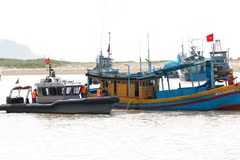
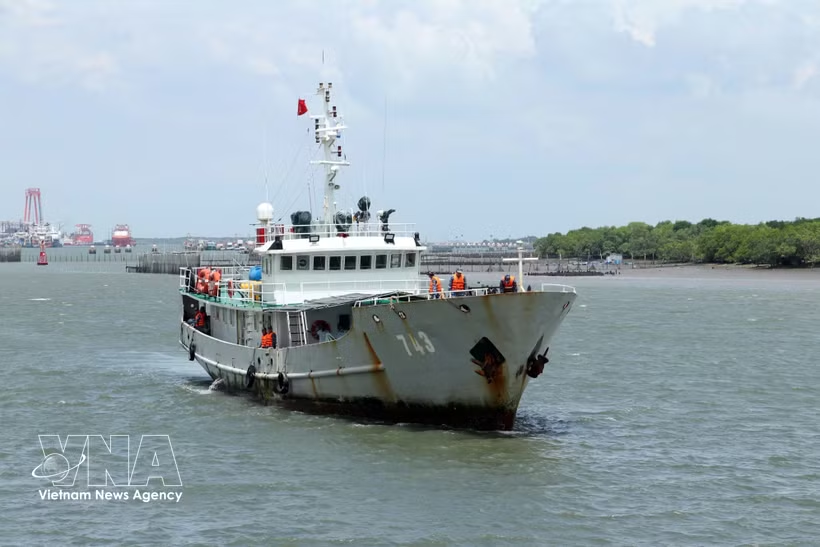
Ship 743 brings fisherman Truong Van Chung back to the Naval Squadron 129 port at noon on August 18, 2026. (Photo: VNA)

Ho Chi Minh City (VNA) – Ho Chi Minh City, the country’s economic hub and a key base for armed and law-enforcement forces in the southern waters, is stepping up efforts to implement the strategic vision of building Vietnam into a strong maritime nation under Resolution No. 20-NQ/TW of the 14th Party Central Committee, helping safeguard national sovereignty and promote sustainable development.

Pooling strategic strength for maritime development

The resolution marks a shift from focusing primarily on the maritime economy to viewing the sea as an economic, strategic and living space, requiring close coordination between development, defence, security, foreign affairs and modern maritime governance.

The southern waters encompass major elements of the country's maritime strength, including busy international shipping routes, key oil and gas fields, offshore renewable energy projects, international submarine cables and extensive traditional fishing grounds.

Ho Chi Minh City has emerged as a major maritime economic centre, home to deep-water international ports and leading domestic and international businesses in the oil and gas, shipping and port areas. It is also a base for naval and law-enforcement forces, alongside one of the country's largest fleet of more than 4,000 fishing vessels.

As a core force responsible for managing more than 300,000 sq.km of waters covering the entire southern continental shelf, Naval Region 2 conducted around 1,500 patrols covering nearly 2 million nautical miles and monitored more than 2.5 million targets from 2021 - 2025. These efforts have contributed to maintaining a peaceful and stable environment for maritime economic activities.

For more than 37 years, the 15 DK1 platforms operated by Naval Region 2 have stood as “steel fortresses” on the southern continental shelf, undertaking combat-readiness duties while serving as weather observation stations, supporting maritime safety and assisting fishermen. The DK1 Battalion was recently awarded the title of “Hero of the People’s Armed Forces” for the second time.

Colonel Do Hong Duyen, Deputy Commander of the Naval Region 2 Command, said defence and security must serve as a firm foundation for economic development. Maritime forces also help maintain safe shipping routes, support fishermen and combine defence capabilities with maritime economic services, while working with local authorities to combat illegal, unreported and unregulated (IUU) fishing.

Foundation for sustainable maritime security

Safeguarding sovereignty also depends on building strong public support. Naval, coast guard, border guard and fisheries surveillance forces have increasingly become trusted companions of fishermen by providing emergency assistance, repairing vessels and supplying water and food at sea.

Naval Squadron 129 operates ship shelters and fisheries logistics service centres in Truong Sa, providing safe havens for fishermen during storms and essential services. DK1 platforms likewise provide medical aid and essential supplies to fishermen in distress.
vnanet-hq.jpg
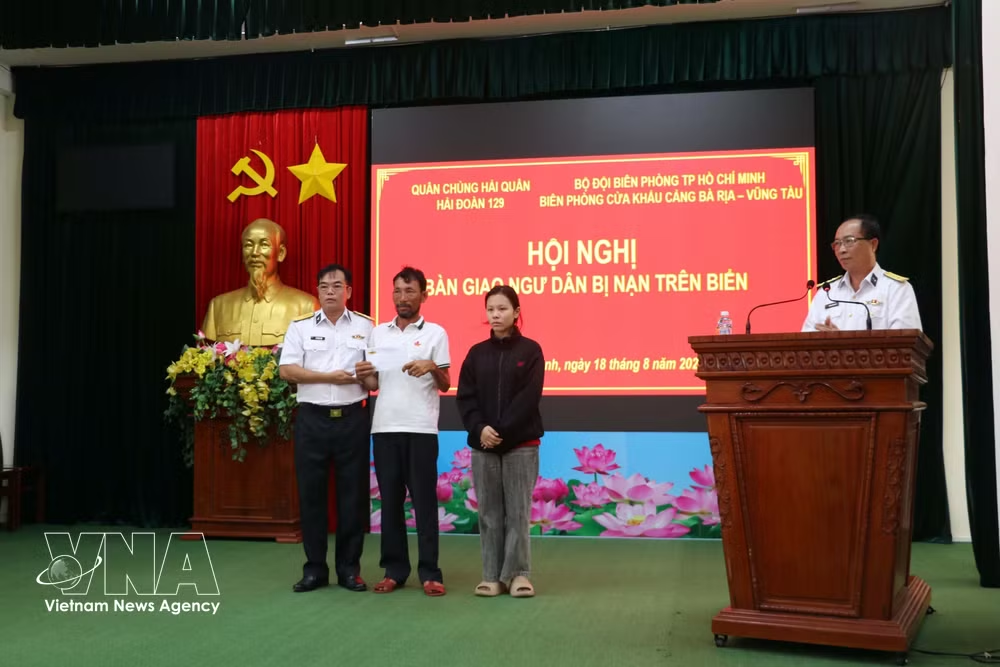
Naval Squadron 129 presents gifts to fisherman Truong Van Chung on August 16 before he returns home. (Photo: VNA)

On August 16, Naval Squadron 129’s ship 743 rescued fisherman Truong Van Chung, 46, from An Giang, after he had fallen overboard and drifted for four days near the Thang Long drilling rig. Earlier this month, medical personnel at DK1/10 promptly provided emergency treatment to a fisherman from Ca Mau province suspected of suffering a stroke and guided his vessel back to shore.

Nguyen Dinh Ngoc, a fishing boat owner in Vung Tau ward, said the regular presence of naval, coast guard, fisheries surveillance forces and DK1 platforms has helped fishermen feel safer at sea and respond quickly to emergencies.

Meanwhile, programmes supporting fishermen and their families, including scholarships and livelihood assistance, have helped strengthen military-civilian solidarity and build a strong social foundation for protecting national maritime sovereignty.

Authorities are also taking tougher action against violations, including fishing in foreign waters, manipulation of vessel monitoring systems and destructive fishing practices. Such measures aim to protect marine resources, safeguard law-abiding fishermen, promote sustainable fishing and contribute to the removal of the European Commission’s “yellow card” warning against Vietnamese seafood.

Resolution No. 20-NQ/TW has opened a new development mindset based on mastering maritime space through the combined strength of the entire nation. In Ho Chi Minh City, closer coordination among armed forces, law-enforcement agencies and fishermen is helping turn that vision into reality, contributing to the goal of building Vietnam into a strong maritime nation in the new era./.
VNA

See more

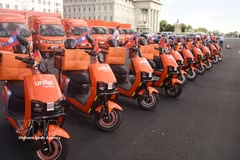
Vietnamese products increasingly win popularity (Photo: VNA)

Vietnam’s home market gives local brands room to grow

Notably, the domestic market has changed a lot. Consumers no longer pick products solely on whether they are domestic or foreign. Quality, price, origin, design, safety, after-sales service and shopping experience increasingly drive purchases.

Quang Tri steps up development of large-timber forests. (Photo: VNA)

Vietnam’s wood industry seeks higher value

According to the Vietnam Timber and Forest Product Association (VIFORE) , about 74% of timber from planted forests is currently used to make wood chips and pellets, while 18% goes into plywood and laminated veneer lumber (LVL). Although these products consume around 80% of the raw material supply, they generate only about 3-4 billion USD of the sector’s total export turnover of 18 billion USD.

Banks dominated July's new supply, accounting for 79% or about 21 trillion VND. (Photo: VNA)

Corporate bond issuance hits five-month low in July

Despite the sharp monthly decline in issuance, Vietnam’s outstanding corporate bond market remained sizeable at nearly 1.5 quadrillion VND as of July. Private-placement bonds accounted for over 1.3 quadrillion VND, while publicly offered bonds represented 180 trillion VND.

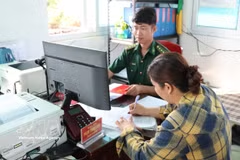
A vessel owner completes declaration procedures at the Vam Lang Border Guard Station before heading out to sea. (Photo: VNA)

Enhancing role of local authorities in combating IUU fishing

Vice Chairman of the My Tho People's Committee Dinh Tu Khoa said lists of ineligible vessels are publicly posted at the ward People's Committee office and residential areas. Heads of residential groups are assigned to supervise vessel owners and ensure that fishing gear and equipment are not kept on ineligible vessels.

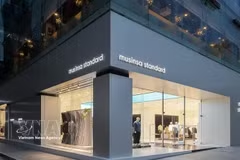
A Musinsa store in the Republic of Korea. (Photo: VNA)

Korean online fashion brand enters Vietnam

Musinsa has already signed a partnership agreement with Au Chau Fashion and Cosmetics (ACFC), a unit of Imex Pan Pacific Group (IPPG), one of Vietnam’s largest distributors.

Illustrative image (Photo: Viettel)

Viettel enters 11th international market, eyes telecom investment in Caribbean

Viettel announced on August 21 that its subsidiary, Viettel Global Investment JSC (Viettel Global), had won the right to use 240 MHz of spectrum in the 700 MHz, 2300 MHz and C-Band frequencies for 4G/5G mobile networks for 20 years, under Resolution No. 073-2026 issued by the Dominican Institute of Telecommunications (INDOTEL).

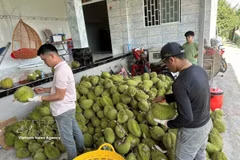
India's opening of its market to Vietnamese durian is a notable development that creats new opportunities for producers and exporters in both countries. (Photo: VNA)

Vietnam, India seek to expand agricultural trade

Economic and trade cooperation is an important pillar of Vietnam–India relations, with agricultural trade offering considerable room for expansion and diversification, said Trade Counsellor Bui Trung Thuong.

Vietnam sets a goal to raise GDP per capita to around 8,500 USD by 2030. (Photo: VNA)

Resolution 19 marks strategic shift in Vietnam’s development thinking

After 40 years of Doi Moi (Renewal), the economy has begun to show signs of shifting from a growth model heavily reliant on expanding capital and labour towards one driven by innovation, science and technology and digital transformation, with greater emphasis on improving labour productivity.

Border guards inspect fishing vessels entering and leaving La Gi fishing port. (Photo: VNA)

Lam Dong launches peak crackdown on illegal fishing

The campaign brings together the provincial Border Guard Command and relevant agencies to step up inspections, patrols and law enforcement while addressing shortcomings pointed out by the European Commission (EC).

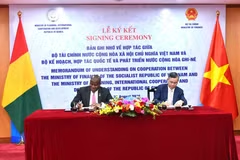
Minister of Finance Ngo Van Tuan (R) and Guinean Minister of Planning, International Cooperation and Development Ismaël NaBé signed a Memorandum of Understanding (MOU) on cooperation between the two ministries in Hanoi on August 20. (Photo published by VNA)

Vietnam, Guinea seek to boost investment cooperation

The MOU signed between the Vietnamese Ministry of Finance and the Guinean Minister of Planning, International Cooperation and Development aims to formalise cooperation, strengthen institutional capacity and share experience in planning, development and other areas agreed upon by the two sides in writing, in line with their respective functions and responsibilities.

At a Petrolimex fuel station. (Photo: VNA)

Petrol, diesel prices increase on August 20

From 3pm on August 20, the retail price of E5RON92 petrol was capped at 21,833 VND (0.84 USD) per litre, up 598 VND per litre from the previous ceiling price. E10RON95-III petrol was priced at no more than 22,668 VND per litre, an increase of 549 VND per litre.