Can Tho to host second Vietnam International Rice Festival

The second Vietnam International Rice Festival in Can Tho city from November 23-26 aims to showcase Vietnam’s rice industry, promote its rice heritage, strengthen the country’s position in global food security, and develop a sustainable rice value chain.

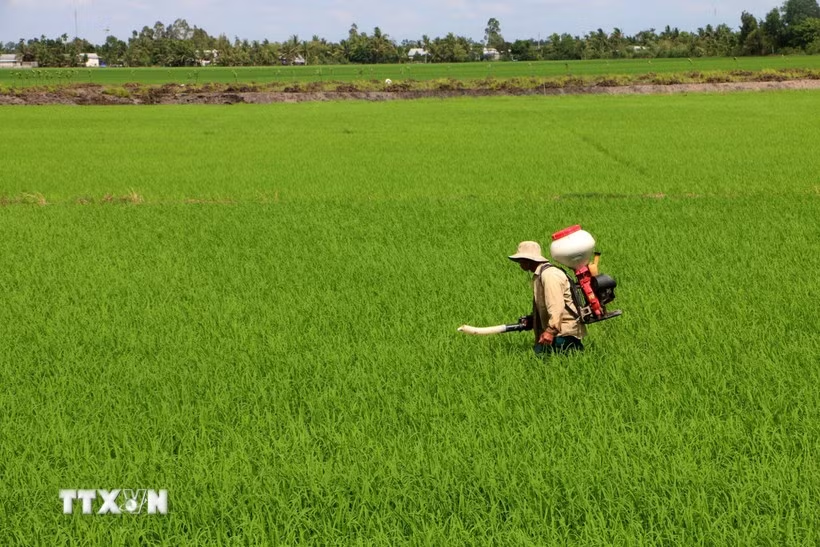
Farmers tend to rice crops in Can Tho city. (Photo: VNA)

Can Tho (VNA) – The Mekong Delta city of Can Tho will host the second Vietnam International Rice Festival from November 23-26, under the theme “Vietnam green rice – Reaching the world.”

​The event, jointly organised by the municipal People’s Committee and the Ministry of Agriculture and Environment, aims to showcase Vietnam’s rice industry, promote its rice heritage, strengthen the country’s position in global food security, and develop a sustainable rice value chain.

The festival is expected to feature more than 500 exhibitors and international delegations. Major activities will take place at Song Hau Park and surrounding streets, with modern agricultural machinery demonstrations along National Highway 61C.

The four-day event will feature exhibitions, competitions, cultural activities, international seminars and business meetings. A major exhibition titled “The rice road from past to future” will trace the development of Vietnam’s rice cultivation from traditional farming to modern agriculture amid Industry 4.0.

Exhibition areas will showcase achievements by localities and rice businesses, agricultural technologies and machinery, digital transformation, specialty and organic rice, OCOP products, cuisine and international rice markets. Visitors will also be able to explore models highlighting terraced rice fields, upland rice, rice-shrimp farming and the project to develop 1 million hectares of high-quality, low-emission rice.

​Two international seminars will focus on expanding markets and advancing green rice production. The first, on November 24, will discuss branding, food safety standards, market regulations and trade connectivity while the second, on November 25, will focus on artificial intelligence (AI), Inernet of Things (IoT), blockchain, digital transformation, carbon credits and circular-economy solutions to reduce emissions.

The festival will also feature traditional southern cultural experiences, eco-tourism activities, visits to Cai Rang Floating Market and the Ngo boat racing final during the Ooc Om Boc Festival.

The event has a projected budget of more than 34 billion VND (1.3 million USD), sourced from State and municipal budgets and social contributions.

Organisers expect the festival to give fresh momentum to the Vietnamese rice brand and accelerate the transition from conventional agricultural production toward a greener, more sustainable agricultural economy./.

VNA

See more

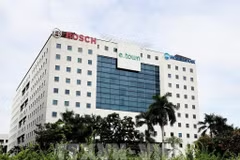
E.town office complex on Cong Hoa street, Ho Chi Minh City. (Photo: VNA)

AI drives new standards for office market

With GCCs, technology and sustainability converging, Ho Chi Minh City’s office market is entering a new phase in which operational quality and adaptability are becoming increasingly important, alongside location.

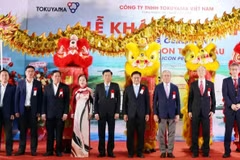
The inauguration of Tokuyama Vietnam's polysilicon plant in Ho Chi Minh City (Photo: Ho Chi Minh City Portal)

Japanese firm to produce key chip material in Vietnam, Malaysia

Tokuyama's Vietnam plant, inaugurated last week, will grind, clean and analyse polysilicon, an essential raw material for semiconductor wafers. Tokuyama is investing 60 million USD in the facility, which is ultimately expected to reach an annual capacity of 4,000 tonnes.

A discussion at the forum "Vietnam-ASEAN in Global Value Chains: From Signal to Action". (Photo: VNA)

Vietnamese firms urged to strengthen capacity as ASEAN pushes deeper digital integration

Vietnamese businesses have established leading positions in some supply chains, including seafood, wood processing, cashew and coffee processing. However, in manufacturing and electronics, many firms remain concentrated in assembly and the supply of simple components. Data transparency, traceability and effective supply-chain management are key to helping leading businesses maintain their positions.

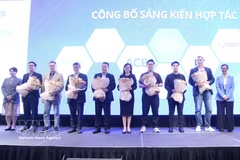
Members of the Vietnam-ASEAN value chain cooperation initiative make debut (Photo: VNA)

Ho Chi Minh City launches VSM 70 pilot programme to upgrade factory competitiveness

Selected companies will have their operations assessed and benchmarked against international best practices. They will get tailored improvement roadmaps and direct support from experts at their factories. They will also join a business community to share real-world experience, and must name one point of contact, share accurate operational data, and keep leaders involved throughout the process.

Ship 743 brings fisherman Truong Van Chung back to the Naval Squadron 129 port at noon on August 18, 2026. (Photo: VNA)

Ho Chi Minh City advances strategy for strong maritime nation

The resolution marks a shift from focusing primarily on the maritime economy to viewing the sea as an economic, strategic and living space, requiring close coordination between development, defence, security, foreign affairs and modern maritime governance.

Vietnamese products increasingly win popularity (Photo: VNA)

Vietnam’s home market gives local brands room to grow

Notably, the domestic market has changed a lot. Consumers no longer pick products solely on whether they are domestic or foreign. Quality, price, origin, design, safety, after-sales service and shopping experience increasingly drive purchases.

Quang Tri steps up development of large-timber forests. (Photo: VNA)

Vietnam’s wood industry seeks higher value

According to the Vietnam Timber and Forest Product Association (VIFORE) , about 74% of timber from planted forests is currently used to make wood chips and pellets, while 18% goes into plywood and laminated veneer lumber (LVL). Although these products consume around 80% of the raw material supply, they generate only about 3-4 billion USD of the sector’s total export turnover of 18 billion USD.

Banks dominated July's new supply, accounting for 79% or about 21 trillion VND. (Photo: VNA)

Corporate bond issuance hits five-month low in July

Despite the sharp monthly decline in issuance, Vietnam’s outstanding corporate bond market remained sizeable at nearly 1.5 quadrillion VND as of July. Private-placement bonds accounted for over 1.3 quadrillion VND, while publicly offered bonds represented 180 trillion VND.

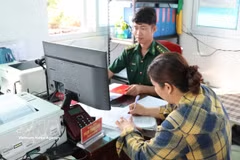
A vessel owner completes declaration procedures at the Vam Lang Border Guard Station before heading out to sea. (Photo: VNA)

Enhancing role of local authorities in combating IUU fishing

Vice Chairman of the My Tho People's Committee Dinh Tu Khoa said lists of ineligible vessels are publicly posted at the ward People's Committee office and residential areas. Heads of residential groups are assigned to supervise vessel owners and ensure that fishing gear and equipment are not kept on ineligible vessels.

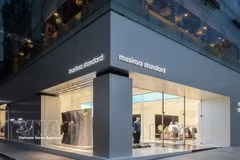
A Musinsa store in the Republic of Korea. (Photo: VNA)

Korean online fashion brand enters Vietnam

Musinsa has already signed a partnership agreement with Au Chau Fashion and Cosmetics (ACFC), a unit of Imex Pan Pacific Group (IPPG), one of Vietnam’s largest distributors.

Illustrative image (Photo: Viettel)

Viettel enters 11th international market, eyes telecom investment in Caribbean

Viettel announced on August 21 that its subsidiary, Viettel Global Investment JSC (Viettel Global), had won the right to use 240 MHz of spectrum in the 700 MHz, 2300 MHz and C-Band frequencies for 4G/5G mobile networks for 20 years, under Resolution No. 073-2026 issued by the Dominican Institute of Telecommunications (INDOTEL).

India's opening of its market to Vietnamese durian is a notable development that creats new opportunities for producers and exporters in both countries. (Photo: VNA)

Vietnam, India seek to expand agricultural trade

Economic and trade cooperation is an important pillar of Vietnam–India relations, with agricultural trade offering considerable room for expansion and diversification, said Trade Counsellor Bui Trung Thuong.

Vietnam sets a goal to raise GDP per capita to around 8,500 USD by 2030. (Photo: VNA)

Resolution 19 marks strategic shift in Vietnam’s development thinking

After 40 years of Doi Moi (Renewal), the economy has begun to show signs of shifting from a growth model heavily reliant on expanding capital and labour towards one driven by innovation, science and technology and digital transformation, with greater emphasis on improving labour productivity.