Vietnamese firms urged to strengthen capacity as ASEAN pushes deeper digital integration

Vietnamese businesses have established leading positions in some supply chains, including seafood, wood processing, cashew and coffee processing. However, in manufacturing and electronics, many firms remain concentrated in assembly and the supply of simple components. Data transparency, traceability and effective supply-chain management are key to helping leading businesses maintain their positions.

A discussion at the forum "Vietnam-ASEAN in Global Value Chains: From Signal to Action". (Photo: VNA)

Ho Chi Minh City (VNA) – Global supply chains are shifting from a focus on cost efficiency toward greater resilience, data transparency, and responsiveness, making the ASEAN Digital Economy Framework Agreement (DEFA) an important foundation for regional digital connectivity while requiring Vietnamese businesses to strengthen their internal capabilities to participate more deeply in global value chains.

The remarks were made by experts said at a Vietnam-ASEAN dialogue forum on global value chains held in Ho Chi Minh City on August 21.

The forum, themed “From Signal to Action”, was organised by the Ho Chi Minh City Centre for the Fourth Industrial Revolution (HCMC C4IR), bringing together policymakers, experts, international organisations and businesses.

Nguyen Duc Huy, Deputy Director of HCMC C4IR, said recent geopolitical developments had pushed up input costs for manufacturers while highlighting the vulnerability of economies whose supply chains depend heavily on a limited number of key connections.

The World Economic Forum's Global Value Chain Outlook 2026 shows that most manufacturing executives worldwide are prioritising the regionalisation of supply chains based on supply readiness rather than labour costs alone, he said.

At the same time, tariff adjustments by major economies, including separate tariffs on transshipped goods, are creating additional pressure on economies that remain heavily dependent on low-value assembly operations.

According to Huy, the criteria for selecting suppliers in global value chains have changed. Businesses are no longer chosen primarily because they offer the lowest costs, but must demonstrate capabilities in data management, compliance with standards, production speed and transparency throughout their operations.

Global buyers are also increasingly seeking supply clusters rather than individual suppliers, he said. Such clusters offer the scale, reliability and mutual support needed to withstand disruptions.

Huy noted that despite Vietnam's continued export growth, domestic enterprises account for less than 30% of total export value. The World Bank's Vietnam 2045 report also shows that the participation of domestic firms in global value chains has declined over many years alongside rising exports.

This indicates that the challenge lies not in export capacity, but in the position of Vietnamese enterprises within value-creating networks, he said.

Bui Thi Ninh, Deputy Director of the Vietnam Chamber of Commerce and Industry's Ho Chi Minh City branch (VCCI-HCM), said Vietnamese businesses have established leading positions in some supply chains, including seafood, wood processing, cashew and coffee processing.

However, in manufacturing and electronics, many firms remain concentrated in assembly and the supply of simple components. Data transparency, traceability and effective supply-chain management are key to helping leading businesses maintain their positions, she said.

For processing and assembly businesses, competitive prices and production capacity are no longer sufficient. Buyers increasingly require international certifications related to digital transformation, green transition and ESG practices. High-quality technical human resources are also essential for businesses seeking to move from contract manufacturing towards mastering production technologies, Ninh added.​

At the ASEAN level, experts noted that despite three decades of tariff liberalisation among member states, intra-regional trade still accounts for only about one-fifth of the bloc's total trade. The main barriers are increasingly related to paperwork, standards, certifications and disconnected systems rather than tariffs.

Pradeep Singh, Vice President for Planning and Logistics, East Asia, at Schneider Electric, said differences in regulations and licensing continue to hamper the movement of electronic products across ASEAN. Better trade flows therefore require not only physical and logistics infrastructure but also interoperable digital infrastructure, integrated data systems and information sharing.

Against this backdrop, DEFA, expected to be completed in 2026, is seen as a new foundation for ASEAN's digital economic integration.

Anne-Katrin Pfister, head of Digital Trade Policy, Asia-Pacific, at the World Economic Forum, said DEFA aims to promote digital economic integration and move ASEAN towards a unified, secure, interoperable and inclusive digital market.

Under the ASEAN Digital Economy Agreement Leadership (ASEAN DEAL) project led by the WEF, DEFA could unlock market opportunities worth 1-2 trillion USD while creating fresh momentum for trade, investment, innovation and business development. It could also enable micro-, small- and medium-sized enterprises to access regional markets at lower costs and with fewer barriers.​

Pfister cautioned, however, that ASEAN countries still differ significantly in digital readiness. Legal and policy frameworks remain uneven, while implementation capacity and resources at national and local levels are limited. Cybersecurity, data protection and building user trust must therefore remain priorities as the region advances digital integration./.
VNA

See more

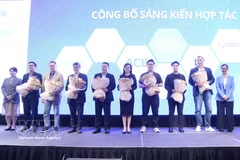
Members of the Vietnam-ASEAN value chain cooperation initiative make debut (Photo: VNA)

Ho Chi Minh City launches VSM 70 pilot programme to upgrade factory competitiveness

Selected companies will have their operations assessed and benchmarked against international best practices. They will get tailored improvement roadmaps and direct support from experts at their factories. They will also join a business community to share real-world experience, and must name one point of contact, share accurate operational data, and keep leaders involved throughout the process.

Ship 743 brings fisherman Truong Van Chung back to the Naval Squadron 129 port at noon on August 18, 2026. (Photo: VNA)

Ho Chi Minh City advances strategy for strong maritime nation

The resolution marks a shift from focusing primarily on the maritime economy to viewing the sea as an economic, strategic and living space, requiring close coordination between development, defence, security, foreign affairs and modern maritime governance.

Vietnamese products increasingly win popularity (Photo: VNA)

Vietnam’s home market gives local brands room to grow

Notably, the domestic market has changed a lot. Consumers no longer pick products solely on whether they are domestic or foreign. Quality, price, origin, design, safety, after-sales service and shopping experience increasingly drive purchases.

Quang Tri steps up development of large-timber forests. (Photo: VNA)

Vietnam’s wood industry seeks higher value

According to the Vietnam Timber and Forest Product Association (VIFORE) , about 74% of timber from planted forests is currently used to make wood chips and pellets, while 18% goes into plywood and laminated veneer lumber (LVL). Although these products consume around 80% of the raw material supply, they generate only about 3-4 billion USD of the sector’s total export turnover of 18 billion USD.

Banks dominated July's new supply, accounting for 79% or about 21 trillion VND. (Photo: VNA)

Corporate bond issuance hits five-month low in July

Despite the sharp monthly decline in issuance, Vietnam’s outstanding corporate bond market remained sizeable at nearly 1.5 quadrillion VND as of July. Private-placement bonds accounted for over 1.3 quadrillion VND, while publicly offered bonds represented 180 trillion VND.

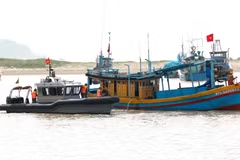
A vessel owner completes declaration procedures at the Vam Lang Border Guard Station before heading out to sea. (Photo: VNA)

Enhancing role of local authorities in combating IUU fishing

Vice Chairman of the My Tho People's Committee Dinh Tu Khoa said lists of ineligible vessels are publicly posted at the ward People's Committee office and residential areas. Heads of residential groups are assigned to supervise vessel owners and ensure that fishing gear and equipment are not kept on ineligible vessels.

A Musinsa store in the Republic of Korea. (Photo: VNA)

Korean online fashion brand enters Vietnam

Musinsa has already signed a partnership agreement with Au Chau Fashion and Cosmetics (ACFC), a unit of Imex Pan Pacific Group (IPPG), one of Vietnam’s largest distributors.

Illustrative image (Photo: Viettel)

Viettel enters 11th international market, eyes telecom investment in Caribbean

Viettel announced on August 21 that its subsidiary, Viettel Global Investment JSC (Viettel Global), had won the right to use 240 MHz of spectrum in the 700 MHz, 2300 MHz and C-Band frequencies for 4G/5G mobile networks for 20 years, under Resolution No. 073-2026 issued by the Dominican Institute of Telecommunications (INDOTEL).

India's opening of its market to Vietnamese durian is a notable development that creats new opportunities for producers and exporters in both countries. (Photo: VNA)

Vietnam, India seek to expand agricultural trade

Economic and trade cooperation is an important pillar of Vietnam–India relations, with agricultural trade offering considerable room for expansion and diversification, said Trade Counsellor Bui Trung Thuong.

Vietnam sets a goal to raise GDP per capita to around 8,500 USD by 2030. (Photo: VNA)

Resolution 19 marks strategic shift in Vietnam’s development thinking

After 40 years of Doi Moi (Renewal), the economy has begun to show signs of shifting from a growth model heavily reliant on expanding capital and labour towards one driven by innovation, science and technology and digital transformation, with greater emphasis on improving labour productivity.

Border guards inspect fishing vessels entering and leaving La Gi fishing port. (Photo: VNA)

Lam Dong launches peak crackdown on illegal fishing

The campaign brings together the provincial Border Guard Command and relevant agencies to step up inspections, patrols and law enforcement while addressing shortcomings pointed out by the European Commission (EC).

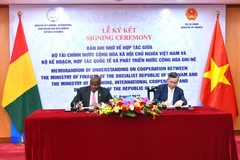
Minister of Finance Ngo Van Tuan (R) and Guinean Minister of Planning, International Cooperation and Development Ismaël NaBé signed a Memorandum of Understanding (MOU) on cooperation between the two ministries in Hanoi on August 20. (Photo published by VNA)

Vietnam, Guinea seek to boost investment cooperation

The MOU signed between the Vietnamese Ministry of Finance and the Guinean Minister of Planning, International Cooperation and Development aims to formalise cooperation, strengthen institutional capacity and share experience in planning, development and other areas agreed upon by the two sides in writing, in line with their respective functions and responsibilities.