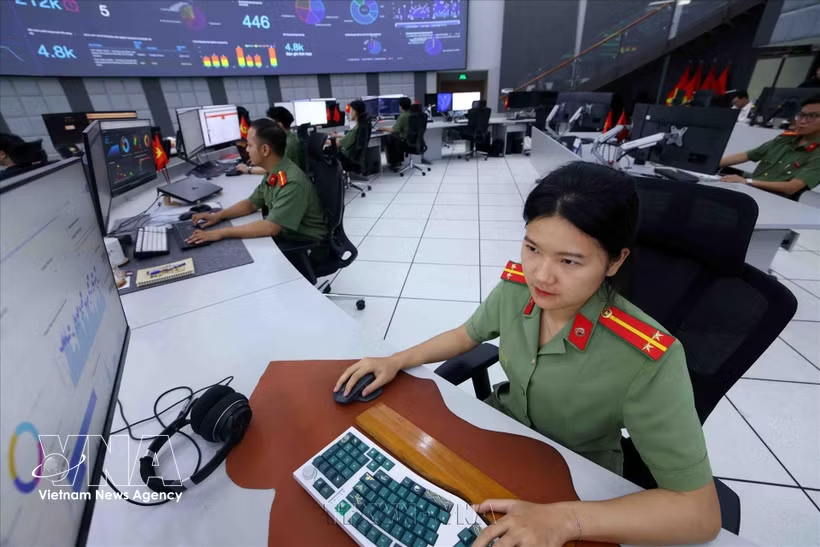
Hanoi (VNA) - Thannks to sweeping changes in strategic thinking and major breakthroughs, efforts to safeguard national sovereignty in cyberspace and ensure cybersecurity and data security have made significant progress, creating a solid foundation for the development of digital government, digital society and digital economy.
Impact of digital transformation, cyberspace
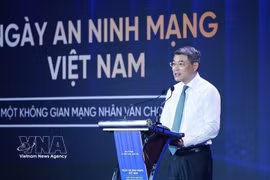
Lieutenant General Le Xuan Minh, Director of the Ministry of Public Security’s Department of Cybersecurity and Hi-tech Crime Prevention (A05), said that as digital transformation advances comprehensively and extensively, the concept of national security is undergoing fundamental changes in both scope and substance.
In practice, cyberspace has become foundational infrastructure for the development of digital government, digital society, and digital economy. Data has become a strategic resource, digital infrastructure the lifeblood of the modern economy, and technology a source of new forms of power, increasing risks and challenges to national security.
He said that data sovereignty is facing growing challenges as cross-border dependence increases. Digital transformation, data centres and interconnected systems are also heightening cybersecurity and data security risks, while cyberattacks are becoming increasingly sophisticated, professional and systematic, aided by artificial intelligence (AI).
Cyberspace has become a “grey zone” in strategic competition, where countries, particularly major powers, are stepping up dangerous activities below the threshold of war. Recent conflicts have highlighted a new form of warfare when cyber and information warfare often pave the way for military operations on the ground. Cyber reconnaissance, attacks, espionage and ideological sabotage have become tactical tools for gaining the upper hand, he noted.
A new form of attacks targeting the cognitive domain has also emerged, involving cognitive warfare and manipulation of digital trust. Perceptions of people and society as a whole are increasingly influenced by content-distribution and AI algorithms used by social media platforms and cross-border AI services. Such platforms have also become operating grounds for hostile forces, while cyber espionage is growing increasingly dangerous.
According to Minh, breakthrough technologies are reshaping approaches to protecting national sovereignty and security in cyberspace, particularly quantum computing, AI, unmanned aerial vehicles (UAVs), next-generation mobile services such as 5G and 6G, and satellite Internet.
National security in cyberspace is consequently facing risks related to technological dependence and national self-reliance. Failure to master core products and services could create new risks of falling behind and losing sovereignty over cyberspace, cybersecurity and data security, especially as Vietnam develops AI products based on foreign technological foundations.
Three strategic breakthroughs
Lieutenant General Minh said the Party, State and Ministry of Public Security have identified these challenges at an early stage. Under the comprehensive direction of the Central Public Security Party Committee and the Ministry of Public Security, efforts to safeguard national security in cyberspace have focused on three strategic breakthroughs.
The first is to improve institutions, policies and laws on cybersecurity and national security in cyberspace. The second is technological self-reliance through research, application and development of cybersecurity products and services. The third is developing high-quality human resources in cybersecurity and data security.
These three breakthroughs have helped generate positive changes and tangible results in safeguarding sovereignty in cyberspace, cybersecurity and data security.
Early, remote risk detection and response
Politburo Resolution No. 57-NQ/TW identifies the protection of national sovereignty in cyberspace, cybersecurity and data security as a consistent and inseparable requirement throughout the development of science and technology, innovation and national digital transformation.
Directive No. 57-CT/TW of the Party Central Committee’s Secretariat emphasises a strategic shift from “passive defence” to “proactive and active defence” and the building of a comprehensive, proactive cybersecurity posture.
Cybersecurity, information security and data security risks must be identified and addressed early and from afar, with appropriate defensive measures ready to neutralise threats and protect national interests in cyberspace, Minh stressed.
To strengthen national security protection in cyberspace and create a firm foundation for the digital society and digital economy, the A05 Director said Vietnam should continue improving its cybersecurity legal framework, particularly regulations governing cyberspace infrastructure, core services, critical digital infrastructure, high-tech security, cross-border data flows, data security and algorithmic security.
He said that Vietnam should build a cyber and information warfare prevention posture as part of a comprehensive cybersecurity and people-based security system, combining legal and technological capabilities and community strengths as well as extending protection from widespread civilian systems to critical national infrastructure.
It is also necessary to strengthen cyberspace management in tandem with cybersecurity protection, ensuring that the two form a seamless and comprehensive system. Priority should be given to building national digital sovereignty, strengthening self-reliance in technology and services, and ensuring the stable operation of Vietnam’s Internet system under all circumstances, including emergencies.
At the same time, Vietnam needs to rapidly develop the capacity to manage and protect security in emerging strategic domains, including the cognitive and low-altitude domains, while developing sovereign cybersecurity technologies. Focus should be placed on protecting critical infrastructure and core national databases, safeguarding personal data, and creating a safe and healthy cyberspace where people can fully benefit from the country’s socio-economic development./.
See more
Mekong Delta launches first robotics, AI research institute
Dr. Nguyen Van Quang, Rector of Nam Can Tho University, said the university is developing a value chain covering training, research, technology development, testing, technology transfer and commercialisation. The model is designed to link research more closely with practical needs, ensuring that technologies generate products and products create value for society.
Daegu innovation space opens in Da Nang
The Daegu technology and innovation space in Da Nang will introduce Daegu’s outstanding technologies, innovative products and solutions while serving as a bridge connecting businesses, research institutes, universities and startup communities from the two cities.
Vietnam steps up preparations for 6G as 5G network expands
A global technology, 6G requires cooperation between countries, businesses and international standards organisations to ensure the compatibility of telecommunications infrastructure worldwide.
Legal know-how essential for content creators in digital space
The workshop highlighted that the rapid development of e-commerce, social media and digital content creation is creating significant opportunities for KOCs and KOLs, while also requiring them to improve their legal knowledge and compliance.
Resolution 57: Shifting from policy reform to concrete technology outcomes
The Ministry of Science and Technology said its top priority through end-2026 is a decisive shift from building institutional framework to delivering products, technologies and measurable results.
Viettel ranks No 1 globally at prestigious IBA 2026 awards
Military-run telecom group Viettel has been named the world's most awarded organisation at the 2026 International Business Awards (IBA), winning 28 prizes including 17 gold, eight silver and three bronze awards.
Can Tho builds smart, modern administration through AI application
Amid efforts to accelerate national digital transformation, localities in Can Tho city are integrating modern technologies into State administration. Beyond conventional software and online platforms, artificial intelligence (AI) is being incorporated into public administrative service processes, leading to tangible improvements in service of people and businesses.
Vietnam, New Zealand can lift sci-tech, workforce training cooperation to new level: expert
The state visit to New Zealand by Party General Secretary and President To Lam has opened the door to cooperation, and the key task now is turning that opportunity into a pathway for people, students, scientists, and businesses to move forward together.
Ho Chi Minh City urged to lead in developing, testing new technology models: Deputy PM
Conviction 2026, a national-level forum on Digital Assets and Artificial Intelligence, which opened in Ho Chi Minh City on August 14, brings together representatives from State management agencies, technology companies, financial institutions, investment funds, experts, research institutes, universities and domestic and international partners, creating opportunities to connect policies, technology, resources and markets, according to Deputy Prime Minister Ho Quoc Dung.
Vietnam, Australia expect stronger technology, innovation ties following top Vietnamese leader's visit
The two countries have already established a solid foundation for such cooperation, moving from traditional trade and people-to-people exchanges towards knowledge-based, high-tech and sustainable development.
Vietnam taps global expertise to develop world-class AI workforce
The network aims to attract global Vietnamese AI talents, strengthen links among research institutions, businesses and experts to form strong research teams and promote commercialisation, while mobilising experts to advise on policies and key national AI programmes and projects.
Vietnam moves to build quantum workforce
As the country's science, technology and innovation hub, Ho Chi Minh City is now scrambling to build capacity for the quantum age, with workforce development at the centre of its push to seize future opportunities.
Vietnam – Japan Innovation Forum 2026 drives new models
NIC Deputy Director Hoang Trung Hieu shared that Vietnam is working to gradually make science, technology, and innovation its main growth drivers. Along the way, Japan stands out as one of its key partners, bringing strong capabilities in sci-tech, industry, and workforce, along with an extensive network of companies, research institutes, and universities.
FPT-Mila partnership to help advance AI development in Vietnam: Deputy PM
Deputy Prime Minister Ho Quoc Dung called on FPT and Mila to make practical products the ultimate benchmark of their cooperation, shifting from pure research towards measurable outcomes ranging from core technologies and inventions to commercialised solutions.
Finland expands opportunities for Vietnamese technology experts
More than 600 technology experts in Vietnam have joined the Discover Finland programme since its official launch in 2025 to explore career development opportunities in the European country.
Vietnam, Australia strengthen parliamentary cooperation
the Australian Parliament looks forward to close coordination with the Vietnamese NA at the Inter-Parliamentary Union (IPU) and other multilateral forums, said Deputy Speaker of the Australian House of Representatives Sharon Claydon.
Vietnam seeks stronger cooperation with US partner in semiconductors, biomedical technology
Vietnam welcomes leading global technology groups such as Thermo Fisher Scientific to engage more deeply in the country’s science and technology ecosystem through investment, research and development, technology transfer and human resources training, as well as cooperation with domestic research institutes, universities and businesses, Deputy Prime Minister Ho Quoc Dung said.
National programme on AI human resources development approved
The programme aims to develop an AI workforce of sufficient scale, structure and quality to meet the requirements of strategic technology sectors, enhance national technological self-reliance, promote innovation and digital transformation, and foster the digital economy and digital society.
VinSpace announces satellite launch contract with SpaceX
VinSpace is responsible for the research, development, manufacturing and on-orbit operation of its satellites. The satellites will support the on-orbit demonstration of in-house developed technologies, strengthen VinSpace's satellite engineering capabilities, and pave the way for future commercial space applications.
Elevating digital infrastructure to drive new era of development
o create new growth momentum for the country in a new development phase, the Politburo's Resolution No. 57-NQ/TW emphasises the need to develop modern digital infrastructure, expand access to high-quality Internet services and build large-scale data centres as the foundation for a national data platform.