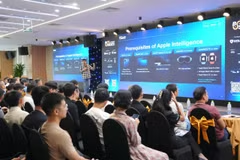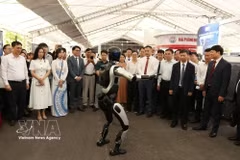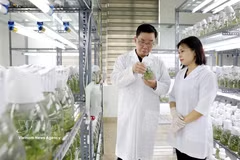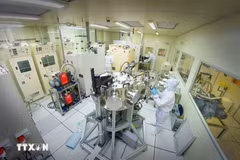
Hanoi (VNA) – Deputy Prime Minister Le Tien Chau has signed Decision No. 1528/QD-TTg dated August 11, 2026, approving the national programme on artificial intelligence (AI) human resources development through 2030, with a vision to 2035.
The programme aims to develop an AI workforce of sufficient scale, structure and quality to meet the requirements of strategic technology sectors, enhance national technological self-reliance, promote innovation and digital transformation, and foster the digital economy and digital society. It also seeks to make the ability to use and apply AI one of the essential competencies of learners, workers, managers and administrators.
The programme also targets the development of highly qualified and specialised personnel capable of researching, developing, mastering, deploying and managing AI systems in a safe, reliable and responsible manner. It aims to help Vietnam become one of the leading countries in the region in AI human resources development, thereby improving labour productivity and national competitiveness while safeguarding national interests in the AI era.
By 2030, the programme targets widespread access to knowledge, skills and competencies for the safe and effective use of AI among learners, workers, managers and administrators. Specifically, at least 80% of general education and university preparatory students, 100% of learners at higher education institutions and at least 80% of learners at vocational education establishments are expected to acquire such competencies. The goals also cover at least 90% of civil servants, public employees and workers at public non-business units, and 100% of personnel working in education and training.
The programme also targets the training, retraining and upskilling of at least 50,000 people with undergraduate or higher qualifications who can apply AI in key sectors and fields.
At the same time, at least 10,000 highly qualified AI personnel, including researchers, engineers and experts capable of researching, developing, mastering, deploying, operating and managing advanced AI systems, will be trained and developed. Of this number, a minimum of 1,500 specialists is expected to be capable of researching, developing, and mastering core technologies and leading key AI tasks.
An AI-integrated education system will be established across all levels and types of education, with 100% of higher education institutions expected to introduce regulations governing the use of the technology in training, research and assessment.
The programme also aims to establish at least 10 advanced, specialised AI training and research centres, as well as at least 25 higher education institutions serving as hubs for AI training, research and innovation.
With a vision to 2035, it seeks to set up a modern and sustainable AI human resources ecosystem capable of adapting to technological developments and international integration. The ability to use and apply AI is expected to become a widespread competency among the workforce, while the technology will serve as a foundational one driving learning, work, production, business and national governance.
To achieve these objectives, the programme sets out a range of specific tasks and solutions, including developing and completing the institutional framework; developing a pool of teachers, experts and training support networks; developing highly qualified human resources; linking training with businesses and the labour market; and developing infrastructure, data and shared practical-learning environments for training, among others.
Particular priority will be given to supporting vulnerable groups, workers at risk of displacement by automation, learners in disadvantaged areas, women working in technology, people with disabilities and other groups requiring equitable access to AI capabilities./.
See more
VinSpace announces satellite launch contract with SpaceX
VinSpace is responsible for the research, development, manufacturing and on-orbit operation of its satellites. The satellites will support the on-orbit demonstration of in-house developed technologies, strengthen VinSpace's satellite engineering capabilities, and pave the way for future commercial space applications.
Elevating digital infrastructure to drive new era of development
o create new growth momentum for the country in a new development phase, the Politburo's Resolution No. 57-NQ/TW emphasises the need to develop modern digital infrastructure, expand access to high-quality Internet services and build large-scale data centres as the foundation for a national data platform.
Sci-tech set to forge new pillar in Vietnam–Canada ties
The collision of Canada’s technological firepower and Vietnam’s development needs could open the door for highly practical joint projects, said CVSE Chairman Assoc. Prof. Vu Viet Hung.
Sci-tech diplomacy: A new mission for diplomatic sector
The directive by General Secretary and State President Lam reflects a shift in Vietnam’s development mindset, in line with the Politburo’s Resolution 57-NQ/TW dated December 22, 2024 on breakthroughs in sci-tech, innovation and national digital transformation. For the first time, sci-tech has been placed at the very centre as a driver of growth model.
Vietnam, India step up cooperation in research, training, policy advice
VASS and its Indian partners agreed to strengthen links between research institutions, develop joint research programmes, co-publish research, organise international workshops, exchange scholars and share research findings.
Science, technology to become new pillar of Vietnam-Australia ties: expert
The visit to Australia by Party General Secretary and State President To Lam will open a new chapter of cooperation, enabling Vietnamese intellectuals and experts in Australia to contribute more effectively to national development and helping science, technology and innovation become an important driver of the Comprehensive Strategic Partnership.
APIE Camp 2026 connects Vietnamese students with global Internet community
Hosting the APIE Camp marked an important milestone for Vietnam, reflecting regional recognition of the country's capabilities in Internet development and its growing role within the Asia-Pacific Internet community, said a local official.
Youth innovation challenge for sustainable communities launched
Unlike conventional idea-based competitions, RE:ACT focuses on deploying solutions that have already reached the minimum viable product stage through Living Labs – community-based pilot environments where innovations are tested under real-world conditions.
Vietnam approves national programme on strategic technologies
The programme seeks to master, develop, perfect and commercialise highly competitive strategic technology products, with priority given to core technologies. It also aims to build a strategic technology ecosystem and strengthen linkages among the State, businesses and science and technology organisations.
FPT named an OpenAI Select Partner
Under the partnership, FPT and OpenAI will work together to help businesses develop AI transformation roadmaps, build AI platforms, strengthen workforce capabilities and deploy responsible AI solutions tailored to their operational needs.
Vietnam draws hyperscalers, cloud titans, AI players
These developments highlight growing confidence in Vietnam as a destination for hyperscale, cloud, and AI infrastructure. The broader digital infrastructure ecosystem also strengthened during the period.
Da Nang seeks to become a strategic investment destination
Da Nang is accelerating efforts to attract investment and mobilise social resources for new development models, leveraging expanded development space, special policy mechanisms and institutional reforms to position itself as a strategic investment destination and a pioneer in Vietnam's economic growth in the new era.
PM urges stronger coordination in cybersecurity response
PM Le Minh Hung pushed for the Regional Counter Cybercrime Hub for Asia-Pacific to be put into operation in 2027, a “Cybersecurity Economy” initiative to be prepped for APEC 2027, stronger specialised cybersecurity agencies, and an expansion of the national cybersecurity operations centre by the second quarter of 2028.
Israeli expert suggests Vietnam prioritise chip design, talent development
Drawing on Israel’s experience, Mel Shalev said Vietnam should focus on developing talent, scientific research, and chip design capabilities instead of rushing into building fabrication facilities.
Trust emerges as one of modern cybersecurity’s biggest challenges
Speaking at the event, VSEC Chairman Truong Duc Luong said this was the second time BSides has been held in Hanoi, continuing to attract strong interest from the cybersecurity community. BSides Hanoi 2026 was designed as a platform connecting Vietnam’s cybersecurity community with international networks, encouraging knowledge sharing and contributing to the sustainable development of the cybersecurity ecosystem.
Hai Phong promotes int’l cooperation in technology transfer, business innovation
Nguyen Cao Thang, Director of the municipal Department of Science and Technology, said the city is accelerating its development strategy based on science, technology and innovation in line with the Politburo's Resolution No. 57-NQ/TW.
Vietnam positioned to harness AI wave, World Bank report says
The WB report identifies Vietnam as one of the few economies outside the European Union (EU) to have adopted a comprehensive AI regulatory framework as early as 2025. Vietnam applies a risk-tiered approach similar to that of the EU AI Act, imposing different obligations depending on whether an AI system poses “unacceptable,” “high,” “low” or “minimal” risks. The approach is viewed as a strategic step towards ensuring safe and transparent AI governance.
Construction sector advances digital transformation with integrated data ecosystem
As digital transformation becomes a key growth driver, the construction sector has come under increasing pressure to modernise its management model to keep pace with the rapid expansion of transport infrastructure, urbanisation and the real estate market.
Politburo’s Resolution 57-NQ/TW powers new growth momentum
NSO Director Nguyen Thi Huong said alongside foreign investment and the green economy, science – technology, innovation, the digital economy and digital transformation are the new drivers that can can pack a serious second-half punch.
Drastic measures taken to turn Resolution 57 into action
A recent meeting of the Central Steering Committee on science, technology, innovation and digital transformation, chaired by Party General Secretary and State President To Lam, marked a new phase in implementing Resolution 57 following the committee’s restructuring.