Legal know-how essential for content creators in digital space

The workshop highlighted that the rapid development of e-commerce, social media and digital content creation is creating significant opportunities for KOCs and KOLs, while also requiring them to improve their legal knowledge and compliance.

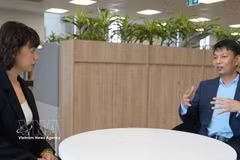
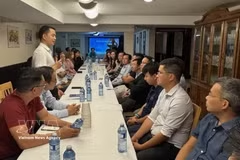
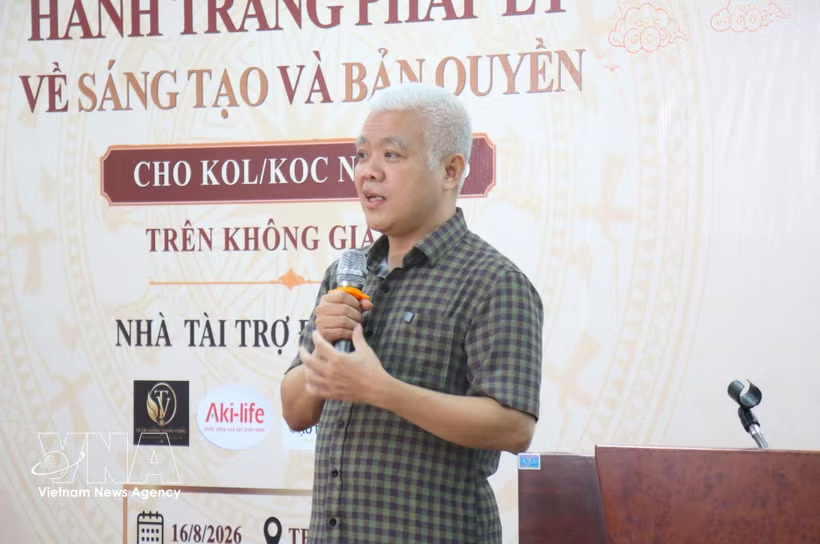
Nguyen Lam Thanh, a representative of TikTok Vietnam, speaks at the workshop in Ho Chi Minh City on August 16 to provide KOCs and KOLs with practical legal knowledge on creativity and copyright in the digital space. (Photo: VNA)

Ho Chi Minh City (VNA) – The Vietnam Copyright and Creativity Association, in coordination with the Vietnam institute for creative development and copyright, held a workshop in Ho Chi Minh City on August 16 to provide KOCs (Key Opinion Consumers) and KOLs (Key Opinion Leaders) with practical legal knowledge on creativity and copyright in the digital space.

The workshop highlighted that the rapid development of e-commerce, social media and digital content creation is creating significant opportunities for KOCs and KOLs, while also requiring them to improve their legal knowledge and compliance.

Nguyen Lam Thanh, a representative of TikTok Vietnam, said 2026 has marked significant changes in the legal environment governing advertising, e-commerce and copyright. As the KOC/KOL community moves from relatively spontaneous growth towards more professional operations, creators need to review their business models and content practices and equip themselves with legal knowledge to minimise risks.

Content creators should clearly distinguish between informational content, advertising content and activities associated with product sales, he said. Each category may carry different legal responsibilities and be subject to regulations governing online information, advertising, e-commerce, consumer protection, taxation and intellectual property.

He stressed that digital platforms are increasingly using automated systems to detect potentially violating content. Depending on the severity, such content may have its visibility restricted or be removed, while accounts may face different sanctions.

For livestreaming activities, Thanh noted that absolute claims such as “the best product in Vietnam” could be flagged if creators lack appropriate evidence to substantiate them. Accounts accumulating violations may face increasingly stringent measures, ranging from temporary restrictions to suspension in serious cases.

From a copyright perspective, Bui Nguyen Hung, former Director of the Copyright Office of Vietnam and Chairman of the Vietnam Copyright and Creativity Association, said copyright issues are becoming increasingly important for content creators.

KOCs and KOLs may be subject to various legal provisions, from the Civil Code and Law on Intellectual Property to advertising regulations. When using other people’s images, music, videos or creative works, creators must establish whether they have the necessary rights to use such materials to avoid disputes.

He also highlighted copyright-related issues arising from the use of artificial intelligence (AI) in content creation. While AI can serve as a powerful creative tool, users must remain in control of the production process and pay attention to rights relating to the data and works used.

Nguyen Van Toan, Director of the Vietnam institute for creative development and copyright, stressed that legal knowledge is essential as online sales and advertising continue to expand. False or misleading advertising can harm consumers while exposing content creators to legal risks.

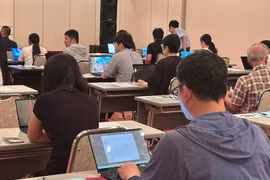
At the workshop, participants also discussed practical issues including the use of images, music and third-party works, quotation limits, KOC/KOL responsibilities in advertising, AI-assisted content creation, and ways to identify and minimise legal risks.

The organisers said legal awareness will not only help KOCs and KOLs avoid violations, but also contribute to building a more transparent, professional and sustainable digital creative environment./.
VNA

See more

Students practice microcontroller programming at the Viet - Han College of Technology in Bac Ninh province (Photo: VNA)

Vietnam steps up semiconductor talent training to meet market demand

Vietnam needs to step up semiconductor workforce training to meet growing market demand and enhance its capacity to participate in the global technology value chain, experts said, highlighting the importance of closely linking training with businesses, production and technological research.

Vietnam seeks to boost education and technology cooperation with France

Vietnam seeks to boost education and technology cooperation with France

Education and training, science and technology, and high-quality human resources are key areas of cooperation in Vietnam-France relations, said Politburo Member, Secretary of the Communist Party of Vietnam Central Committee, and Chairman of its Commission for Organisation Nguyen Duy Ngoc while visiting the Institut Polytechnique de Paris on September 11.

General Secretary of the Communist Party of Vietnam Central Committee and President To Lam witnesses the exchange of cooperation agreements between the two countries. (Photo: VNA)

Vietnam, France deepen cooperation in science, technology, workforce training

The University of Science and Technology of Hanoi (USTH), under the Vietnam Academy of Science and Technology (VAST), and the French Alternative Energies and Atomic Energy Commission (CEA) exchanged two cooperation agreements in Paris on September 11, in the presence of General Secretary of the Communist Party of Vietnam Central Committee and President To Lam.

A display area for unmanned aerial vehicles (UAVs) at a workshop in Da Nang city on June 12, 2026. (Photo: VNA)

Vietnam eyes UAV industry as key driver of low-altitude economy

For Vietnam, the opportunity presented by unmanned aerial vehicles (UAVs) lies not only in expanding their applications but, more importantly, in gradually building industrial capacity, mastering technologies and engaging more deeply in global value chains.

A semiconductor chip by TSMC (Photo: VCG)

Vietnam seeks deeper integration into global semiconductor value chains

Nguyen Anh Tuan, Director of the National Centre for Pilot Semiconductor Chip Manufacturing Support under the Ministry of Science and Technology, said that amid increasingly intense global technological competition, the semiconductor industry is not only a high-value-added economic sector but also a foundation for technological self-reliance, national security and economic competitiveness.

Demonstration of an autonomous electric street sweeper. (Photo: VNA)

Hanoi approves controlled pilot of two technology projects

The two projects involve an intelligent autonomous transportation system developed by Phenikaa-X JSC and a technology for producing mixed rare-earth oxides with a purity of over 95% on a semi-industrial scale developed by the Mining Technology and Construction Consultancy JSC.

Prof. Dr. Tran Hong Thai, President of the Vietnam Academy of Science and Technology (VAST), has a working session with leaders of Russia’s State Atomic Energy Corporation Rosatom. (Photo: VNA)

Vietnam, Russia develop quantum technology cooperation roadmap

Quantum technology is an emerging field undergoing rapid breakthroughs and requiring enormous investment resources. Learning from the experience of pioneering countries such as Russia will enable Vietnam to significantly shorten the time needed to build its workforce and develop endogenous capabilities.

Senior Vice-President of Latin America and Asia at Thales Group Guy Bonassi (L) at a meeting with Vietnamese Ambassador to France Trinh Duc Hai (Photo published by VNA)

Vietnam, France should expand cooperation in strategic fields: business leader

General Secretary of the Communist Party of Vietnam Central Committee and President To Lam’s visit to France, Guy Bonassi, Senior Vice-President of Latin America and Asia at Thales Group, said the upgrade of bilateral ties to a Comprehensive Strategic Partnership reflects their shared desire to deepen and broaden cooperation, with technological autonomy, resilience and human resources development assuming increasingly important roles.

The Vietnamese delegation led by Deputy Prime Minister Ho Quoc Dung visits the Korea Institute of Science and Technology (KIST). (Photo: VNA)

Vietnam, RoK promote strategic technological cooperation

Deputy Prime Minister Ho Quoc Dung proposed expanding joint research programmes, particularly in strategic areas where Vietnam has development needs, and KIST has strengths, including semiconductor integrated circuits, AI, batteries and energy storage, and biotechnology.

Digital transformation brings economic benefits closer to businesses

Digital transformation brings economic benefits closer to businesses

In addition to streamlining processes and reducing the time required to complete administrative procedures, digital models are creating more opportunities for businesses, household enterprises and small traders to access information, adopt new payment methods, connect with partners and expand their markets.