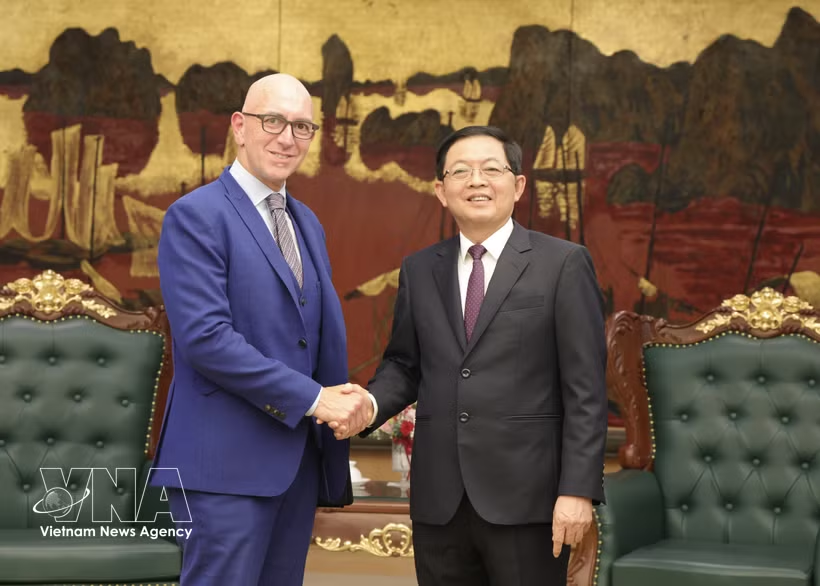
Hanoi (VNA) - Deputy Prime Minister Ho Quoc Dung received Gianluca Pettiti, President and Chief Operating Officer of US-based Thermo Fisher Scientific, in Hanoi on August 12 to discuss Vietnam’s priorities in developing its science, technology and innovation ecosystem.
Dung said the Vietnamese Government identifies science and technology, innovation and digital transformation as key drivers of productivity and competitiveness, as well as rapid growth and sustainable development.
To realise these goals, Vietnam is focusing on strategic technology sectors, including semiconductors, artificial intelligence (AI), biomedical technology and high-tech manufacturing, while prioritising investment projects with high technological content and added value.
In this direction, Vietnam welcomes leading global technology groups such as Thermo Fisher Scientific to engage more deeply in the country’s science and technology ecosystem through investment, research and development, technology transfer and human resources training, as well as cooperation with domestic research institutes, universities and businesses, he stated.
The Deputy PM welcomed Thermo Fisher Scientific’s interest in expanding its presence and exploring long-term investment opportunities in Vietnam, including the development of technology infrastructure, shared laboratory facilities and manufacturing projects in semiconductors and biomedical technology in Hanoi.
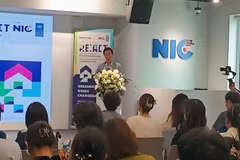
He also highlighted Thermo Fisher Scientific’s cooperation with the National Innovation Centre (NIC) in preparing to organise a forum to discuss partnership with Vietnam to realise the country's ambitions in semiconductors, artificial intelligence and innovation.
As part of the cooperation, the two sides will sign a memorandum of understanding (MoU) to study the establishment of a shared laboratory at the NIC covering semiconductors, materials science, biotechnology and life sciences.
Dung highly valued the experience and insights shared by the Thermo Fisher Scientific president and delegation, particularly those relating to shared laboratory models in Vietnam. He said these represented valuable input and demonstrated the company’s commitment to supporting Vietnam in building and developing a comprehensive science and technology ecosystem.
Against this backdrop, he asked Thermo Fisher Scientific to work closely with the NIC and relevant agencies, universities and research institutes to soon translate the MoU into programmes and projects with clearly defined outcomes. As an immediate priority, the two sides should focus on establishing shared laboratories at the NIC for semiconductors and biomedical technology to directly support research, training, testing and product development.
Affirming that the Vietnamese Government stands ready to support and facilitate cooperation, Dung expressed his hope that Thermo Fisher Scientific will continue expanding its investment and implementing practical and substantive cooperation programmes in Vietnam.
For his part, Gianluca Pettiti expressed his impression of Vietnam’s development and confidence that the country would achieve further progress in innovation. He noted that Vietnam has enjoyed rapid GDP growth, a stable environment, a favourable innovation ecosystem and a forward-looking legal and policy framework.
Regarding cooperation opportunities with Vietnam, Pettiti affirmed that Thermo Fisher Scientific wishes to accompany and support the country in pursuing its development goals, particularly as the group expands its operational network and strengthens investment both in the region and in Vietnam.
He said Thermo Fisher Scientific also hopes to support Vietnam by providing forensic equipment and genetic sequencing technologies that could assist efforts to search for and identify the remains of fallen soldiers.
Founded in 2006 and headquartered in Massachusetts, the United States, Thermo Fisher Scientific had a market capitalisation of 219 billion USD as of August 2026 and employs more than 125,000 people in over 50 countries. Its two main areas of operation are semiconductor technology and advanced biomedical technology.
Following exchanges with the NIC, the group is exploring opportunities to expand its presence and pursue long-term investment in Vietnam, including technology infrastructure, shared laboratory facilities and manufacturing projects in semiconductors and biomedical technology in Hanoi./.
See more
National programme on AI human resources development approved
The programme aims to develop an AI workforce of sufficient scale, structure and quality to meet the requirements of strategic technology sectors, enhance national technological self-reliance, promote innovation and digital transformation, and foster the digital economy and digital society.
VinSpace announces satellite launch contract with SpaceX
VinSpace is responsible for the research, development, manufacturing and on-orbit operation of its satellites. The satellites will support the on-orbit demonstration of in-house developed technologies, strengthen VinSpace's satellite engineering capabilities, and pave the way for future commercial space applications.
Elevating digital infrastructure to drive new era of development
o create new growth momentum for the country in a new development phase, the Politburo's Resolution No. 57-NQ/TW emphasises the need to develop modern digital infrastructure, expand access to high-quality Internet services and build large-scale data centres as the foundation for a national data platform.
Sci-tech set to forge new pillar in Vietnam–Canada ties
The collision of Canada’s technological firepower and Vietnam’s development needs could open the door for highly practical joint projects, said CVSE Chairman Assoc. Prof. Vu Viet Hung.
Sci-tech diplomacy: A new mission for diplomatic sector
The directive by General Secretary and State President Lam reflects a shift in Vietnam’s development mindset, in line with the Politburo’s Resolution 57-NQ/TW dated December 22, 2024 on breakthroughs in sci-tech, innovation and national digital transformation. For the first time, sci-tech has been placed at the very centre as a driver of growth model.
Vietnam, India step up cooperation in research, training, policy advice
VASS and its Indian partners agreed to strengthen links between research institutions, develop joint research programmes, co-publish research, organise international workshops, exchange scholars and share research findings.
Science, technology to become new pillar of Vietnam-Australia ties: expert
The visit to Australia by Party General Secretary and State President To Lam will open a new chapter of cooperation, enabling Vietnamese intellectuals and experts in Australia to contribute more effectively to national development and helping science, technology and innovation become an important driver of the Comprehensive Strategic Partnership.
APIE Camp 2026 connects Vietnamese students with global Internet community
Hosting the APIE Camp marked an important milestone for Vietnam, reflecting regional recognition of the country's capabilities in Internet development and its growing role within the Asia-Pacific Internet community, said a local official.
Youth innovation challenge for sustainable communities launched
Unlike conventional idea-based competitions, RE:ACT focuses on deploying solutions that have already reached the minimum viable product stage through Living Labs – community-based pilot environments where innovations are tested under real-world conditions.
Vietnam approves national programme on strategic technologies
The programme seeks to master, develop, perfect and commercialise highly competitive strategic technology products, with priority given to core technologies. It also aims to build a strategic technology ecosystem and strengthen linkages among the State, businesses and science and technology organisations.
FPT named an OpenAI Select Partner
Under the partnership, FPT and OpenAI will work together to help businesses develop AI transformation roadmaps, build AI platforms, strengthen workforce capabilities and deploy responsible AI solutions tailored to their operational needs.
Vietnam draws hyperscalers, cloud titans, AI players
These developments highlight growing confidence in Vietnam as a destination for hyperscale, cloud, and AI infrastructure. The broader digital infrastructure ecosystem also strengthened during the period.
Da Nang seeks to become a strategic investment destination
Da Nang is accelerating efforts to attract investment and mobilise social resources for new development models, leveraging expanded development space, special policy mechanisms and institutional reforms to position itself as a strategic investment destination and a pioneer in Vietnam's economic growth in the new era.
PM urges stronger coordination in cybersecurity response
PM Le Minh Hung pushed for the Regional Counter Cybercrime Hub for Asia-Pacific to be put into operation in 2027, a “Cybersecurity Economy” initiative to be prepped for APEC 2027, stronger specialised cybersecurity agencies, and an expansion of the national cybersecurity operations centre by the second quarter of 2028.
Israeli expert suggests Vietnam prioritise chip design, talent development
Drawing on Israel’s experience, Mel Shalev said Vietnam should focus on developing talent, scientific research, and chip design capabilities instead of rushing into building fabrication facilities.
Trust emerges as one of modern cybersecurity’s biggest challenges
Speaking at the event, VSEC Chairman Truong Duc Luong said this was the second time BSides has been held in Hanoi, continuing to attract strong interest from the cybersecurity community. BSides Hanoi 2026 was designed as a platform connecting Vietnam’s cybersecurity community with international networks, encouraging knowledge sharing and contributing to the sustainable development of the cybersecurity ecosystem.
Hai Phong promotes int’l cooperation in technology transfer, business innovation
Nguyen Cao Thang, Director of the municipal Department of Science and Technology, said the city is accelerating its development strategy based on science, technology and innovation in line with the Politburo's Resolution No. 57-NQ/TW.
Vietnam positioned to harness AI wave, World Bank report says
The WB report identifies Vietnam as one of the few economies outside the European Union (EU) to have adopted a comprehensive AI regulatory framework as early as 2025. Vietnam applies a risk-tiered approach similar to that of the EU AI Act, imposing different obligations depending on whether an AI system poses “unacceptable,” “high,” “low” or “minimal” risks. The approach is viewed as a strategic step towards ensuring safe and transparent AI governance.
Construction sector advances digital transformation with integrated data ecosystem
As digital transformation becomes a key growth driver, the construction sector has come under increasing pressure to modernise its management model to keep pace with the rapid expansion of transport infrastructure, urbanisation and the real estate market.
Politburo’s Resolution 57-NQ/TW powers new growth momentum
NSO Director Nguyen Thi Huong said alongside foreign investment and the green economy, science – technology, innovation, the digital economy and digital transformation are the new drivers that can can pack a serious second-half punch.