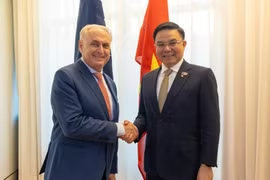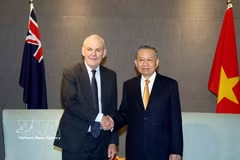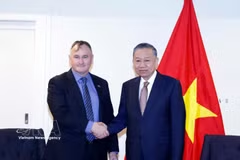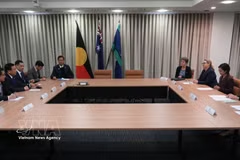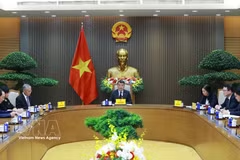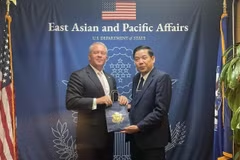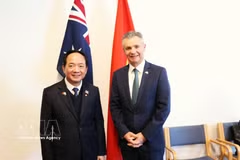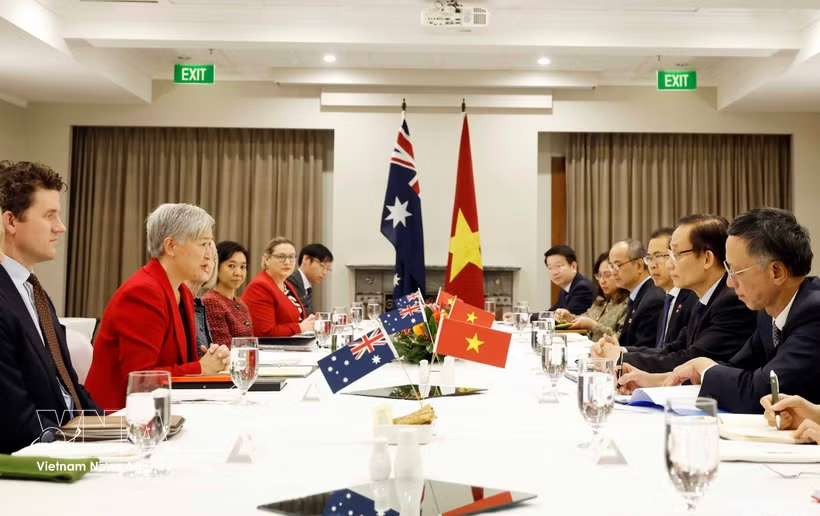
Canberra (VNA) - Vietnam's Minister of Foreign Affairs Le Hoai Trung and his Australian counterpart Penny Wong co-chaired the 8th Vietnam–Australia Foreign Ministers’ Meeting (FMM-8) in Canberra on August 12.
The two sides held extensive discussions on bilateral ties and regional and international issues of shared concern.
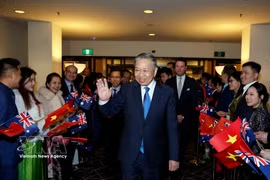
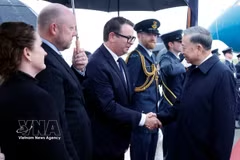
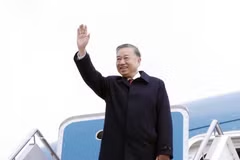
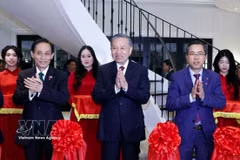
They welcomed the organisation of FMM-8 as part of General Secretary of the Communist Party of Vietnam Central Committee and President To Lam's state visit to Australia, which has generated important outcomes, including the adoption of three joint statements, reflecting deep strategic trust, converging interests and shared visions between the two countries.
The ministers welcomed the effective implementation of the Action Plan to implement Vietnam–Australia Comprehensive Strategic Partnership for 2024–2027, with significant progress across all six pillars.
Defence and security ties have been deepened while two-way trade has doubled over the past five years, exceeding 14 billion USD in 2025. Cooperation in education and training, development, science and technology, innovation and people-to-people exchanges has also continued to expand, they noted.
Trung stressed the need to translate high-level commitments and orientations into tangible outcomes at an early date. He proposed that the two foreign ministries further strengthen their role as focal points in reviewing implementation progress, identifying priorities, hastening delivery and addressing obstacles.
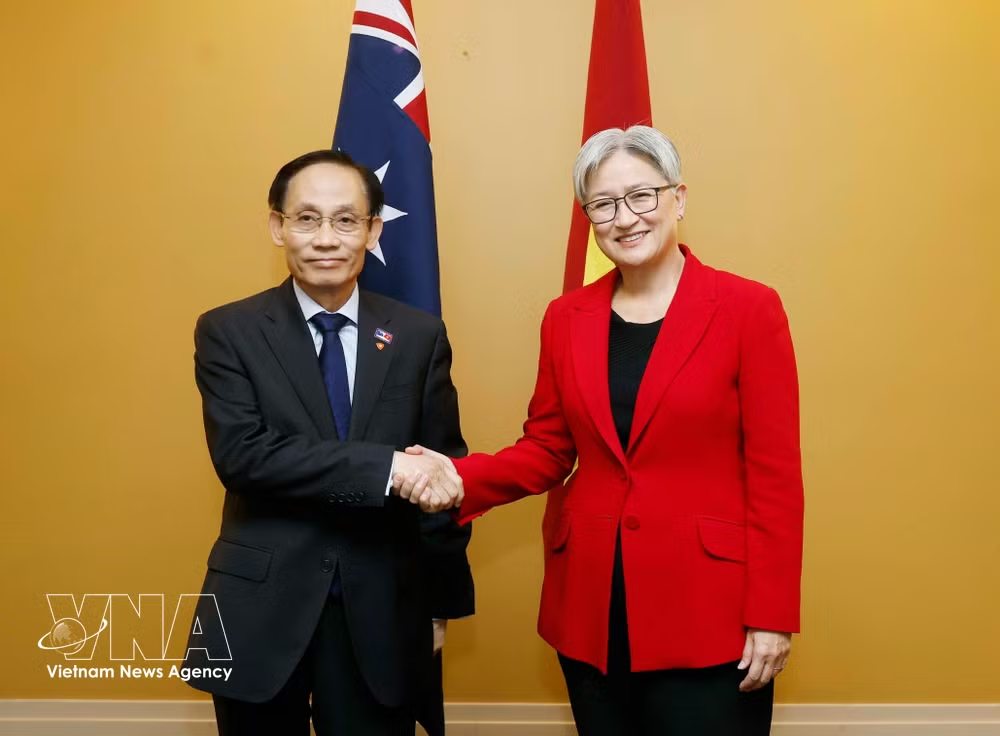
Wong affirmed that Australia attaches great importance to its Comprehensive Strategic Partnership with Vietnam and highly values the substantive progress in bilateral relations, expressing her country's wish to work with Vietnam to make better use of the complementary strengths of the two economies, deepen defence and security cooperation, and expand collaboration into new areas, particularly supply-chain connectivity, high-quality investment, the green and digital economies, new energy, future industries and innovation ecosystem linkages.
On regional and international issues, the two ministers shared the view that it is important to build an open, inclusive, transparent and rules-based regional architecture in which all countries have the opportunity to contribute to peace, stability and prosperity.
They underscored ASEAN’s central role and agreed to strengthen coordination at ASEAN, the United Nations (UN), the Asia-Pacific Economic Cooperation (APEC) forum and other multilateral mechanisms.
Wong affirmed Australia’s strong commitment to Southeast Asia and ASEAN centrality, while recognising Vietnam’s increasingly important role in ASEAN and regional mechanisms. She expressed support for Vietnam’s successful hosting of APEC 2027, contributing to stronger economic cooperation, sustainable growth and regional connectivity.
Regarding the East Sea, the two sides affirmed the importance of maintaining peace, stability, security, safety and freedom of navigation and overflight, and settling disputes and differences on the basis of respect for international law, including the 1982 United Nations Convention on the Law of the Sea (UNCLOS).
On the occasion, the Vietnamese FM held a working session with the Australian Department of Foreign Affairs and Trade to exchange experience in applying artificial intelligence (AI) to diplomatic work.
He said Vietnam is entering an important stage of development, pursuing a new development model with the determination to become a developed country by 2045.
In this context, foreign affairs are assuming an increasingly strategic and regular role in mobilising and creating resources for national development, with development-oriented diplomacy identified as a key priority of the diplomatic sector.
He expressed his hope that Australia will continue to share experience and support Vietnam’s Ministry of Foreign Affairs in strengthening personnel capacity, towards building a professional, comprehensive and modern diplomatic service.
Trung noted that AI is driving profound changes in the economy, society, governance and international relations. In diplomacy, AI presents opportunities to enhance policy analysis, strategic forecasting and public services, while also posing new challenges.
He proposed that Australia share experience in developing AI governance frameworks, applying AI to foreign-policy formulation and diplomatic activities, strengthening diplomats’ digital capabilities, and promoting the safe, secure and responsible use of AI.
At the working session, the Australian department announced its provision of three PhD scholarships in AI for Vietnam’s Ministry of Foreign Affairs.
The two sides agreed to step up policy exchanges, training and cooperation among relevant agencies, while exploring the inclusion of AI as a regular topic of discussion within the FMM framework and other cooperation mechanisms between the two ministries./.