Ministries to complete apparatus restructuring tied to decentralisation in October

Regarding institutional reform, ministries and ministry-level agencies are tasked with speeding up the review and issuance of legal documents to thoroughly and promptly remove institutional bottlenecks for localities.

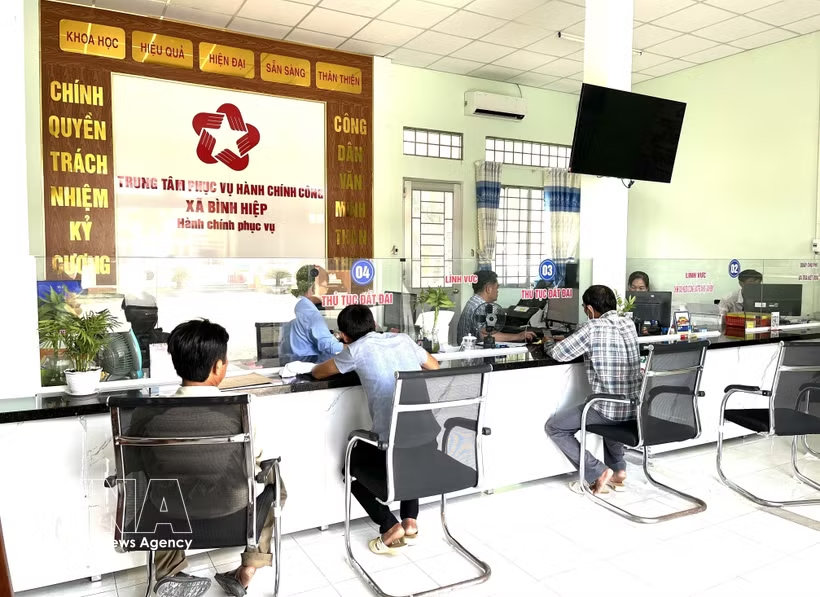
Binh Hiep commune's Public Administration Service Centre in Tay Ninh province has been upgraded to better serve local residents. (Photo: VNA)

Hanoi (VNA) – Ministries and ministry-level agencies are required to complete the restructuring of their apparatus in tandem with the decentralisation and delegation of authority in October 2026 under a recently released Government action plan.

The Government has issued Resolution No. 221/NQ-CP promulgating its action plan for implementing Conclusion No. 76-KL/TW, dated July 28, 2026, of the 14th Party Central Committee on further perfecting and efficiently operating the overall organisational model of the political system and the two-tier local administration model.

The plan sets a series of tasks and measures, including fine-tuning institutional frameworks; promoting decentralisation and delegation of authority alongside adequate resources, power controls and streamlined administrative procedures; restructuring the internal apparatus of ministries, ministry-level agencies and public service units; improving the quality of officials, civil servants and public employees, particularly at the commune level; and accelerating digital transformation and data connectivity.

Others include considering the establishment of special economic zones to create new development space, and exploring a model of commune-level administrative units serving as the nuclei; reviewing and refining the criteria, standards, and economic-technical norms to ensure adequate resources for commune-level administrations; and efficiently handling public offices, assets and documents following the restructuring.

Regarding institutional reform, ministries and ministry-level agencies are tasked with speeding up the review and issuance of legal documents to thoroughly and promptly remove institutional bottlenecks for localities. Power decentralisation must be substantive and accompanied by sufficient personnel, funding, data, digital infrastructure, professional guidance, implementation tools and post-restructuring inspection mechanisms, following the principle of “localities decide, localities implement and localities take responsibility.”

The focus will be given to addressing overlapping regulations, as well as those with unclear responsibilities or that are no longer suited to the new model. This includes ensuring that each task has one lead agency and one primary point of bearing responsibility, supported by a shared data source, an integrated coordination process, and a mechanism for inspection and supervision.

The Ministry of Home Affairs, in coordination with the Ministry of Justice and relevant ministries, will amend or propose amendments to the regulations concerning apparatus structures, with completion required in October 2026. It will also work with other ministries, agencies and localities to review and improve regulations on encouraging and protecting officials who demonstrate innovation, creativity and willingness to take responsibility for the common interest.

The Ministry of Finance is tasked with updating regulations on mechanisms, norms and criteria for allocating budgets to the commune-level administrative units, as well as guiding the decentralisation of power in the management of public assets and infrastructure facilities following restructuring.

Meanwhile, the Ministry of Education and Training will reorganise public higher education institutions, including transferring multidisciplinary institutions to the ministry or local authorities for management, and merging institutions located in the same locality, to reduce the number of public higher education institutions by at least 20% before April 1, 2027. Public vocational and continuing education institutions will also be reorganised, with the number to be reduced by at least 30% before October 1 this year.

The Ministry of Health will reorganise hospitals and higher education institutions under its management, and streamline forensic and psychiatric assessment units. It will also complete the model for commune-level health stations, ensure adequate medical personnel and equipment, develop electronic health records on VNeID, and connect health data from the commune to provincial levels, with completion expected by this October.

The plan also calls for continued restructuring of public service units and educational and healthcare facilities at the local level, with relevant ministries and provincial-level administrations responsible for completing specified tasks in accordance with the set deadlines./.

VNA

See more

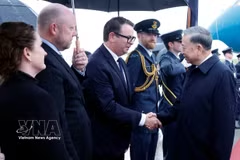
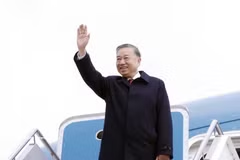
New Zealand officials welcome Party General Secretary and President To Lam (R) at Auckland International Airport. (Photo: VNA)

Party General Secretary and President To Lam begins state visit to New Zealand

Over more than five decades since the establishment of diplomatic relations on June 19, 1975, Vietnam and New Zealand have continuously worked to build a solid foundation for the bilateral ties. The two countries are expanding cooperation in smart agriculture, climate change adaptation and carbon markets in line with Vietnam’s green growth objectives.

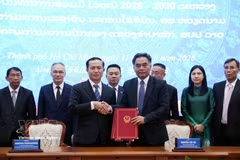
Standing Vice Chairman of the Ho Chi Minh City People’s Committee Nguyen Loc Ha (R) and Vice Chairman of the Champasak provincial Administrative Committee Phimpone Phandanuvong sign an MoU on cooperation between the two localities for the 2026-2030 period. (Photo: VNA)

Ho Chi Minh City-Champasak cooperation: A bright spot in Vietnam-Laos local ties

Cooperation priorities for the 2026-2030 period will cover trade, investment, agriculture, tourism, finance, education and human resources training, and socio-cultural affairs, with a focus on business connectivity, trade and investment promotion, tourism development, and support for education and human resources training.

General Secretary of the Communist Party of Vietnam (CPV) Central Committee and President To Lam (right) meets with Craig Bradshaw, CEO of EQ Resources Limited of Australia. (Photo: VNA)

Top Vietnamese leader highlights strategic mineral, high-tech cooperation with Australian firms

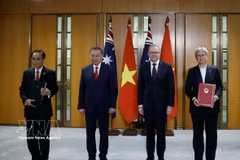
General Secretary of the Communist Party of Vietnam (CPV) Central Committee and President To Lam received leaders of Australian businesses in Canberra on August 12 morning (local time), highlighting opportunities to expand cooperation in strategic mineral supply chains, high technology and innovation as the Comprehensive Strategic Partnership between the two nations enters a new phase.

Dr Nguyen Thi Lan, Chairwoman of the Vietnamese Association in Chongqing and Sichuan (Photo published by VNA)

New impetus for overseas Vietnamese communities

On August 2, 2026, General Secretary of the Central Committee of the Communist Party of Vietnam and President To Lam signed the resolution, marking an important shift after more than two decades of implementing Politburo Resolution No. 36-NQ/TW. It affirms that the overseas group is an inseparable part of the nation and one of the country’s important strategic resources, contributing to strengthening national collective power.

Prime Minister Le Minh Hung (centre) holds high-level phone talks with his Dutch counterpart Rob Jetten on August 11. (Photo: VNA)

Vietnam, Netherlands to deepen cooperation, elevate Comprehensive Partnership

Congratulating the Netherlands on its achievements in socio-economic development and foreign affairs, PM Hung thanked the country for considering Vietnam as one of its leading strategic partners in the region under its new foreign policy. He affirmed that Vietnam attaches importance to and wants to further deepen its multifaceted cooperation with the Netherlands.

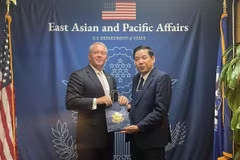
Deputy Minister of National Defence Sen. Lt. Gen. Nguyen Van Gau (right) and US Assistant Secretary of State for East Asian and Pacific Affairs Michael George DeSombre at their meeting on August 10 (Photo published by VNA)

Vietnam, US step up cooperation in search for missing Vietnamese soldiers

A Vietnamese official proposed that the US continue increasing resources for dioxin remediation at Bien Hoa and Phu Cat airbases, expand projects supporting people with disabilities, enhance the sharing of historical data, provide DNA technology assistance and continue close coordination in the search for missing US service members and Vietnamese soldiers.

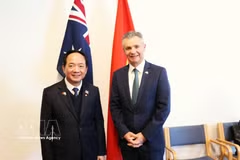
Trinh Van Quyet (left), member of the Political Bureau of the Communist Party of Vietnam (CPV) Central Committee, Secretary of the CPV Central Committee and Chairman of its Commission for Publicity, and Australian Assistant Minister for Foreign Affairs and Trade Matt Thistlethwaite at their meeting in Canberra on August 11, 2026 (Photo: VNA)

Vietnam, Australia seek to forge stronger bonds

The two sides highlighted the progress in the Vietnam–Australia Comprehensive Strategic Partnership and discussed measures to boost cooperation in areas with considerable potential, including communications, digital trade, cybersecurity, education and people-to-people exchanges.

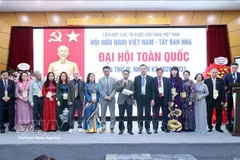
The executive board of the Vietnam–Spain Friendship Association for the 2026–2031 term makes debut at the congress. (Photo: VNA)

Vietnam–Spain Friendship Association looks to strengthen people-to-people ties

Nguyen Duc Loi, President of the Vietnam–Spain Friendship Association for the 2021–2026 term, said Vietnam–Spain relations have continued to develop positively across various fields, with political ties increasingly strengthened and cooperation in trade, education, culture, tourism, and people-to-people exchanges.