Stronger decentralisation for megacities must go with tighter power controls: Lawmakers

Most deputies welcomed the draft law’s reform-oriented approach and a number of breakthrough policies, including greater decentralisation in organisational arrangements, staffing management and policy implementation.

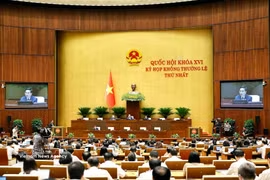
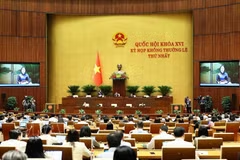
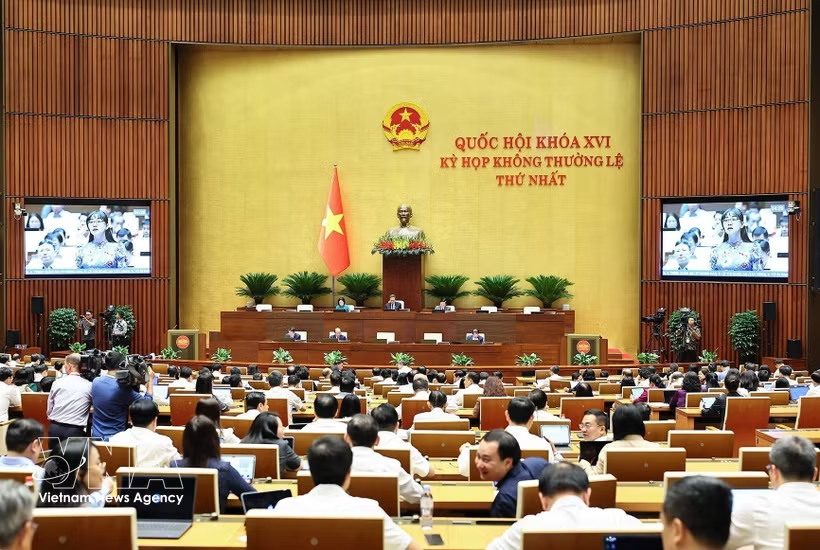
An overview of the discussion (Photo: VNA)

Hanoi (VNA) - Lawmakers on August 11 discussed in plenary the draft Law on Urban Development, welcoming the bill’s stronger decentralisation and delegation of powers while stressing that greater powers must be matched by tighter oversight.

They said this will provide a robust and flexible legal framework for developing modern, smart, green and sustainable Vietnamese cities with stronger international competitiveness.

Greater powers to unlock development potential

Most deputies welcomed the draft law’s reform-oriented approach and a number of breakthrough policies, including greater decentralisation in organisational arrangements, staffing management and policy implementation.

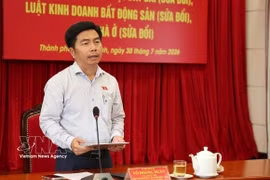
Discussing greater autonomy for special urban administrations, deputy Nguyen Ngoc Son of Hai Phong city proposed that the law clearly regulate the solicitation and handling of opinions from the Government or Prime Minister on matters involving national and inter-regional planning and infrastructure before a city approves its plans.

He also called for clearer rules on the scope of regulations that a municipal People’s Committee can temporarily suspend. Where such measures differ from laws or resolutions of the National Assembly, they must follow mechanisms specifically authorised by the legislature, avoiding a “grey area” between technological experimentation and legal policy pilots.

Deputy Trinh Xuan An of Dong Nai also stressed that comprehensive decentralisation must go hand in hand with power controls and a stronger role for People’s Councils. He said the authority and responsibility of leaders must be tied to oversight, openness and transparency.

According to An, the draft law assigns more than 150 powers to People’s Councils, giving them considerable room to decide local policies. Decentralisation, he said, should not merely mean transferring powers from central authorities to municipal People’s Committees and their chairpersons. People’s Councils must fully exercise their role as elected institutions responsible for policymaking and overseeing local administrations.

An proposed three levels of oversight: before decisions are made, during implementation, and through post-implementation evaluation and accountability. He also called for stronger capacity among People’s Council committees and full-time deputies, alongside clearer boundaries between powers that may depart from general laws and the corresponding oversight mechanisms.

Stronger decentralisation, tighter oversight

Deputy Nguyen Dai Thang of Hung Yen urged the drafting body to clarify the financial responsibility of leaders and the oversight roles of the National Assembly, Government and People’s Councils. He also proposed specific criteria and conditions for other cities to apply the mechanisms under the law, preventing “ask-give” mechanisms or premature application.

Thang supported greater autonomy in staffing and recruitment policies, particularly in human resources management. He proposed stipulating that funding for such policies must come from local budgets, without using central budget funds or altering general policies applicable to civil servants and public employees.

Regarding controlled pilot mechanisms, Thang called for clearer rules governing their relationship with sector-specific laws, particularly those on land, monetary policy, planning and investment.

On stalled projects, Son proposed that when a stalled project resumes, authorities fully review land-related financial obligations and those arising from project adjustments, ensuring that the State suffers no revenue losses while avoiding the re-establishment of obligations already lawfully fulfilled.

Projects involving large or complex land values, public assets or financial obligations should also undergo inter-agency appraisal before decisions are made. Son suggested considering a deadline of December 31, 2026, arguing that extending the mechanism for up to 10 years could weaken its urgency and encourage a wait-and-see mentality./.

VNA
See more

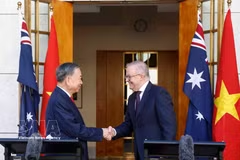
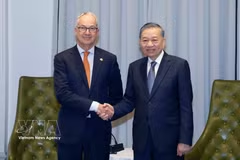
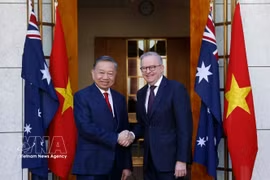
General Secretary of the Communist Party of Vietnam Central Committee and President To Lam (L) shakes hands with Australian Prime Minister Anthony Albanese (Photo: VNA)

Party General Secretary and President To Lam, Australian Prime Minister meet the press

Vietnam and Australia will step up cooperation in artificial intelligence (AI), semiconductors, digital technology, cybersecurity, green technology and emerging technologies, while supporting each other in enhancing capacity to participate more deeply in regional and global supply chains. The two sides will also strengthen cooperation in education and training and people-to-people exchanges.

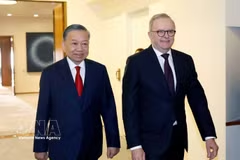
Australian Prime Minister Anthony Albanese (R) welcomes General Secretary of the CPV Central Committee and President To Lam (Photo: VNA)

Top Vietnamese leader holds talks with Australian PM

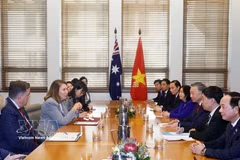
PM Albanese welcomed General Secretary and President Lam and the high-ranking Vietnamese delegation on their state visit to Australia, stressing its signficance amid the rapidly growing ties, particularly since the two countries elevated their ties to a Comprehensive Strategic Partnership in March 2024.

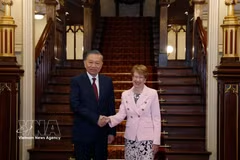
General Secretary of the Communist Party of Vietnam Central Committee and President of Vietnam To Lam meets with President of the Australian Senate Sue Lines and Speaker of the House of Representatives Milton Dick in Canberra on August 11 (Photo: VNA)

Top leader meets with Australian Senate President, House Speaker

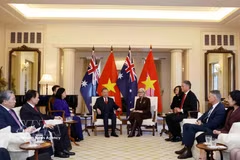
Welcoming General Secretary and President Lam and the Vietnamese high-ranking delegation, the Australian parliamentary leaders spoke highly of Vietnam’s development achievements and expressed their admiration for the dynamism and creativity of the country and its people, particularly young Vietnamese. They said this energy and determination reflected Vietnam’s strong resolve and aspiration to build a prosperous and powerful nation.

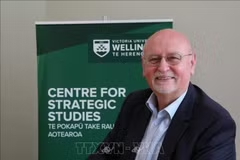
Prof. Emeritus Roberto Rabel, a senior fellow at the Centre for Strategic Studies at Victoria University of Wellington (Photo: VNA)

Top leader’s state visit to give fresh impetus to Vietnam–New Zealand ties: expert

The upcoming state visit by General Secretary of the Communist Party of Vietnam Central Committee and President of Vietnam To Lam to New Zealand is expected to provide fresh momentum for strengthening official cooperation and expanding links among businesses, organisations and communities, said Prof. Emeritus Roberto Rabel, a senior fellow at the Centre for Strategic Studies at Victoria University of Wellington.

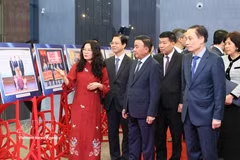
Politburo member and standing member of the Party Central Committee’s Secretariat Tran Cam Tu and delegates visit an exhibition showcasing outstanding images on people-to-people diplomacy activities in 2025. (Photo: VNA)

📝 OP-ED: Foreign policy must serve the national interest

It is no coincidence that Resolution No. 06-NQ/TW identifies foreign affairs as a key, regular task. In a world changing rapidly and marked by uncertainty, any disagreement or shift in relations among major powers can have a direct impact on Vietnam’s development environment.

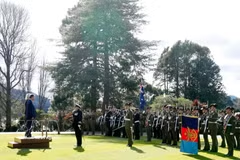
Australian Governor-General Sam Mostyn hosts a welcome ceremony for General Secretary of the Communist Party of Vietnam Central Committee and President To Lam in Canberra on August 11 morning (Photo: VNA)

Australian Governor-General hosts welcome ceremony for top Vietnamese leader

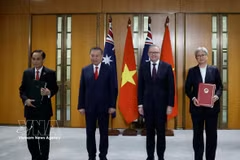
Following the welcome ceremony, General Secretary and President Lam held a meeting with Governor-General Mostyn, and talks with Prime Minister Anthony Albanese. He witnessed the exchange of cooperation documents and met the press. He also had meetings with the President of the Australian Senate and the Speaker of the House of Representatives.

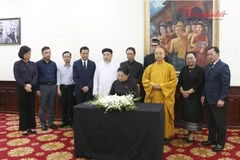
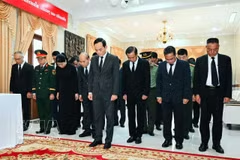
Politburo member and Secretary of the Ho Chi Minh City Party Committee Tran Luu Quang leads a delegation from the city's leadership in paying tribute to President of the National Assembly of Laos Xaysomphone Phonvihane at the Lao Consulate General on August 10, 2026. (Photo: VNA)

Ho Chi Minh City leaders pay tribute to late Lao National Assembly President

The municipal Party Committee, administration, and people has lost a close comrade who paid special attention to preserving the great friendship, special solidarity, comprehensive cooperation, and strategic cohesion between Vietnam and Laos, including the friendship and cooperation between Ho Chi Minh City and Lao localities.

General Secretary of the Central Committee of the Communist Party of Vietnam (CPV) and President To Lam (R) receives Nicholas Moore, Australia’s Special Envoy for Southeast Asia, in Sydney on August 10. (Photo: VNA)

Top leader receives Australian Special Envoy for Southeast Asia

General Secretary of the Central Committee of the Communist Party of Vietnam (CPV) and President To Lam said Vietnam considers Australia one of its leading important partners in the Indo-Pacific region, noting that bilateral relations are facing many new opportunities and the Australia-Vietnam Comprehensive Strategic Partnership should continue to be advanced in an increasingly substantive and effective manner.

Ambassador Nguyen Minh Tam leads the delegation from the Vietnamese Embassy, and other Vietnamese representative agencies, as well as the Vietnamese community in Laos, to pay their respects to President of the Lao National Assembly Xaysomphone Phomvihane (Photo: VNA)

Vietnamese Embassy, community pay tribute to Lao National Assembly President

Writing in the condolence book at the memorial service, Ambassador Nguyen Minh Tam, on behalf of the Vietnamese Embassy, representative agencies, and community in Laos, expressed profound sorrow and conveyed his deepest condolences to the Lao Party, State, National Assembly and people, and the bereaved family.

Vietnamese Ambassador to the Czech Republic Duong Hoai Nam speaks on Resolution No. 23. Photo: VNA

Resolution 23: Four networks connecting OV intellectuals, experts to be established

Overseas Vietnamese are regarded not only as an integral part of the Vietnamese nation but also as an important strategic resource contributing to national strength. They serve as a bridge between Vietnam and the world and participate directly in the cause of national construction, development and defence, according to newly-issued Politburo Resolution No. 23.

General Secretary of the Central Committee of the Communist Party of Vietnam (CPV) and President To Lam (left) and Governor of New South Wales Margaret Beazley at their meeting on August 10. (Photo: VNA)

Top Vietnamese leader meets with Governor of New South Wales

Suggesting that Australia could explore growing Vietnamese coffee varieties, General Secretary and President Lam said the two sides should step up cooperation across a wide range of areas, particularly high-tech agriculture, biotechnology, agricultural processing, trade and investment.

General Secretary of the Communist Party of Vietnam Central Committee and President To Lam (right) receives prominent Vietnamese intellectuals and scientists who are members of the Vietnam-Australia Scholars & Experts Association (VASEA) in Sydney on August 10. (Photo: VNA)

Top leader receives Vietnamese intellectuals, scientists in Australia

General Secretary of the Communist Party of Vietnam Central Committee and President To Lam urged Vietnamese intellectuals and scientists in Australia to further strengthen great national unity, promote Vietnamese cultural values, mentor younger generations and Vietnamese students studying in Australia, and help foster closer community ties.