Hanoi (VNA) – With energy demand forecast to rise sharply as Vietnam targets double-digit economic growth in the new era, finalising the policy and institutional framework is crucial to enabling a breakthrough in the energy sector and ensuring sufficient supply for growth.
Policy bottlenecks hamper energy development
Speaking at a forum on policy perfection to build competitive advantages for energy development held by the Vietnam Economic Times on August 11, Dao Quang Binh, Secretary General of the Vietnam Economic Association and deputy head of the magazine's editorial council, said the development history of many countries shows that breakthrough growth is often accompanied by strong institutional reforms.
For Vietnam, he said, improving policies to enhance the energy sector’s competitiveness is not only about addressing immediate needs but also preparing for a new development cycle featuring fast, green and prosperous growth.
By 2030, energy demand in the country is expected to surge, but the sector is facing major challenges, including declining traditional energy supply sources, delayed projects, an incomplete legal framework and inadequate financial mechanisms for large-scale LNG, renewable energy and hydrogen projects.
Dr Nguyen Hung Dung, Vice Chairman and Secretary General of the Vietnam Petroleum Association, identified four major policy bottlenecks.
First, policies remain fragmented as energy projects are subject to the laws on electricity, oil and gas, investment, land, environmental protection and marine resources, along with a number of decrees. Overlapping or inconsistent regulations have also prolonged investment preparation.
For offshore wind projects, although the Government issued Decree No. 272/2026/ND-CP on July 4 regulating offshore wind surveys and development, key mechanisms for power pricing, power purchase agreements, risk sharing and payment guarantees remain lacking. Meanwhile, these are crucial factors considered by international lenders.
Second, energy markets remain underdeveloped. Vietnam’s competitive electricity market currently operates only at certain levels while gas and LNG markets have yet to fully develop. Electricity prices have yet to fully reflect market signals, and slow price adjustments make long-term financial planning difficult for investors.
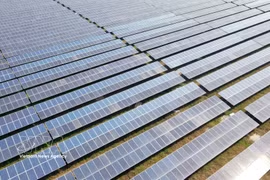
Third, transmission infrastructure has not kept pace with power generation expansion. During the solar and wind power boom, some completed projects were unable to operate at full capacity due to grid congestion, causing losses for investors and reducing the efficiency of resource use.
Fourth, Dung said, policies for emerging energy sectors remain inadequate. Hydrogen, carbon capture, utilisation and storage (CCUS), sustainable aviation fuel (SAF) and carbon credits still lack sufficient technical standards, investment incentives, pricing mechanisms and consumer markets, making businesses and financial institutions hesitant to invest.
He also stressed the need to strengthen strategic energy reserves, diversify supply sources and build a resilient energy market amid complex geopolitical developments.
Synchronising policies
To make energy a true driver of national development, Dung proposed creating a stable, integrated and predictable institutional framework, adding it is necessary to review investment regulations to ensure consistency among relevant laws and streamline procedures.

Vietnam should also develop competitive energy markets under State regulation, with mechanisms promptly issued for electricity pricing, gas and LNG markets, long-term power purchase agreements, risk sharing, carbon credits and green finance to attract private and foreign investment, he said.
An energy industry ecosystem is also essential, he went on, adding that the country should devise incentives for domestic businesses to engage more deeply in the value chains of offshore wind power, LNG, hydrogen and new energy soures, thereby raising domestically generated value and enhancing the economy's competitiveness.
Country Representative of the Global Green Growth Institute (GGGI) Juhern Kim called for comprehensive energy and digital infrastructure planning that links AI and data-centre development with power supply and grid capacity.
Phan Duc Hieu, a standing member of the National Assembly’s Committee for Economic and Financial Affairs, said the draft revised Oil and Gas Law is being fine-tuned based on lawmakers’ opinions. The draft is expected to strengthen decentralisation, cut administrative procedures, introduce stronger investment incentives and promote domestic oil and gas services.
Vu Yen Hang, Chairwoman of Minh Triet Capital SJC, said these reforms are necessary but not sufficient as international investors also require implementation transparency, policy predictability and consistency among relevant laws.
The revised Oil and Gas Law 2026 is expected to be passed on August 23 at the first extraordinary session of the 16th National Assembly./.