Vietnam sets new State ownership thresholds, accelerates SOE restructuring

The Prime Minister’s Decision 40/2026/QĐ-TTg, effective August 5, establishes three main State ownership thresholds: 100%, at least 65% and above 50% to below 65%, depending on the strategic importance of each industry and enterprise to the economy.

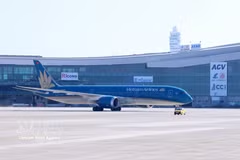
Construction at Long Thanh International Airport, developed by the Airports Corporation of Vietnam, is accelerating. The State can retain at least 65% in sectors including airport management and operation, air transport. (Photo: VNA)

Hanoi (VNS/VNA) - Vietnam is accelerating the restructuring of State capital in State-owned enterprises (SOEs), with a new framework setting different ownership thresholds by industry and requiring plans for the 2026-30 period to be completed this month.

The Prime Minister’s Decision 40/2026/QĐ-TTg, effective August 5, establishes three main State ownership thresholds: 100%, at least 65% and above 50% to below 65%, depending on the strategic importance of each industry and enterprise to the economy.

This framework is designed to concentrate State capital in essential sectors, while creating more room for restructuring or divestment and for private sector participation in areas where State ownership can be reduced or withdrawn.

Under the decision, the State will retain 100% ownership in enterprises involved in essential public services, natural monopolies, high technology, science and technology, innovation and digital transformation, as well as major national infrastructure projects in transport, irrigation, energy and digital infrastructure.

The State can retain at least 65% ownership in other key sectors, including airport management and operation, air transport, operation of special seaports, large-scale mineral extraction, finance and banking, mechanical engineering and clean water supply and drainage.

A lower threshold of more than 50% but less than 65% applies to enterprises in areas considered important to major economic balance such as national telecommunications infrastructure and mineral exploration and reserve assessment.

For enterprises outside the sectors listed above, the State may still retain stakes based on their importance, such as cement producers with a market share of at least 30% that operate raw-material mines in areas considered crucial for national defence and security.

This also includes other providers of public utility products and services whose public service revenue accounts for at least 50% of total revenue for three consecutive years, and enterprises with cultural, historical or architectural value, national brands or having an important role in national defence and security.

For multi-sector enterprises, the applicable ownership threshold will be determined by the sector accounting for the largest share of total output or revenue over the three consecutive years preceding approval of the five-year restructuring plan.

The new rules could affect a number of major SOEs.

According to Mirae Asset Securities, Petrolimex could be among the companies most directly affected. Fuel importers with a market share of at least 30% fall into the group where State ownership can range from above 50% to below 65%. The State currently holds about 75.8% of Petrolimex, meaning it would have to relinquish a stake of around 11%.

Mirae Asset also identified Petrovietnam Fertiliser and Chemicals Corporation and DAP-Vinachem as companies whose State ownership could be reviewed. Petrovietnam currently holds about 59.5% of fertiliser company Dam Phu My, while Vinachem owns about 64% of DAP-Vinachem.

Airports Corporation of Vietnam (ACV), in which the Ministry of Finance holds 95.4%, could also be under review for potential further divestment, as it only requires State ownership of at least 65%.

BIDV Securities Research (BSC Research) said giving State ownership representatives more discretion will allow greater flexibility in restructuring, transferring or divesting in line with market conditions.

A new wave of State divestment is expected, similar to the 2016-18 period, which would potentially increase the supply of shares on the stock market, BSC said.

Under Decision 40, after excluding Viettel, Vietcombank, VietinBank and BIDV, State ownership representatives are required to propose State capital restructuring plans for 19 major groups and corporations.

These include Petrovietnam, Electricity of Vietnam, Petrolimex, Vietnam National Chemical Group, Vietnam Rubber Group, Vietnam National Coal and Mineral Industries Group, Vietnam Post and Telecommunications Group, Vietnam Airlines, Vietnam Maritime Corporation, Vietnam Railways, Airports Corporation of Vietnam, the State Capital Investment Corporation and Agribank.

The Government is moving quickly to implement the framework.

Under an official Government dispatch dated August 7, ministries, agencies and local authorities must approve five-year State capital restructuring plans by August 31.

SOEs, except Viettel, BIDV, VietinBank and Vietcombank, must submit proposals to the Ministry of Finance by August 12.

The Ministry of Finance is required to report on the restructuring of State capital in SOEs to the Prime Minister by August 25, with a nationwide progress report due in the fourth quarter.

The Government has also called for mergers, consolidation and transfers of enterprises where appropriate to improve economies of scale and strengthen the overall performance of economic sectors.

It has ordered the restructuring of the State Capital Investment Corporation to be accelerated, including the establishment of an independent monitoring mechanism for the transfer and management of its holdings./.

VNA
See more

A road in Ho Chi Minh City. (Photo: VNA)

Ho Chi Minh City to integrate IoT into smart transport infrastructure

To promote IoT application in smart transport, the Ho Chi Minh City People's Committee Chairman has assigned the Department of Construction to lead the deployment of IoT in the construction, management, operation and maintenance of transport infrastructure. The department will also review and propose integrating IoT sensors and smart monitoring devices into transport construction, renovation and upgrading projects across the city.

Online promotion of lychee and other key agricultural and OCOP products from Bac Ninh province. (Photo: VNA)

Vietnam tightening e-commerce management

Amid the rapid expansion of online commerce, closely linked to consumption, exports, logistics, electronic payments and the digital economy, the legislation is expected to shape the sector’s sustainable future while ensuring a balance between State management, consumer rights and business interests.

At the 19th Ho Chi Minh City International Travel Expo (ITE HCMC 2025) (Photo: VNA)

ITE HCMC 2026 to connect Vietnam's tourism with the world

From its early editions in 2005-2010, which attracted around 210 exhibitors and 120 international buyers from 18 countries, ITE HCMC has grown significantly. This year's event is expected to feature more than 520 exhibitors and brands, 260 international buyers from over 40 countries and territories, and more than 21,000 pre-arranged B2B appointments.

Checking tickets before passengers board the train at Hai Phong Station. (Photo: VNA)

Vietnam-China rail link prioritised to boost trade

The Ministry of Construction said it has tasked the Vietnam Railway Authority with working alongside relevant Chinese agencies to develop detailed plans for the Hai Phong–Ha Long–Mong Cai railway, which is slated for completion in 2026.

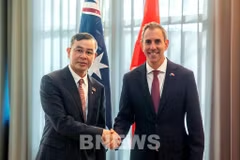
Australian Treasurer Jim Chalmers (right) and Vietnamese Minister of Finance Ngo Van Tuan at their meeting in Sydney on August 11 (Photo: Ministry of Finance)

Vietnam, Australia strengthen all-round financial cooperation

Minister of Finance Ngo Van Tuan called on the Australian Government to continue providing official development assistance (ODA), particularly for climate-resilient infrastructure projects, share experience, and provide technical assistance in public financial management reforms.

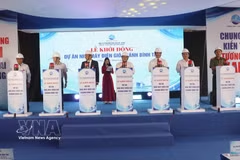
Delegates press the button to launch the project. (Photo: VNA)

Ca Mau launches 96 million USD wind power project

The project which has a designed capacity of 50MW, will cover around 600ha of sea and land areas, with total investment estimated at 2.5 trillion VND (96 million USD). It comprises a 13km 110kV transmission line, a 63MVA step-up substation, medium-voltage underground cable systems, and wind turbines and their foundations.

A Vietnam Airlines aircraft. (Photo: VNA)

Vietnam Airlines marks 35,000th flight to Australia

Over 35 years of operations, Vietnam Airlines has operated 35,000 flights and carried 7.5 million passengers between Vietnam and Australia, reflecting steady market growth and rising demand for connectivity between the two countries.

A view of the press conference. (Photo: VNA)

2026 Banking Sector Digital Transformation to open in Hanoi

The annual event, which will be held on August 18-19, 2026, at the ICE International Exhibition Centre, 91 Tran Hung Dao Street, Hanoi, is expected to attract around 324 delegates and feature 21 booths representing credit institutions, payment intermediary service providers, and technology companies.

SME products livestreamed on the digital platform of Ca Mau Radio and Television Station.( Photo: VNA)

Digital transformation key to unlocking SME growth in Vietnam

Science, technology, innovation and digital transformation have become strategic imperatives directly linked to labour productivity, competitiveness, growth quality and the economy's self-reliance, with sci-tech application and innovation by small and medium-sized enterprises (SMEs) playing an important role.

New Zealand apples on sale at a supermarket in Vietnam (Photo: VNA)

Vietnamese consumers develop taste for Australian, New Zealand fruit

According to statistics from the Department of Customs, in the first six months of 2026, Vietnam imported 102.8 million USD worth of fruit, vegetables and flowers from Australia, up 55.7% from the same period last year. Australia's share of total imports rose from 5.5% to 6.51%, highlighting the growing position of the market as a supplier. Imports from New Zealand reached 78.04 million USD, up 20.4% year-on-year.

Semiconductor products, chips and components displayed at a ceremony to launch a national centre for semiconductor chip pilot production support in Hanoi on June 26. (Photo: VNA)

US semiconductor push offers Vietnam opportunities, policy challenges

The Vietnam-US semiconductor partnership is therefore not simply a “golden opportunity” arising from geopolitical shifts, but also a long-term test of Vietnam’s institutional reform and implementation capacity. If domestic capacity cannot keep pace, adjusting targets toward quality and execution, rather than simply expanding the number of projects, will be essential.

Workers process fruit for export at the Chanh Thu factory in Cho Lach commune, Vinh Long province. (Photo: VNA)

Vietnam works to maintain edge in key agricultural market

According to Le Hang, Deputy Secretary-General of the Vietnam Association of Seafood Exporters and Producers (VASEP), China and Hong Kong (China) remained bright spots for Vietnam’s aquatic exports in July, with revenue exceeding 267 million USD, up 24.7% year-on-year.