Ho Chi Minh City to integrate IoT into smart transport infrastructure

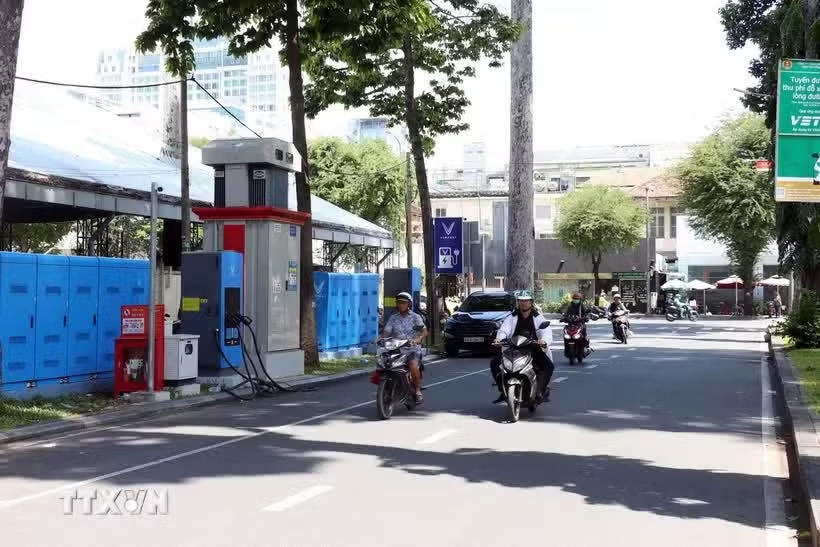
To promote IoT application in smart transport, the Ho Chi Minh City People's Committee Chairman has assigned the Department of Construction to lead the deployment of IoT in the construction, management, operation and maintenance of transport infrastructure. The department will also review and propose integrating IoT sensors and smart monitoring devices into transport construction, renovation and upgrading projects across the city.

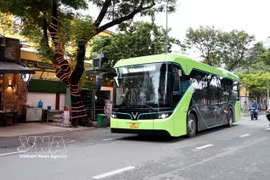
A road in Ho Chi Minh City. (Photo: VNA)

Ho Chi Minh City (VNA) – Ho Chi Minh City will study the integration of Internet of Things (IoT) sensor systems and smart monitoring devices into transport infrastructure projects, while applying IoT in maintaining traffic order and safety, as well as preventing, detecting and handling traffic violations.

To promote IoT application in smart transport, the municipal People's Committee Chairman has assigned the Department of Construction to lead the deployment of IoT in the construction, management, operation and maintenance of transport infrastructure. The department will also review and propose integrating IoT sensors and smart monitoring devices into transport construction, renovation and upgrading projects across the city.

The city will also focus on researching, testing and mastering technologies for smart transport. The Department of Science and Technology will advise the municipal People's Committee on research, testing, innovation and assessment of IoT technologies for smart transport, as well as manage and guide the implementation of scientific and technological tasks and pilot projects involving IoT, artificial intelligence (AI) and big data in urban transport.

The department will also coordinate with businesses, research institutes and universities to support research and development, technology mastery and the localisation of IoT equipment and platforms, while participating in the assessment of technologies, technical standards and the effectiveness of IoT application in smart transport.

To ensure sufficient resources for implementation, the Department of Finance will coordinate with relevant agencies to develop mechanisms for mobilising social resources, public-private partnerships (PPP), sponsorships and aid for transport IoT projects. It will also study and issue detailed guidance on local budget spending for the periodic maintenance and repair of on-site IoT devices after they are handed over to commune-level People's Committees for management.

Meanwhile, the Ho Chi Minh City police will lead the application of IoT in maintaining traffic order and safety, preventing, detecting and handling traffic violations. It will also establish coordination mechanisms between specialised agencies and local authorities to receive and process traffic information and incidents, including congestion, accidents and violations, detected by IoT systems.

They will coordinate in the sharing and use of IoT data from cameras, sensors and monitoring systems for State management and maintaining security and order. It will also participate in developing and implementing cybersecurity, information security and personal data protection solutions for the city's transport IoT systems.

Effective use of such data will require data connectivity, sharing and analysis across different systems. Accordingly, the municipal Digital Transformation Centre will coordinate with agencies under the Ministry of Construction to integrate, connect and share data between IoT applications and shared digital platforms and the city's shared data warehouse. It will also lead the deployment of AI and big data applications for smart transport and provide guidance on updating field data in the smart transport system.

At the grassroots level, commune- and ward-level People's Committees and special zones will prioritise and coordinate in the implementation of IT projects that connect IoT-related software and applications in smart transport, including traffic and security cameras and traffic-volume monitoring devices. They will share relevant data with the Department of Construction, municipal police and other agencies.

The integration of IoT into transport infrastructure and connectivity of data from field devices is expected to improve the management, operation and maintenance of infrastructure and gradually complete the city's smart transport system./.
VNA

See more

Online promotion of lychee and other key agricultural and OCOP products from Bac Ninh province. (Photo: VNA)

Vietnam tightening e-commerce management

Amid the rapid expansion of online commerce, closely linked to consumption, exports, logistics, electronic payments and the digital economy, the legislation is expected to shape the sector’s sustainable future while ensuring a balance between State management, consumer rights and business interests.

At the 19th Ho Chi Minh City International Travel Expo (ITE HCMC 2025) (Photo: VNA)

ITE HCMC 2026 to connect Vietnam's tourism with the world

From its early editions in 2005-2010, which attracted around 210 exhibitors and 120 international buyers from 18 countries, ITE HCMC has grown significantly. This year's event is expected to feature more than 520 exhibitors and brands, 260 international buyers from over 40 countries and territories, and more than 21,000 pre-arranged B2B appointments.

Checking tickets before passengers board the train at Hai Phong Station. (Photo: VNA)

Vietnam-China rail link prioritised to boost trade

The Ministry of Construction said it has tasked the Vietnam Railway Authority with working alongside relevant Chinese agencies to develop detailed plans for the Hai Phong–Ha Long–Mong Cai railway, which is slated for completion in 2026.

Australian Treasurer Jim Chalmers (right) and Vietnamese Minister of Finance Ngo Van Tuan at their meeting in Sydney on August 11 (Photo: Ministry of Finance)

Vietnam, Australia strengthen all-round financial cooperation

Minister of Finance Ngo Van Tuan called on the Australian Government to continue providing official development assistance (ODA), particularly for climate-resilient infrastructure projects, share experience, and provide technical assistance in public financial management reforms.

Delegates press the button to launch the project. (Photo: VNA)

Ca Mau launches 96 million USD wind power project

The project which has a designed capacity of 50MW, will cover around 600ha of sea and land areas, with total investment estimated at 2.5 trillion VND (96 million USD). It comprises a 13km 110kV transmission line, a 63MVA step-up substation, medium-voltage underground cable systems, and wind turbines and their foundations.

A Vietnam Airlines aircraft. (Photo: VNA)

Vietnam Airlines marks 35,000th flight to Australia

Over 35 years of operations, Vietnam Airlines has operated 35,000 flights and carried 7.5 million passengers between Vietnam and Australia, reflecting steady market growth and rising demand for connectivity between the two countries.

A view of the press conference. (Photo: VNA)

2026 Banking Sector Digital Transformation to open in Hanoi

The annual event, which will be held on August 18-19, 2026, at the ICE International Exhibition Centre, 91 Tran Hung Dao Street, Hanoi, is expected to attract around 324 delegates and feature 21 booths representing credit institutions, payment intermediary service providers, and technology companies.

SME products livestreamed on the digital platform of Ca Mau Radio and Television Station.( Photo: VNA)

Digital transformation key to unlocking SME growth in Vietnam

Science, technology, innovation and digital transformation have become strategic imperatives directly linked to labour productivity, competitiveness, growth quality and the economy's self-reliance, with sci-tech application and innovation by small and medium-sized enterprises (SMEs) playing an important role.

New Zealand apples on sale at a supermarket in Vietnam (Photo: VNA)

Vietnamese consumers develop taste for Australian, New Zealand fruit

According to statistics from the Department of Customs, in the first six months of 2026, Vietnam imported 102.8 million USD worth of fruit, vegetables and flowers from Australia, up 55.7% from the same period last year. Australia's share of total imports rose from 5.5% to 6.51%, highlighting the growing position of the market as a supplier. Imports from New Zealand reached 78.04 million USD, up 20.4% year-on-year.

Semiconductor products, chips and components displayed at a ceremony to launch a national centre for semiconductor chip pilot production support in Hanoi on June 26. (Photo: VNA)

US semiconductor push offers Vietnam opportunities, policy challenges

The Vietnam-US semiconductor partnership is therefore not simply a “golden opportunity” arising from geopolitical shifts, but also a long-term test of Vietnam’s institutional reform and implementation capacity. If domestic capacity cannot keep pace, adjusting targets toward quality and execution, rather than simply expanding the number of projects, will be essential.

Workers process fruit for export at the Chanh Thu factory in Cho Lach commune, Vinh Long province. (Photo: VNA)

Vietnam works to maintain edge in key agricultural market

According to Le Hang, Deputy Secretary-General of the Vietnam Association of Seafood Exporters and Producers (VASEP), China and Hong Kong (China) remained bright spots for Vietnam’s aquatic exports in July, with revenue exceeding 267 million USD, up 24.7% year-on-year.

An estimated 6,300 workers are needed by the semiconductor industry in Bac Giang province during the 2025-2030 period. (Photo: VNA)

India's semiconductor strategy complementary to Vietnam's chip sector: expert

Sudhanshu Mittal, Director of Engineering Solutions at the National Association of Software and Service Companies (Nasscom) of India, noted that during the state visit to India by General Secretary of the Communist Party of Vietnam Central Committee and President To Lam in May, the two countries signed a number of cooperation agreements, with semiconductors identified as a priority area alongside artificial intelligence (AI), cybersecurity, and advanced technologies.