Vietnam, Australia expect stronger technology, innovation ties following top Vietnamese leader's visit

The two countries have already established a solid foundation for such cooperation, moving from traditional trade and people-to-people exchanges towards knowledge-based, high-tech and sustainable development.

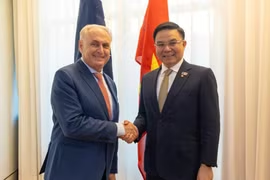
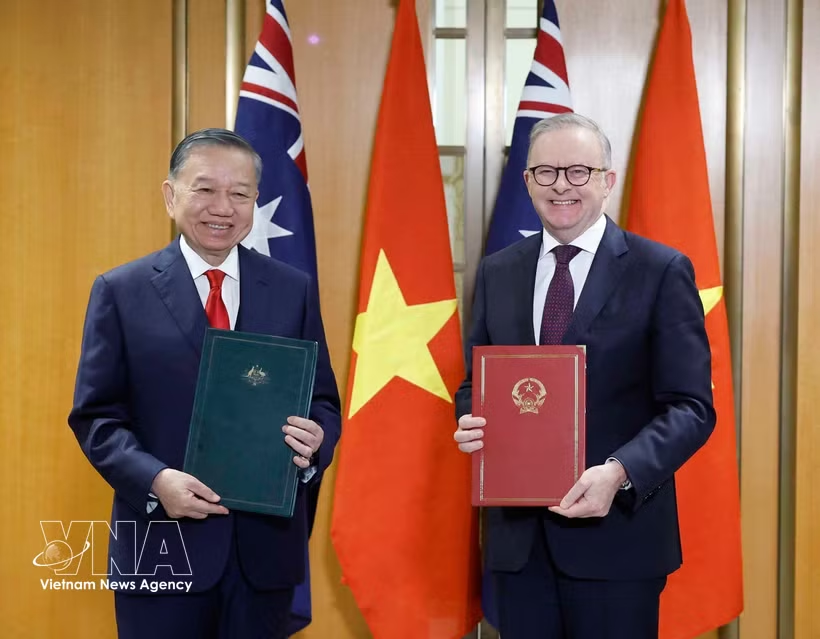
General Secretary of the Communist Party of Vietnam (CPV) Central Committee and President To Lam (left) and Australian Prime Minister Anthony Albanese exchange the Joint Statement. (Photo: VNA)

Hanoi (VNA) – The state visit to Australia by General Secretary of the Communist Party of Vietnam (CPV) Central Committee and President To Lam from August 9-12 has opened a new chapter in Vietnam-Australia cooperation, with the two sides agreeing to make science, technology, innovation and digital transformation key pillars of their Comprehensive Strategic Partnership.

From knowledge sharing to co-creating technology

For Vietnam, advancing science, technology, innovation and high-quality human resources is essential to achieving its goal of becoming a developed, high-income country by 2045. The country has identified knowledge, science, technology, innovation, digital transformation and international integration as major economic growth drivers.

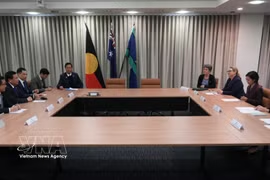
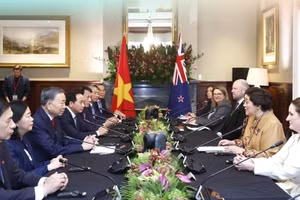
During the talks between General Secretary and President Lam and Australian Prime Minister Anthony Albanese, the two sides agreed to expand cooperation in strategic areas such as artificial intelligence (AI), semiconductors, quantum technology, biotechnology, biomedicine, marine research, critical minerals and green hydrogen; promote joint research; connect universities, research institutes and businesses; and work towards forming a Vietnam-Australia technology ecosystem and promoting high-quality human resources development.

Addressing a forum on science, technology, innovation, education and human resources development, the Vietnamese leader called for stronger cooperation between the two nations to build more resilient supply chains, promote open innovation, share knowledge and jointly train the workforce of the future.

The two countries have already established a solid foundation for such cooperation, moving from traditional trade and people-to-people exchanges towards knowledge-based, high-tech and sustainable development. The Aus4Innovation programme in 2018 - 2028 has helped connect maanagement agencies, research institutes and businesses; while the Australia-Vietnam Strategic Technology Centre has expanded its focus from 5G and 6G to AI, semiconductors, cybersecurity and quantum technology.

In 2026, the Vietnamese Ministry of Science and Technology approved a joint research programme focusing on strategic technologies for 2026-2028.

Minister of Science and Technology Vu Hai Quan proposed the two sides concentrating resources on strategic technologies, including AI, semiconductors, cybersecurity, quantum technology, biotechnology, clean energy and marine technology. He also called for stronger links among investment funds, technology capital, research institutions and businesses so that promising inventions can move from laboratories to the market.

Vietnam and Australia should jointly identify a number of sectors and specific businesses to implement digital transformation and AI application projects, particularly among small- and medium-sized enterprises (SMEs), while developing joint research groups, shared laboratories and programmes that bring scientists and businesses together, Quan said.

Mobilising overseas Vietnamese intellectual resources

The Vietnamese community in Australia - the world's fourth largest of this kind, has made important contributions to the bilateral ties. Vietnamese entrepreneurs, intellectuals, experts and students have increasingly engaged in activities supporting their homeland.

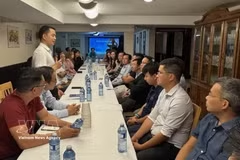
At a meeting with Vietnamese intellectuals and experts in Australia, General Secreatry and President Lam urged them to serve as bridges for technology transfer and developing "new productive forces", particularly in education, AI, semiconductors, high-tech agriculture, renewable energy and strategic minerals. He stressed that cooperation should go beyond technology transfer to sharing scientific mindset and innovation methods, and helping develop high-quality human resources in Vietnam.

Prof. Dr. Chu Hoang Long, Director of the Hub for Vietnam Policy Studies at the Australian National University, said Vietnam should proactively work with the international community to establish governance mechanisms that steer AI development towards serving the common interests of humanity, while minimising its potential negative impacts at both national and global levels. He affirmed his readiness to work with Vietnamese colleagues in this important area.

The Vietnamese intellectual community in Australia proposed long-term mechanisms to mobilise overseas Vietnamese expertise, including attracting scientists and specialists capable of leading major national projects, while connecting Vietnamese intellectuals in Australia with domestic agencies, organisations and businesses.

During the top leader’s visit, the two sides adopted joint statements on deepening their Comprehensive Strategic Partnership, enhancing economic resilience cooperation and strengthening connectivity in science, technology and innovation, while signing a number of cooperation documents.

The trip not only reinforced political trust but also laid foundations for a modern, knowledge- and technology-based cooperation model. With strong political determination of leaders and active engagement by businesses, research institutions and OV intellectuals, Vietnam-Australia ties are expected to achieve new breakthroughs in support of the development aspirations of both countries./.

VNA
See more

Delegates at the opening ceremony of Conviction 2026 (Photo: VNA)

Ho Chi Minh City urged to lead in developing, testing new technology models: Deputy PM

Conviction 2026, a national-level forum on Digital Assets and Artificial Intelligence, which opened in Ho Chi Minh City on August 14, brings together representatives from State management agencies, technology companies, financial institutions, investment funds, experts, research institutes, universities and domestic and international partners, creating opportunities to connect policies, technology, resources and markets, according to Deputy Prime Minister Ho Quoc Dung.

Students at the Ho Chi Minh City University of Technology – Vietnam National University, Ho Chi Minh City, practice applying advanced technologies (Photo: VNA)

Vietnam taps global expertise to develop world-class AI workforce

The network aims to attract global Vietnamese AI talents, strengthen links among research institutions, businesses and experts to form strong research teams and promote commercialisation, while mobilising experts to advise on policies and key national AI programmes and projects.

Vietnam moves to build quantum workforce

Vietnam moves to build quantum workforce

As the country's science, technology and innovation hub, Ho Chi Minh City is now scrambling to build capacity for the quantum age, with workforce development at the centre of its push to seize future opportunities.

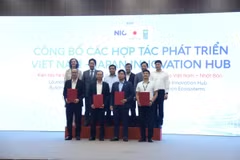
At the Vietnam – Japan Innovation Forum 2026 (Photo: tapchikinhtetaichinh.vn)

Vietnam – Japan Innovation Forum 2026 drives new models

NIC Deputy Director Hoang Trung Hieu shared that Vietnam is working to gradually make science, technology, and innovation its main growth drivers. Along the way, Japan stands out as one of its key partners, bringing strong capabilities in sci-tech, industry, and workforce, along with an extensive network of companies, research institutes, and universities.

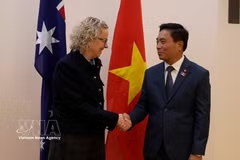
Vice President of the National Assembly Nguyen Doan Anh (R) and Deputy Speaker of the Australian House of Representatives Sharon Claydon (Photo: VNA)

Vietnam, Australia strengthen parliamentary cooperation

the Australian Parliament looks forward to close coordination with the Vietnamese NA at the Inter-Parliamentary Union (IPU) and other multilateral forums, said Deputy Speaker of the Australian House of Representatives Sharon Claydon.

Deputy Prime Minister Ho Quoc Dung (R) receives Gianluca Pettiti, President and Chief Operating Officer of US-based Thermo Fisher Scientific, in Hanoi on August 12 (Photo: VNA)

Vietnam seeks stronger cooperation with US partner in semiconductors, biomedical technology

Vietnam welcomes leading global technology groups such as Thermo Fisher Scientific to engage more deeply in the country’s science and technology ecosystem through investment, research and development, technology transfer and human resources training, as well as cooperation with domestic research institutes, universities and businesses, Deputy Prime Minister Ho Quoc Dung said.

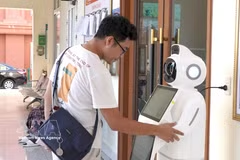
AI-powered robots help ease the workload of civil servants in providing initial consultations, while enabling citizens to become familiar with AI applications in accessing public services. (Photo: VNA)

National programme on AI human resources development approved

The programme aims to develop an AI workforce of sufficient scale, structure and quality to meet the requirements of strategic technology sectors, enhance national technological self-reliance, promote innovation and digital transformation, and foster the digital economy and digital society.

Illustrative image (Source: techgenez.com)

VinSpace announces satellite launch contract with SpaceX

VinSpace is responsible for the research, development, manufacturing and on-orbit operation of its satellites. The satellites will support the on-orbit demonstration of in-house developed technologies, strengthen VinSpace's satellite engineering capabilities, and pave the way for future commercial space applications.

Elevating digital infrastructure to drive new era of development

Elevating digital infrastructure to drive new era of development

o create new growth momentum for the country in a new development phase, the Politburo's Resolution No. 57-NQ/TW emphasises the need to develop modern digital infrastructure, expand access to high-quality Internet services and build large-scale data centres as the foundation for a national data platform.

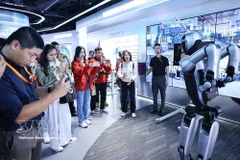
Visitors to UBTECH, a company major in the research and development of humanoid robots (Photo: VNA)

Sci-tech diplomacy: A new mission for diplomatic sector

The directive by General Secretary and State President Lam reflects a shift in Vietnam’s development mindset, in line with the Politburo’s Resolution 57-NQ/TW dated December 22, 2024 on breakthroughs in sci-tech, innovation and national digital transformation. For the first time, sci-tech has been placed at the very centre as a driver of growth model.

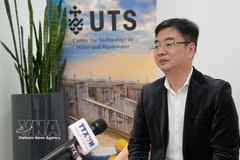
Prof. Nghiem Duc Long from University of Technology Sydney (UTS), who is also Chairman of the Vietnam-Australia Scholars & Experts Association (VASEA) (Photo: VNA)

Science, technology to become new pillar of Vietnam-Australia ties: expert

The visit to Australia by Party General Secretary and State President To Lam will open a new chapter of cooperation, enabling Vietnamese intellectuals and experts in Australia to contribute more effectively to national development and helping science, technology and innovation become an important driver of the Comprehensive Strategic Partnership.

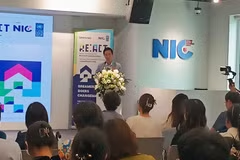
Deputy Director of the Vietnam National Innovation Centre (NIC) Do Tien Thinh speaks at the launch of RE:ACT in Hanoi on August 7. (Photo: NIC)

Youth innovation challenge for sustainable communities launched

Unlike conventional idea-based competitions, RE:ACT focuses on deploying solutions that have already reached the minimum viable product stage through Living Labs – community-based pilot environments where innovations are tested under real-world conditions.

The special national science, technology and innovation programme on strategic technologies targets mastery of at least four strategic technologies for 2026-2030. (Photo: baochinhphu.vn)

Vietnam approves national programme on strategic technologies

The programme seeks to master, develop, perfect and commercialise highly competitive strategic technology products, with priority given to core technologies. It also aims to build a strategic technology ecosystem and strengthen linkages among the State, businesses and science and technology organisations.

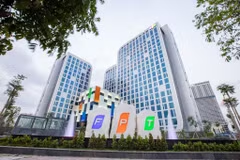
FPT Group headquarters ( Photo courtesy of FPT)

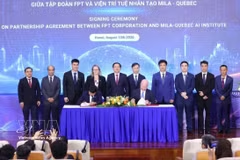
FPT named an OpenAI Select Partner

Under the partnership, FPT and OpenAI will work together to help businesses develop AI transformation roadmaps, build AI platforms, strengthen workforce capabilities and deploy responsible AI solutions tailored to their operational needs.

Dak Lak province's Smart City Monitoring and Operations Centre manages and operates the provincial data centre, as well as shared digital platforms and software systems used across the province. (Photo: VNA)

Vietnam draws hyperscalers, cloud titans, AI players

These developments highlight growing confidence in Vietnam as a destination for hyperscale, cloud, and AI infrastructure. The broader digital infrastructure ecosystem also strengthened during the period.