Vietnam, Australia partner to advance cutting-edge RNA biomedical technology

The two sides aim to pursue joint investment, research, scientific publications, and the development of advanced biomedical products, leveraging the strengths of both research institutes and the two countries.
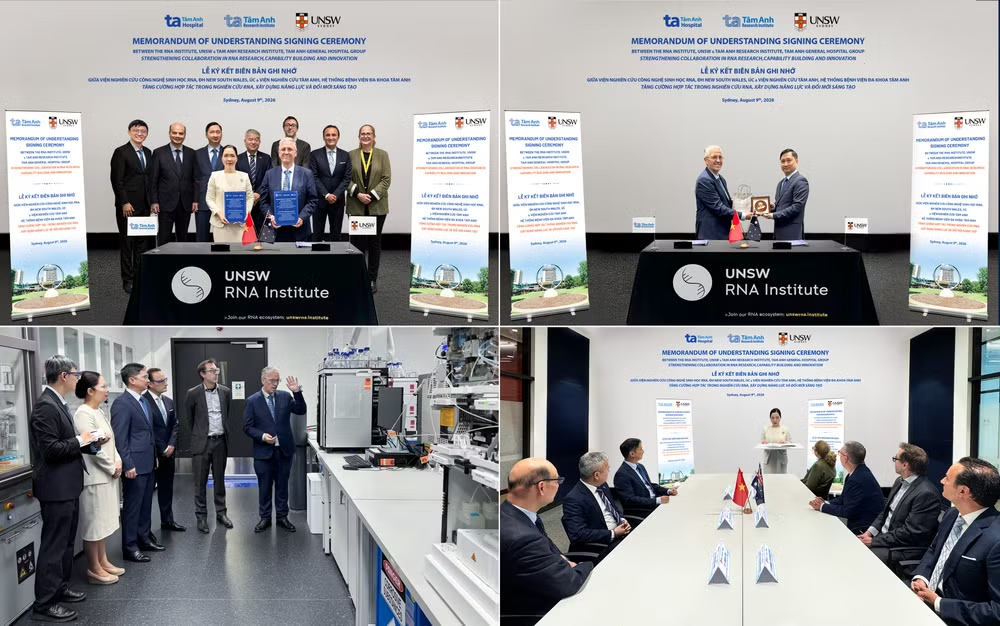
The Tam Anh Research Institute and the UNSW RNA Institute at the University of New South Wales (UNSW), Australia, sign a Memorandum of Understanding (MoU) to develop RNA technology (Photo: Tam Anh Research Institute)

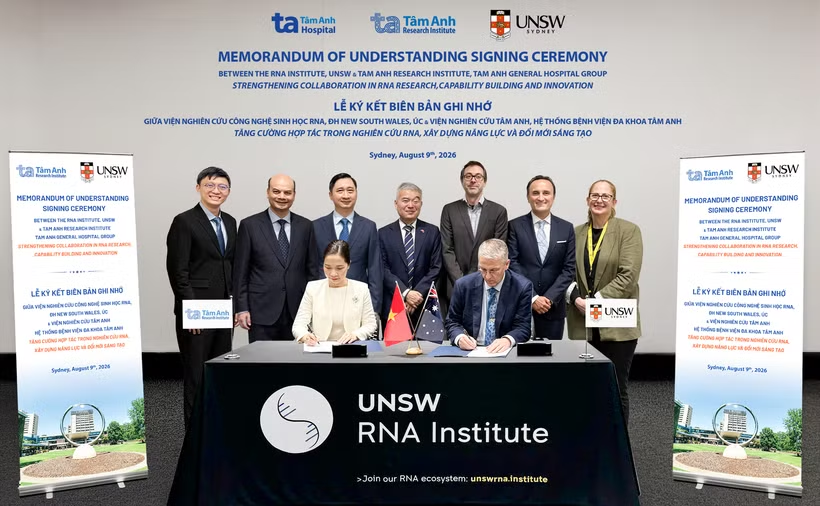
​Hanoi (VNA) - Recently, Tam Anh Research Institute and the UNSW RNA Institute at the University of New South Wales (UNSW), Australia, signed a Memorandum of Understanding (MoU) to develop RNA technology, opening up prospects for next-generation medicines and vaccines for influenza, lung cancer, and colorectal cancer.

​The signing took place at an important time in bilateral cooperation, coinciding with the State Visit of General Secretary and President To Lam to Australia from August 9 to 12, as Vietnam and Australia continue to advance their Comprehensive Strategic Partnership.

The two sides aim to pursue joint investment, research, scientific publications, and the development of advanced biomedical products, leveraging the strengths of both research institutes and the two countries.

tam-anh1.png
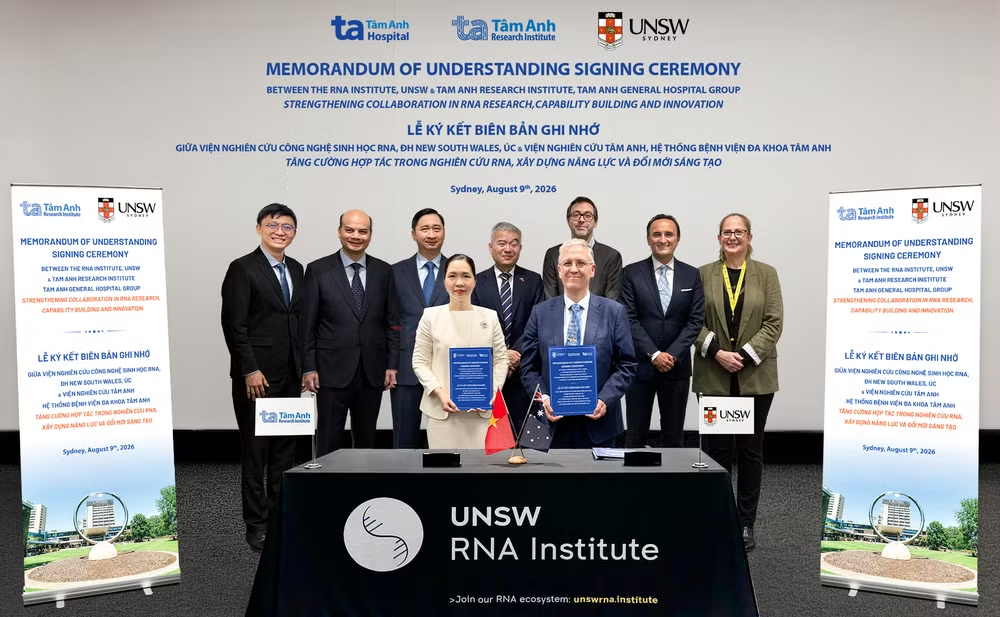
The MoU signing ceremony takes place at the University of New South Wales (UNSW), Australia, in the presence of the Consul General of Vietnam in Sydney. (Photo: Tam Anh Research Institute)

This marks the first time a Vietnamese research institute has established a core biomedical technology partnership with a leading Australian research institute. The RNA Institute is part of the University of New South Wales (UNSW Sydney), a member of the Group of Eight (Go8), a group of Australia’s leading research-intensive universities. According to the QS World University Rankings 2027, UNSW ranks 19th globally and first in Australia.

The institute is currently focusing on the research and development of mRNA vaccines against infectious diseases, such as influenza; and personalized cancer vaccines for lung and colorectal cancer. It also aims to progressively build end-to-end capabilities across the RNA technology chain, which serves as a foundation for many next-generation vaccines, biologics, and therapies.

Speaking at the ceremony, Mr. Nguyen Thanh Tung, Consul General of Vietnam in Sydney, highly appreciated the important scientific partnership between Tam Anh Research Institute and the UNSW RNA Institute, emphasizing the strategic significance of the collaboration at this particular time.

Core RNA technology

RNA (ribonucleic acid) is a biological molecule that plays a role in transmitting genetic information within cells.

If DNA is considered the “blueprint,” RNA acts as the “messenger” that brings the blueprint into production, instructing cells to produce the proteins needed for vital functions. This mechanism makes RNA a technological platform for many next-generation vaccines, biologics, and therapies.

Using the RNA platform, scientists can develop a range of technologies. For example, mRNA is used to develop vaccines and certain therapies; siRNA helps “silence” disease-causing genes; and gRNA supports gene-editing technologies.

As a result, RNA is opening up new therapeutic approaches for cancer, genetic disorders, immune-related diseases, rare diseases, and many other areas of biomedical science.

Professor Pall Thordarson, Director of the UNSW RNA Institute, said Vietnam has an opportunity to become an important driving force behind the RNA technology revolution in the Asia-Pacific region.

According to Professor Thordarson, Vietnam’s experience in conducting mRNA vaccine clinical trials, together with the World Health Organization (WHO) recognizing Vietnam’s vaccine regulatory system as having reached Maturity Level 3, makes Vietnam an attractive partner for Australian researchers.

Mapping mutation profiles in lung and colorectal cancers

The value of this partnership lies not only in technology transfer but also in jointly generating data and developing solutions suited to the disease characteristics of populations in Vietnam and Southeast Asia.

Professor Pall Thordarson said this represents one of Vietnam’s particular scientific advantages. The number of patients and the biological characteristics of diseases in Vietnam can help fill data gaps in international databases currently being used to develop RNA-based therapies.
tam-anh4.png
Delegates from the Tam Anh Research Institute work with colleagues and visit the laboratories and Preclinical Centre at the UNSW RNA Institute. (Photo: Tam Anh Research Institute)

One research area of interest to the UNSW RNA Institute is mapping mutation profiles in lung and colorectal cancers, two diseases that impose a significant health burden in Vietnam.

As an initial focus, the UNSW RNA Institute has proposed two major research programs: developing an mRNA influenza vaccine and developing prototype personalized cancer vaccines for patients with lung or colorectal cancer.

These research directions could create direct value for Vietnam while expanding the RNA research data and capabilities of both institutions in the Asia-Pacific region.

Dr. Phuong Le Tri, Executive Director of Tam Anh Research Institute, said this is the first time Vietnam has gained access to an end-to-end RNA development model, connecting foundational research, technology development, preclinical evaluation, clinical trials, and preparations for domestic manufacturing capabilities.

In the initial phase, the two sides plan to implement hands-on training programs in Australia, exchange experts, establish research protocols, and progressively develop capabilities in RNA design, synthesis, purification, quality control, and packaging.

Rather than accessing completed vaccines and biologics as in the past, the partnership with the UNSW RNA Institute enables Vietnamese scientists to participate in core technology research from the earliest stages.

While Vietnam has traditionally accessed vaccines and biologics after the underlying technologies have been fully developed, the partnership with the UNSW RNA Institute opens up new opportunities for Vietnamese scientists to jointly research core technologies from the early stages, develop safer vaccines and medicines, progressively master RNA technology, strengthen national health security, and contribute to the global biomedical innovation ecosystem./.

VNA

See more

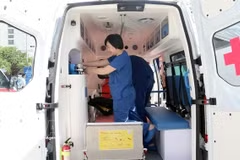
An ambulance from the pre-hospital emergency care service in Phu Quoc special zone in An Giang province. (Photo: VNA)

Pre-hospital emergency care system to be launched nationwide

From 2027, the national pre-hospital emergency management platform will be put into operation, connecting data with the 113, 114 and 115 emergency call systems to facilitate rapid emergency dispatch and improve public access to emergency services.

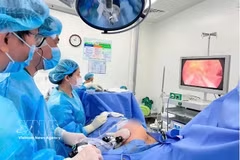
Foreign patients travel to Vietnam for robotic cancer surgery at one-tenth of US costs

Foreign patients travel to Vietnam for robotic cancer surgery at one-tenth of US costs

With robot-assisted surgery costing tens of thousands of dollars in the US and Singapore, a growing number of international patients are traveling to Vietnam for robotic cancer surgery, including procedures for prostate, gynecological and gastrointestinal cancers, using the US made da Vinci Xi system at costs starting from just 3,000 USD.

Under a phased rollout beginning in 2026, every resident in Ho Chi Minh City will receive at least one annual health check-up or health screening. (Photo: VNA)

Ho Chi Minh City develops integrated multi-tier healthcare system

Under the new model, healthcare is organised into interconnected levels based on people's needs rather than administrative boundaries. Patients can move seamlessly between levels while their electronic health records and treatment information remain connected through digital platforms, referral systems, telemedicine, electronic medical records, and integrated health databases.

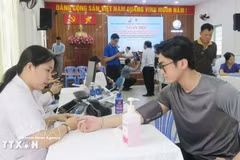
Doctors conduct heart and lung examinations for workers. (Photo: VNA)

Draft policy encourages people to prepare for old age from middle age

A draft circular guiding the implementation of the National Target Programme on Health Care, Population and Development (2026-2035) marks a shift from focusing solely on elderly care to encouraging healthy and independent ageing through early preparation. It covers healthy lifestyles, regular health check-ups, financial planning, suitable employment and home-based elderly care skills.

The meeting between the Vietnam Military Medical University delegation and leaders of the Lao Ministry of National Defence in Vientiane (Photo: VNA)

Vietnam, Laos deepen military medical cooperation

Since 1954, Vietnam Military Medical University has trained 687 Lao military medical personnel, including 322 doctors, 67 master's degree holders, 10 doctorate holders, and dozens of specialist physicians, alongside hundreds of pharmacists and medical technicians.

Vietnam's first penis transplant from a brain-dead donor is successfully performed at Viet Duc University Hospital. (Photo published by VNA)

Vietnam reaches new milestone in reconstructive transplant surgery

As the first operation of its kind in Vietnam, the hospital spent months developing treatment protocols, studying international experience and assembling a multidisciplinary team that included experts in transplantation, andrology, microsurgery, anaesthesia, immunology and pathology.

Dr. Nguyen Thanh Xuan is performing brain surgery on a patient (Photo published by VNA)

National strategy aims to build advanced medical ecosystem

Vietnam's adjusted healthcare network master plan for 2021–2030, with a vision to 2050, also outlines a regional structure covering the country's six socio-economic regions. It envisages 17 provincial general hospitals serving regional functions, at least one highly specialised hospital in each region, and at least one advanced medical facility in every province and city.

Vietnamese Ambassador to Bulgaria Nguyen Thi Minh Nguyet and Prof. Dr. Nguyen Huu Tu, President of Hanoi Medical University, meet with Prof. Boycho Landjov, President of Sofia Medical University. (Photo: VNA)

Vietnam, Bulgaria forge closer medical ties

The visit's highlight was the signing of a memorandum of understanding (MoU) between Hanoi Medical University and Sofia Medical University, creating a long-term framework for academic exchanges, scientific research and institutional cooperation between the two countries' leading medical schools.

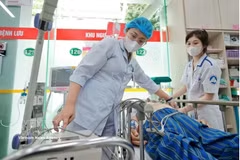
The Intensive Care Unit at Duc Giang General Hospital has continuously introduced and applied advanced specialised techniques to improve the treatment and survival of critically ill patients. (Photo: VNA)

40 years of renewal: Healthcare quality advanced for new era

Over the past four decades of Doi moi (Renewal), Vietnam’s healthcare sector has made remarkable progress, and is now well positioned to achieve further breakthroughs by harnessing science, technology and innovation to improve public health care in the new era, according to experts from the Vietnam Union of Science and Technology Associations (VUSTA).