Two-way remote robotic surgery network marks breakthrough in Vietnam’s healthcare

The network links Vinmec Smart City Hospital in Hanoi and Vinmec Can Tho Hospital. Unlike previous standalone remote robotic procedures, the new model allows either establishment to take turns serving as the command centre, creating an interconnected surgical network rather than relying on a single control hub.

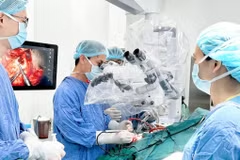
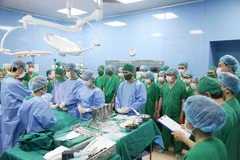
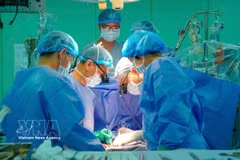
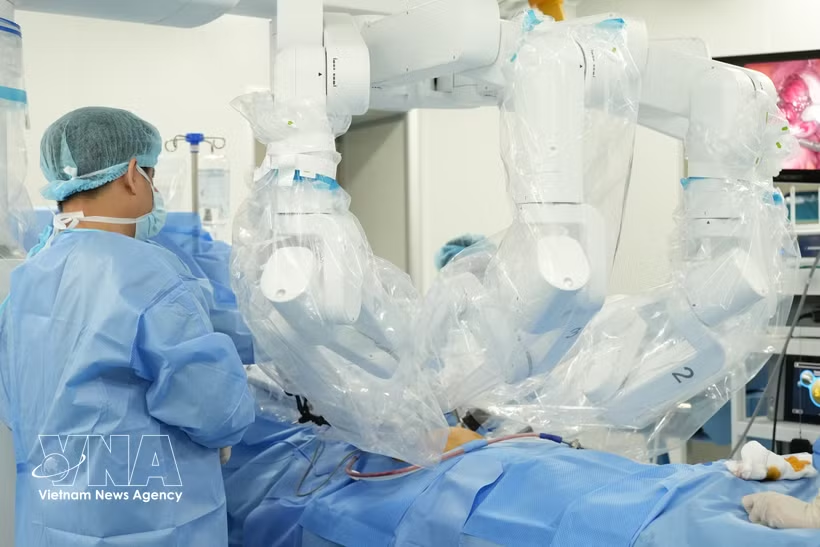
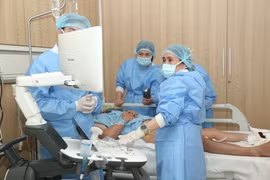
Despite geographical distance, the two surgeries were carried out safely and successfully. (Photo published by VNA)

Hanoi (VNA) – The Hanoi Department of Health, in collaboration with the Vinmec Healthcare System, announced the successful completion of two-way remote robotic surgeries on August 3, with a network between Hanoi and Can Tho enabling two hospitals, located more than 1,700 kilometres apart, to alternate as both the remote command centre and the site where the patient undergoes surgery.

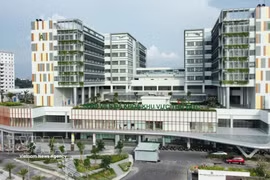
The network links Vinmec Smart City Hospital in Hanoi and Vinmec Can Tho Hospital. Unlike previous standalone remote robotic procedures, the new model allows either establishment to take turns serving as the command centre, creating an interconnected surgical network rather than relying on a single control hub.

The first patient was a 15-year-old girl diagnosed with a tumour in her right ovary. The primary objective was not only to remove the tumour but also to preserve as much healthy ovarian tissue as possible to maintain hormonal function and future fertility.

During the procedure, the lead surgeon in Hanoi operated the robotic system remotely, while the surgical team in Can Tho carried out the procedure in the operation theatre. The second patient was a 42-year-old man with cancer in the left lobe of the liver against a background of chronic hepatitis B infection. In this case, the direction of control was reversed: Vinmec Can Tho served as the robotic command centre, while the surgery was performed at the hospital in Hanoi.

This was also the first time in Vietnam that a remote robotic surgery model with bidirectional control has been implemented between two hospitals within the same healthcare system.

Speaking at the announcement ceremony, Dr Nguyen Trong Dien, Director of the Hanoi Department of Health, described the achievement as a breakthrough for Vietnamese medicine in applying science and technology to healthcare. He noted that, as of the announcement, Vinmec had successfully performed four surgeries using this model.

vnanet-two-way-remote-robotic-surgery-network-2.jpg
Dr Nguyen Trong Dien, Director of the Hanoi Department of Health, speaks at the announcement ceremony on August 3. (Photo published by VNA)

He said the milestone represents not only a technological achievement but also clear evidence of the capital’s strategy to develop a modern healthcare system.

Public and private healthcare providers, he added, should be integrated into Hanoi’s healthcare network and make full use of highly qualified medical professionals to improve service delivery and public health protection and management.

According to Dien, the Capital Law and newly introduced policies are providing an important foundation for this development. Since August 1, 2026, the department has been authorised to license a wider range of advanced medical procedures and recognise international practising certificates held by foreign specialists, helping attract highly skilled professionals.

The municipal health sector is also developing proposals that would allow experts from central and municipal hospitals, universities and private healthcare providers to practise across multiple medical facilities in Hanoi, thereby making more effective use of existing human resources.

In addition, Hanoi is studying a pricing mechanism for high-tech medical services, including telemedicine, to establish a legal framework for innovations such as remote robotic surgery. The long-term goal is to develop Hanoi into a high-quality medical centre and a regional hub for smart healthcare and medical tourism./.
VNA

See more

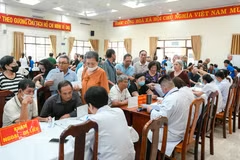
Under a phased rollout beginning in 2026, every resident in Ho Chi Minh City will receive at least one annual health check-up or health screening. (Photo: VNA)

Ho Chi Minh City develops integrated multi-tier healthcare system

Under the new model, healthcare is organised into interconnected levels based on people's needs rather than administrative boundaries. Patients can move seamlessly between levels while their electronic health records and treatment information remain connected through digital platforms, referral systems, telemedicine, electronic medical records, and integrated health databases.

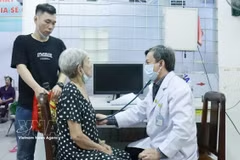
Doctors conduct heart and lung examinations for workers. (Photo: VNA)

Draft policy encourages people to prepare for old age from middle age

A draft circular guiding the implementation of the National Target Programme on Health Care, Population and Development (2026-2035) marks a shift from focusing solely on elderly care to encouraging healthy and independent ageing through early preparation. It covers healthy lifestyles, regular health check-ups, financial planning, suitable employment and home-based elderly care skills.

The meeting between the Vietnam Military Medical University delegation and leaders of the Lao Ministry of National Defence in Vientiane (Photo: VNA)

Vietnam, Laos deepen military medical cooperation

Since 1954, Vietnam Military Medical University has trained 687 Lao military medical personnel, including 322 doctors, 67 master's degree holders, 10 doctorate holders, and dozens of specialist physicians, alongside hundreds of pharmacists and medical technicians.

Dr. Nguyen Thanh Xuan is performing brain surgery on a patient (Photo published by VNA)

National strategy aims to build advanced medical ecosystem

Vietnam's adjusted healthcare network master plan for 2021–2030, with a vision to 2050, also outlines a regional structure covering the country's six socio-economic regions. It envisages 17 provincial general hospitals serving regional functions, at least one highly specialised hospital in each region, and at least one advanced medical facility in every province and city.

Vietnamese Ambassador to Bulgaria Nguyen Thi Minh Nguyet and Prof. Dr. Nguyen Huu Tu, President of Hanoi Medical University, meet with Prof. Boycho Landjov, President of Sofia Medical University. (Photo: VNA)

Vietnam, Bulgaria forge closer medical ties

The visit's highlight was the signing of a memorandum of understanding (MoU) between Hanoi Medical University and Sofia Medical University, creating a long-term framework for academic exchanges, scientific research and institutional cooperation between the two countries' leading medical schools.

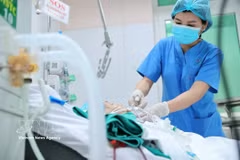
The Intensive Care Unit at Duc Giang General Hospital has continuously introduced and applied advanced specialised techniques to improve the treatment and survival of critically ill patients. (Photo: VNA)

40 years of renewal: Healthcare quality advanced for new era

Over the past four decades of Doi moi (Renewal), Vietnam’s healthcare sector has made remarkable progress, and is now well positioned to achieve further breakthroughs by harnessing science, technology and innovation to improve public health care in the new era, according to experts from the Vietnam Union of Science and Technology Associations (VUSTA).

Doctors from Cho Ray Hospital conduct preventive health screenings for residents at the Cho Lon ward health station. (Photo: VNA)

Ho Chi Minh City targets completion of universal health check-ups by December 15

According to the municipal Department of Health, as of July 20, a total of 732,873 residents had undergone periodic check-ups and had electronic health records established. The figure reflects encouraging initial results from the citywide campaign launched by the department and underscores local authorities' commitment to implementing one of the largest community healthcare programmes ever undertaken in the southern metropolis.

Medical staff at Cho Ray Hospital in Ho Chi Minh City cares for and treat the victim. (Photo published by VNA)

Last survivor of Phu Quoc boat capsize shows signs of recovery

The health condition of the last patient receiving treatment following the deadly boat capsize off the Phu Quoc special one in An Giang province has shown positive signs of improvement after three more days of intensive care, Cho Ray Hospital in Ho Chi Minh City said on July 16.

The number of foreign tourists coming to Ho Chi Minh City for travel combined with medical check-ups is increasing. (Photo: VNA)

Vietnam looks to unlock medical tourism potential with national strategy

The draft strategy aims to position Vietnam as a trusted healthcare destination in Southeast Asia by 2030 and eventually among Asia's leading medical tourism hubs. The plan marks a shift from viewing medical tourism as an untapped opportunity to making it a national development priority.