Health insurance covers 94.4 million medical visits in H1

Health insurance covered around 94.4 million patient visits during the January-June period, similar to the same period last year. Inpatient treatment accounted for 10.3% of total cases, slightly higher than in 2025.

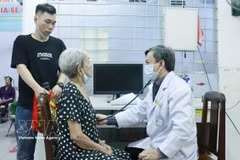
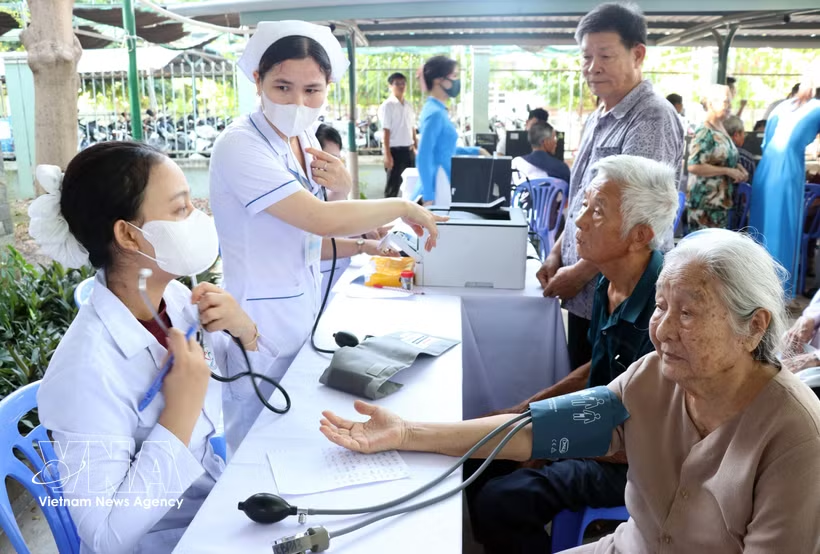
Medical workers from Ninh Thuan General Hospital in Khanh Hoa province provide check-ups for elderly people. (Photo: VNA)

Hanoi (VNA) – Vietnam's health insurance system covered about 94.4 million medical examinations and treatments in the first half of 2026, while efforts to strengthen digital management and cost control helped improve the implementation of the national health insurance policy, according to Vietnam Social Security (VSS).

The figures were announced at a nationwide online conference held by VSS on July 30 to review the implementation of health insurance policies in the first six months of the year and outline measures to control healthcare spending in the remainder of 2026.

According to the agency, by the end of June, 3,672 medical facilities nationwide had signed up to provide health insurance-covered services, including 2,354 public and 1,318 private healthcare establishments, 26 more than in 2025.​

The network comprises 94 specialised hospitals, 1,498 basic-level facilities and 2,080 primary healthcare providers, helping meet the country's growing and increasingly diverse healthcare needs.

Health insurance covered around 94.4 million patient visits during the January-June period, similar to the same period last year. Inpatient treatment accounted for 10.3% of total cases, slightly higher than in 2025.

Total health insurance spending reached 84.77 trillion VND (3.22 billion USD), up 11.1% year-on-year and equivalent to 54.4% of the full-year spending estimate.

Opening the conference, VSS Director Le Hung Son said the agency had implemented a wide range of measures to improve the delivery of health insurance and better protect the interests of participants.

He noted, however, that rising healthcare costs pose growing challenges in the second half of the year, requiring stronger management, higher-quality medical claims assessment and stricter enforcement of regulations.

Son urged local authorities to carefully assess the implementation of health insurance policies, identify shortcomings and adopt practical solutions. He also called for greater use of data analysis to monitor healthcare spending, detect unusual cost patterns at medical facilities and prevent overspending that could affect the balance of the health insurance fund and the rights of insured patients.

VSS said it had worked closely with local authorities to implement new health insurance regulations that took effect this year, while ensuring timely reimbursement for medical services and improving the quality of claims assessment to safeguard participants' legitimate rights.

The agency has also accelerated digital transformation by expanding the use of information technology, data analytics and artificial intelligence in health insurance management. Early warning systems have helped detect unusual spending patterns and curb abuse of the health insurance fund. As a result, the number of provinces and centrally-run cities with health insurance spending exceeding the national average has fallen from 28 to 13.

Despite these achievements, VSS acknowledged several challenges. Average healthcare costs per insured patient increased by 11.7% from a year earlier, with spending rising sharply in several localities, including Hanoi, Ho Chi Minh City, Vinh Long, Ca Mau and Son La.

The conference also identified delays in processing some reimbursement claims, inconsistent cost monitoring and shortcomings in the use of medical services and equipment at some healthcare facilities. Participants stressed the need for stronger financial discipline, more effective supervision and greater accountability to ensure the sustainable operation of Vietnam's health insurance fund while protecting participants' benefits./.​

VNA

See more

The meeting between the Vietnam Military Medical University delegation and leaders of the Lao Ministry of National Defence in Vientiane (Photo: VNA)

Vietnam, Laos deepen military medical cooperation

Since 1954, Vietnam Military Medical University has trained 687 Lao military medical personnel, including 322 doctors, 67 master's degree holders, 10 doctorate holders, and dozens of specialist physicians, alongside hundreds of pharmacists and medical technicians.

Vietnam's first penis transplant from a brain-dead donor is successfully performed at Viet Duc University Hospital. (Photo published by VNA)

Vietnam reaches new milestone in reconstructive transplant surgery

As the first operation of its kind in Vietnam, the hospital spent months developing treatment protocols, studying international experience and assembling a multidisciplinary team that included experts in transplantation, andrology, microsurgery, anaesthesia, immunology and pathology.

Dr. Nguyen Thanh Xuan is performing brain surgery on a patient (Photo published by VNA)

National strategy aims to build advanced medical ecosystem

Vietnam's adjusted healthcare network master plan for 2021–2030, with a vision to 2050, also outlines a regional structure covering the country's six socio-economic regions. It envisages 17 provincial general hospitals serving regional functions, at least one highly specialised hospital in each region, and at least one advanced medical facility in every province and city.

Vietnamese Ambassador to Bulgaria Nguyen Thi Minh Nguyet and Prof. Dr. Nguyen Huu Tu, President of Hanoi Medical University, meet with Prof. Boycho Landjov, President of Sofia Medical University. (Photo: VNA)

Vietnam, Bulgaria forge closer medical ties

The visit's highlight was the signing of a memorandum of understanding (MoU) between Hanoi Medical University and Sofia Medical University, creating a long-term framework for academic exchanges, scientific research and institutional cooperation between the two countries' leading medical schools.

Doctors from Cho Ray Hospital conduct preventive health screenings for residents at the Cho Lon ward health station. (Photo: VNA)

Ho Chi Minh City targets completion of universal health check-ups by December 15

According to the municipal Department of Health, as of July 20, a total of 732,873 residents had undergone periodic check-ups and had electronic health records established. The figure reflects encouraging initial results from the citywide campaign launched by the department and underscores local authorities' commitment to implementing one of the largest community healthcare programmes ever undertaken in the southern metropolis.

Medical staff at Cho Ray Hospital in Ho Chi Minh City cares for and treat the victim. (Photo published by VNA)

Last survivor of Phu Quoc boat capsize shows signs of recovery

The health condition of the last patient receiving treatment following the deadly boat capsize off the Phu Quoc special one in An Giang province has shown positive signs of improvement after three more days of intensive care, Cho Ray Hospital in Ho Chi Minh City said on July 16.

The number of foreign tourists coming to Ho Chi Minh City for travel combined with medical check-ups is increasing. (Photo: VNA)

Vietnam looks to unlock medical tourism potential with national strategy

The draft strategy aims to position Vietnam as a trusted healthcare destination in Southeast Asia by 2030 and eventually among Asia's leading medical tourism hubs. The plan marks a shift from viewing medical tourism as an untapped opportunity to making it a national development priority.

Delegates at the conference. (Photo: VNA)

Vietnam to produce first homegrown next-generation vaccines from 2028

Under the agreement, Sanofi will transfer technology to VNVC to manufacture selected high-demand vaccines for children and adults at VNVC Vaccine and Bioproduct Plant. The first next-generation vaccines produced in Vietnam are expected to roll off production lines in 2028.

Eric and Alysha joyfully welcome their baby through Mini IVF after more than 10 years of waiting. (Photo: Hong Ngoc Phuc Truong Minh General Hospital)

Vietnam - a destination for journeys to parenthood

An increasing number of international families are choosing Vietnam for infertility treatment, embarking on journeys to parenthood that transcend geographical distance and differences in nationality.

Thu Duc General Hospital, with a capacity of 1,000 beds, was inaugurated and put into operation in April 2025 (Photo: VNA)

Ho Chi Minh City moves to expand robotic surgery to gateway hospitals

According to the municipal Department of Health, developing gateway hospitals is a key pillar of the city's strategy to establish a regional specialised healthcare system. The network is designed to permanently relieve overcrowding at major downtown hospitals while strengthening strong inter-regional emergency care and treatment network.