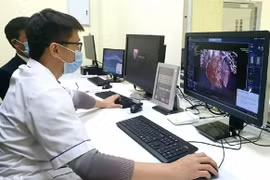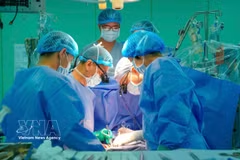
Da Nang (VNA) – The Da Nang Oncology Hospital has successfully treated a patient with non-small cell lung cancer (NSCLC) carrying both EGFR and ALK gene mutations simultaneously – an exceptionally rare condition in both medical literature and clinical practice.
The patient, identified as N.T.T., born in 1970 and residing in Dien Ban Bac ward of Da Nang, sought treatment at the hospital after being diagnosed with lung cancer at another medical facility. She had experienced persistent coughing and right-sided chest pain that affected her daily life and had no history of smoking.
Pathological examination confirmed lung adenocarcinoma, the most common subtype of NSCLC. Imaging revealed a tumour in the right lung with mediastinal lymph node involvement but no evidence of brain or bone metastases at the time of diagnosis. Based on the findings, doctors diagnosed advanced-stage right lung cancer and ordered molecular testing to determine the most appropriate treatment strategy. The test results showed that the patient harboured both EGFR and ALK driver mutations. Doctors noted that lung cancer patients typically carry only one actionable driver mutation to guide targeted therapy, making the coexistence of both mutations extremely uncommon.
To ensure diagnostic accuracy, the tissue sample was re-examined and the test results verified before the hospital confirmed it as the first dual-mutation case recorded at the Da Nang Oncology Hospital. The case posed a significant clinical challenge, as limited evidence exists on which mutation should be prioritised when both are present.
Following multidisciplinary consultations and a review of available clinical evidence, the patient initially received the targeted therapy afatinib. However, after nearly three months, computed tomography (CT) scans indicated that the response fell short of expectations. The hospital's multidisciplinary team subsequently decided to switch to a targeted treatment directed at the ALK mutation.
After more than six months of treatment, follow-up assessments showed a favourable response. CT imaging no longer detected the tumour, the patient's clinical symptoms had improved markedly, and her overall health remained stable.
According to Dr Nguyen Kim Thong, head of the hospital's Internal Medicine Department No. 2, the case underscores the growing importance of precision medicine in cancer treatment. Analysing the biological characteristics of each tumour enables physicians to tailor treatment to individual patients, improving therapeutic outcomes.
The case also highlights the hospital's capability in molecular diagnostics, multidisciplinary consultations and personalised cancer treatment, enabling patients in Vietnam's central and Central Highlands regions to access advanced oncology care closer to home./.
See more
Vietnam, Australia partner to advance cutting-edge RNA biomedical technology
The two sides aim to pursue joint investment, research, scientific publications, and the development of advanced biomedical products, leveraging the strengths of both research institutes and the two countries.
Pre-hospital emergency care system to be launched nationwide
From 2027, the national pre-hospital emergency management platform will be put into operation, connecting data with the 113, 114 and 115 emergency call systems to facilitate rapid emergency dispatch and improve public access to emergency services.
Foreign patients travel to Vietnam for robotic cancer surgery at one-tenth of US costs
With robot-assisted surgery costing tens of thousands of dollars in the US and Singapore, a growing number of international patients are traveling to Vietnam for robotic cancer surgery, including procedures for prostate, gynecological and gastrointestinal cancers, using the US made da Vinci Xi system at costs starting from just 3,000 USD.
Nearly 2 million Ho Chi Minh City residents receive free health check-ups
According to the municipal Department of Health, while several localities have achieved coverage rates of more than 60%, some others still have rates below 5%, highlighting considerable disparities in programme implementation.
Vietnam, China open joint health hubs in border disease fight
Officials cut the ribbon on a Vietnam–China cross-border training and exchange centre for infectious disease control, along with a Guangxi facility dedicated to disease surveillance and prevention training.
Multipolar healthcare system to bring medical services closer to residents
Under the traditional model, patients must come to specialists. Under the multipolar model, specialist expertise will be brought closer to where people live.
Vietnam launches national action plan against breast and cervical cancer
Breast cancer is currently the most common cancer among Vietnamese women, with more than 24,560 new cases diagnosed each year and around 10,000 deaths annually.
Vietnamese, Taiwanese experts discuss multimodal weight management
Experts emphasised that obesity treatment requires multidisciplinary coordination, targeting not only weight loss but also comprehensive health management.
Two-way remote robotic surgery network marks breakthrough in Vietnam’s healthcare
The network links Vinmec Smart City Hospital in Hanoi and Vinmec Can Tho Hospital. Unlike previous standalone remote robotic procedures, the new model allows either establishment to take turns serving as the command centre, creating an interconnected surgical network rather than relying on a single control hub.
Ho Chi Minh City develops integrated multi-tier healthcare system
Under the new model, healthcare is organised into interconnected levels based on people's needs rather than administrative boundaries. Patients can move seamlessly between levels while their electronic health records and treatment information remain connected through digital platforms, referral systems, telemedicine, electronic medical records, and integrated health databases.
Draft policy encourages people to prepare for old age from middle age
A draft circular guiding the implementation of the National Target Programme on Health Care, Population and Development (2026-2035) marks a shift from focusing solely on elderly care to encouraging healthy and independent ageing through early preparation. It covers healthy lifestyles, regular health check-ups, financial planning, suitable employment and home-based elderly care skills.
Efforts made to create breakthroughs in primary health care, workforce development
Aiming to ensure all citizens can access quality healthcare close to home, detect diseases earlier and improve quality of life amid rapid population aging, cities and provinces are adopting reforms to enhance healthcare capacity.
Health insurance covers 94.4 million medical visits in H1
Health insurance covered around 94.4 million patient visits during the January-June period, similar to the same period last year. Inpatient treatment accounted for 10.3% of total cases, slightly higher than in 2025.
Vietnam, Laos deepen military medical cooperation
Since 1954, Vietnam Military Medical University has trained 687 Lao military medical personnel, including 322 doctors, 67 master's degree holders, 10 doctorate holders, and dozens of specialist physicians, alongside hundreds of pharmacists and medical technicians.
Vietnam reaches new milestone in reconstructive transplant surgery
As the first operation of its kind in Vietnam, the hospital spent months developing treatment protocols, studying international experience and assembling a multidisciplinary team that included experts in transplantation, andrology, microsurgery, anaesthesia, immunology and pathology.
National strategy aims to build advanced medical ecosystem
Vietnam's adjusted healthcare network master plan for 2021–2030, with a vision to 2050, also outlines a regional structure covering the country's six socio-economic regions. It envisages 17 provincial general hospitals serving regional functions, at least one highly specialised hospital in each region, and at least one advanced medical facility in every province and city.
First multi-organ retrieval at Bai Chay hospital gives five patients new lease of life
With the successful completion of its first multi-organ retrieval, Bai Chay hospital has become the third medical facility in Quang Ninh to perform the highly complex procedure in accordance with the national protocol. The achievement also highlights the profound humanitarian value of organ donation in society
Vietnam, Bulgaria forge closer medical ties
The visit's highlight was the signing of a memorandum of understanding (MoU) between Hanoi Medical University and Sofia Medical University, creating a long-term framework for academic exchanges, scientific research and institutional cooperation between the two countries' leading medical schools.
Ho Chi Minh City-based hospitals launch health checkups for policy beneficiaries
Hospitals in Ho Chi Minh City are providing free health checkups, medicines and counselling services for policy beneficiary families, people who rendered service to the nation and residents in former revolutionary bases to commemorate the 79th anniversary of War Invalids and Martyrs' Day (July 27, 1947–2026).
40 years of renewal: Healthcare quality advanced for new era
Over the past four decades of Doi moi (Renewal), Vietnam’s healthcare sector has made remarkable progress, and is now well positioned to achieve further breakthroughs by harnessing science, technology and innovation to improve public health care in the new era, according to experts from the Vietnam Union of Science and Technology Associations (VUSTA).