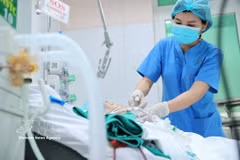
Hanoi (VNS/VNA) – The entire healthcare system will launch a pre-hospital emergency care service starting from next year as part of a newly approved Government project.
The project to develop the pre-hospital emergency care system for 2026–2030 period aims to ensure that 100% of emergency calls are received and handled with timely and appropriate medical advice and emergency dispatch based on conditions and practical requirements.
From 2027, the national pre-hospital emergency management platform will be put into operation, connecting data with the 113, 114 and 115 emergency call systems to facilitate rapid emergency dispatch and improve public access to emergency services.
The overall goal is to build and develop a synchronous and modern pre-hospital emergency care system capable of ensuring timely receipt, processing and dispatch of emergency calls.
All provinces and cities nationwide are expected to establish emergency networks tailored to local conditions and emergency care needs.
Inter-agency coordination mechanisms will also be established among the health sector, police, military, fire prevention and fighting and search-and-rescue forces and local authorities for receiving information, dispatching emergency services, reaching incident scenes, providing first aid and emergency care, transporting and handing over patients.
At least 75% of medical staff at commune-level health stations are expected to receive training in pre-hospital emergency care.
Basic first-aid and emergency response knowledge will be disseminated to at least 3% of the population, with at least 1% of the population receiving hands-on training in first-aid and basic emergency skills.
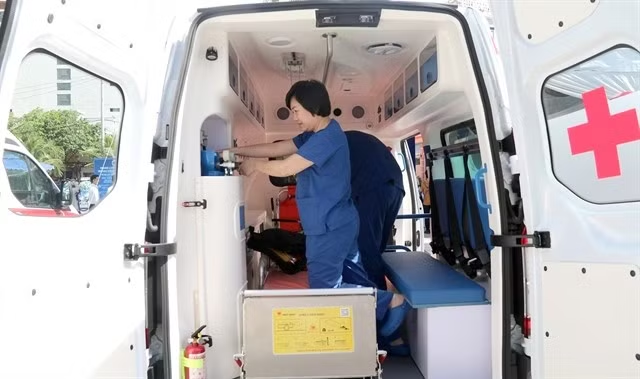
The project also aims to invest in and deploy at least one standard ambulance per 100,000 people across the pre-hospital emergency care system.
The quality of pre-hospital emergency services is also expected to be improved, aiming to ensure that an ambulance is dispatched within no more than five minutes of the decision to deploy one in life-threatening emergencies.
Dr Ha Anh Duc, Director-General of the Department of Medical Service Administration under the Ministry of Health, said the development of the pre-hospital emergency care system would require uniform national standards, rather than allowing each locality to implement its own criteria.
The Ministry of Health would standardise emergency vehicles and transport means, including advanced life-support ambulances, patient transport vehicles, rapid-response vehicles for urban areas, waterborne emergency vehicles and specialised vehicles for remote and mountainous areas.
It would also clearly distinguish between ambulances providing pre-hospital emergency services and vehicles used solely for routine patient transportation.
Human resources would also be standardised, from the composition of emergency response teams to training programmes for doctors, nurses, technicians and ambulance drivers, he said.
According to Duc, in many countries, ambulance drivers are also members of emergency response teams and receive formal training to provide initial medical assistance. Vietnam will gradually move toward this model while developing the paramedic profession and introducing formal paramedic training at medical education institutions.
Another key goal of the project is to improve first-aid skills among members of the public. Priority groups for training include teachers, students, hotel and restaurant staff, swimming pool employees, security personnel and community volunteers.
Duc said if people could recognise cardiac arrest, perform chest compressions and call for assistance properly, they could save many lives before medical personnel arrive at the scene.
Experience from Ho Chi Minh City
Ho Chi Minh City has already set a successful model in launching the pre-hospital emergency system.
Associate Professor Tran Van Thuan, Deputy Minister of Health, said as a pioneer in developing and implementing pre-hospital emergency care services in Vietnam, Ho Chi Minh City had established a multi-tiered, multi-centre and multi-modal emergency response system, encompassing road, waterway and air ambulance services.
This model was consistent with the orientation set out in the national project on developing the pre-hospital emergency care system, he said.
Dr Nguyen Duy Long, Director of HCM City’s 115 Emergency Centre, said before 2013, pre-hospital emergency services in the city were mainly provided by a single hospital covering the entire area, initially Saigon General Hospital, now Facility 2 of Gia Dinh People’s Hospital and later Trung Vuong Hospital. Under this centralised model, reaching patients in areas far from the city centre was virtually impossible, particularly in cases requiring intervention during the golden hour.
At the end of 2013, the Ho Chi Minh City People’s Committee established the 115 Emergency Centre under the municipal Department of Health and developed a citywide pre-hospital emergency network. This marked a major shift from a centralised model to a network-based system, mobilising resources from both the public and private healthcare sectors.
Hospitals with adequate personnel, equipment and expertise were encouraged to join the 115 satellite emergency network to shorten response times to incident scenes, he said.
Following the administrative merger with Binh Duong and Ba Ria-Vung Tau, Ho Chi Minh City’s pre-hospital emergency network continued to expand and now comprises 73 satellite stations covering the entire city.
The current organisational model includes three forms, namely the 115 Emergency Centre which provides all personnel, vehicles and ambulances; the centre and satellite stations coordinating and sharing resources and the center which deploys emergency personnel to be stationed directly at satellite stations.
The expanded network has delivered clear results. The number of emergency calls has increased steadily each year, reflecting growing public confidence in the service. In 2025 alone, the 115 emergency hotline received more than 400,000 calls, Thanh Nien (Young People) newspaper reports.
Dr Long said in the coming period, Ho Chi Minh City’s pre-hospital emergency care system would develop into a multi-tiered, multi-centre model with the establishment of additional emergency centres in Tan Kien, Thu Duc areas and the former Can Gio area, while expanding the network into the former Binh Duong and Ba Ria-Vung Tau areas.
The centre would also coordinate with Military Hospital 175 to develop air ambulance services for offshore and island areas, he said.
He said the pre-hospital emergency system would be organised into four tiers. The first would comprise specialised personnel of the 115 Emergency Centre. The second would be the network of hospital-based satellite stations while the third would consist of the grassroots healthcare system, particularly health stations with adequate equipment and personnel. The fourth would be a community network involving the Red Cross, community health workers and residents trained in first aid.
The city’s strategic objectives would be aligned with the Ministry of Health’s orientations, he said.
Recommendations
Associate Professor Tang Chi Thuong, Director of Ho Chi Minh City’s Department of Health, urged the Ministry of Health to soon issue or update regulations guiding pre-hospital emergency care, saying many aspects of the service have changed in practice but lack a sufficient legal basis for implementation.
According to Thuong, regulations on emergency vehicles should first be updated. The emergency response system now needs to encompass not only conventional ambulances but also various other types of vehicles, such as two-wheeled emergency vehicles, vehicles transporting emergency medical specialists, routine patient transport vehicles and advanced life-support ambulances. Each type should have separate regulations governing equipment, personnel and scope of operation.
He also called for a clear distinction between patient transport vehicles and emergency ambulances, as not every patient transport case requires the use of emergency warning signals. Clearly defining the standards, functions and operating scope of each type of vehicle would help ensure efficient use of resources while improving road safety.
Thuong also proposed shifting from a voluntary or encouraged approach to mandatory participation in the pre-hospital emergency network.
“Hospitals with emergency departments should be required to participate in the network and meet standards for personnel, vehicles and equipment.
"Ambulance drivers should also be required to undergo basic emergency care training and qualify as emergency responders capable of assisting medical teams during emergency treatment and patient transport,” he said./.
VNA