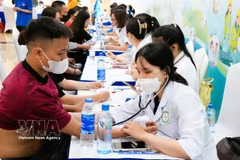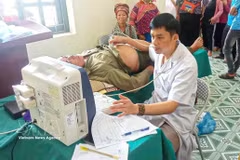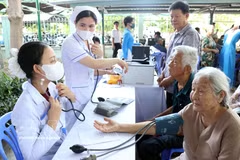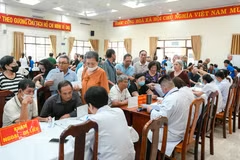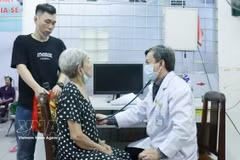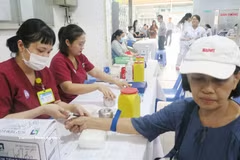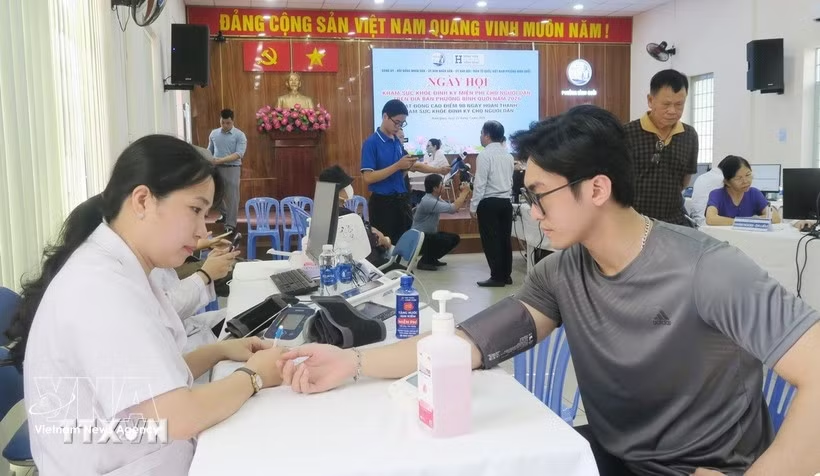
Ho Chi Minh City (VNA) – Nearly 2 million residents in Ho Chi Minh City had received free health check-ups under the city’s universal health examination programme as of August 10.
According to the municipal Department of Health, while several localities have achieved coverage rates of more than 60%, some others still have rates below 5%, highlighting considerable disparities in programme implementation.
During the initial phase, an average of only 30,000-40,000 people received check-ups each week. However, the figure has surged to 300,000-400,000 per week over the past three weeks. The sharp increase reflects stronger engagement by local authorities and healthcare facilities, as well as growing public participation.
The six localities with the highest coverage rates are Phuoc Thang ward (63.83%), An Nhon Tay commune (52.77%), Con Dao special zone (52.36%), Thanh An commune (48.12%), Xuan Thoi Son commune (41.04%) and Long Hai commune (40.11%). Meanwhile, two wards – Ben Thanh and Ban Co – had coverage rates below 5%, at 3.34% and 4.86%, respectively, as of August 10.
The department’s Director Tang Chi Thuong said the health sector will continue supporting localities with low coverage, while urging areas with higher rates to reach residents who remain underserved, particularly senior people, persons with disabilities and those facing difficulties in travelling, ensuring broader and more equitable access to healthcare./.
See more
Vietnam, China open joint health hubs in border disease fight
Officials cut the ribbon on a Vietnam–China cross-border training and exchange centre for infectious disease control, along with a Guangxi facility dedicated to disease surveillance and prevention training.
Multipolar healthcare system to bring medical services closer to residents
Under the traditional model, patients must come to specialists. Under the multipolar model, specialist expertise will be brought closer to where people live.
Vietnam launches national action plan against breast and cervical cancer
Breast cancer is currently the most common cancer among Vietnamese women, with more than 24,560 new cases diagnosed each year and around 10,000 deaths annually.
Vietnamese, Taiwanese experts discuss multimodal weight management
Experts emphasised that obesity treatment requires multidisciplinary coordination, targeting not only weight loss but also comprehensive health management.
Two-way remote robotic surgery network marks breakthrough in Vietnam’s healthcare
The network links Vinmec Smart City Hospital in Hanoi and Vinmec Can Tho Hospital. Unlike previous standalone remote robotic procedures, the new model allows either establishment to take turns serving as the command centre, creating an interconnected surgical network rather than relying on a single control hub.
Ho Chi Minh City develops integrated multi-tier healthcare system
Under the new model, healthcare is organised into interconnected levels based on people's needs rather than administrative boundaries. Patients can move seamlessly between levels while their electronic health records and treatment information remain connected through digital platforms, referral systems, telemedicine, electronic medical records, and integrated health databases.
Draft policy encourages people to prepare for old age from middle age
A draft circular guiding the implementation of the National Target Programme on Health Care, Population and Development (2026-2035) marks a shift from focusing solely on elderly care to encouraging healthy and independent ageing through early preparation. It covers healthy lifestyles, regular health check-ups, financial planning, suitable employment and home-based elderly care skills.
Rare dual-gene lung cancer case responds well to precision treatment in Da Nang
The Da Nang Oncology Hospital has successfully treated a patient with non-small cell lung cancer (NSCLC) carrying both EGFR and ALK gene mutations simultaneously – an exceptionally rare condition in both medical literature and clinical practice.
Efforts made to create breakthroughs in primary health care, workforce development
Aiming to ensure all citizens can access quality healthcare close to home, detect diseases earlier and improve quality of life amid rapid population aging, cities and provinces are adopting reforms to enhance healthcare capacity.
Health insurance covers 94.4 million medical visits in H1
Health insurance covered around 94.4 million patient visits during the January-June period, similar to the same period last year. Inpatient treatment accounted for 10.3% of total cases, slightly higher than in 2025.
Vietnam, Laos deepen military medical cooperation
Since 1954, Vietnam Military Medical University has trained 687 Lao military medical personnel, including 322 doctors, 67 master's degree holders, 10 doctorate holders, and dozens of specialist physicians, alongside hundreds of pharmacists and medical technicians.
Vietnam reaches new milestone in reconstructive transplant surgery
As the first operation of its kind in Vietnam, the hospital spent months developing treatment protocols, studying international experience and assembling a multidisciplinary team that included experts in transplantation, andrology, microsurgery, anaesthesia, immunology and pathology.
National strategy aims to build advanced medical ecosystem
Vietnam's adjusted healthcare network master plan for 2021–2030, with a vision to 2050, also outlines a regional structure covering the country's six socio-economic regions. It envisages 17 provincial general hospitals serving regional functions, at least one highly specialised hospital in each region, and at least one advanced medical facility in every province and city.
First multi-organ retrieval at Bai Chay hospital gives five patients new lease of life
With the successful completion of its first multi-organ retrieval, Bai Chay hospital has become the third medical facility in Quang Ninh to perform the highly complex procedure in accordance with the national protocol. The achievement also highlights the profound humanitarian value of organ donation in society
Vietnam, Bulgaria forge closer medical ties
The visit's highlight was the signing of a memorandum of understanding (MoU) between Hanoi Medical University and Sofia Medical University, creating a long-term framework for academic exchanges, scientific research and institutional cooperation between the two countries' leading medical schools.
Ho Chi Minh City-based hospitals launch health checkups for policy beneficiaries
Hospitals in Ho Chi Minh City are providing free health checkups, medicines and counselling services for policy beneficiary families, people who rendered service to the nation and residents in former revolutionary bases to commemorate the 79th anniversary of War Invalids and Martyrs' Day (July 27, 1947–2026).
40 years of renewal: Healthcare quality advanced for new era
Over the past four decades of Doi moi (Renewal), Vietnam’s healthcare sector has made remarkable progress, and is now well positioned to achieve further breakthroughs by harnessing science, technology and innovation to improve public health care in the new era, according to experts from the Vietnam Union of Science and Technology Associations (VUSTA).
Vietnam’s first patient with systemic lupus erythematosus recovers thanks to CAR-T immune cell therapy
Vinmec Smart City Hospital in Hanoi announced it has successfully applied CAR-T cell therapy for the first time to treat a 28-year-old female patient suffering from systemic lupus erythematosus with severe kidney damage.
Ho Chi Minh City targets completion of universal health check-ups by December 15
According to the municipal Department of Health, as of July 20, a total of 732,873 residents had undergone periodic check-ups and had electronic health records established. The figure reflects encouraging initial results from the citywide campaign launched by the department and underscores local authorities' commitment to implementing one of the largest community healthcare programmes ever undertaken in the southern metropolis.
Ho Chi Minh City mobilises 10,000 health workers for mass health checks
The campaign, launched on July 16, aims to ensure that all residents receive health examinations, have electronic health records and benefit from continuous health management.