Resolution 57: Shifting from policy reform to concrete technology outcomes

The Ministry of Science and Technology said its top priority through end-2026 is a decisive shift from building institutional framework to delivering products, technologies and measurable results.

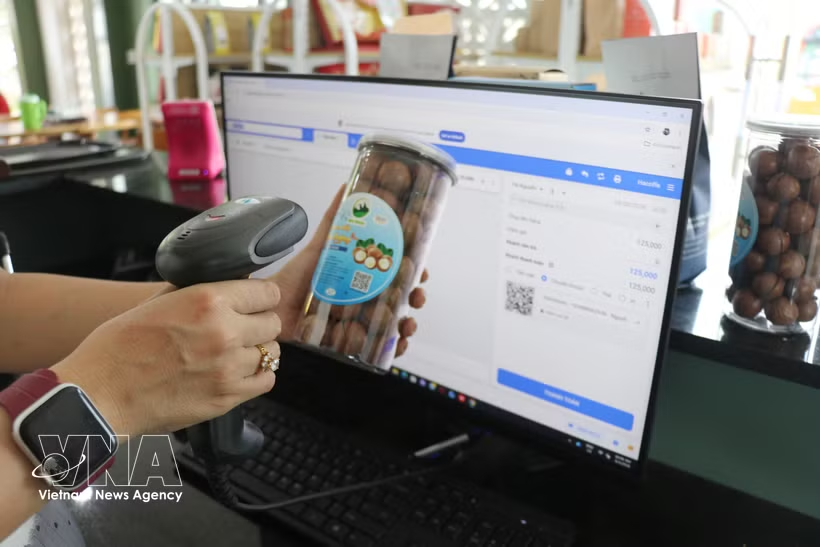
OCOP products are digitised with QR codes for traceability, listed on e-commerce platforms (Photo: VNA)

Hanoi (VNA) - More than 20 months after Vietnam began rolling out the Politburo’s Resolution 57 on science, technology, innovation and digital transformation, the biggest achievement has been clearing institutional and resource bottlenecks, said the Ministry of Science and Technology’s Department of Planning and Finance.

The ministry said its top priority through end-2026 is a decisive shift from building institutional framework to delivering products, technologies and measurable results.

The new legal framework is largely in place. The 2026 budget for those areas is estimated at nearly 95 trillion VND (3.63 billion USD), equal to about 3% of total state budget spending.

The ministry recommended the Prime Minister issue a directive to speed up the 2026 agenda. The directive orders a full review of task lists, faster fund allocation and disbursement, and action on delayed projects. It ties leaders’ accountability to results and targets responsibility shifting.

Going forward, it will focus on refining guidelines to clear emerging obstacles, reorienting budget planning toward output and capital efficiency rather than spreading funds thinly, and strengthening oversight so resources can be moved quickly from slow-moving tasks to those with stronger capacity.

Minister of Science and Technology Vu Hai Quan urged agencies and units to disburse funds decisively, clear obstacles and hold leaders accountable for staying on schedule.
vnanet-r.jpg
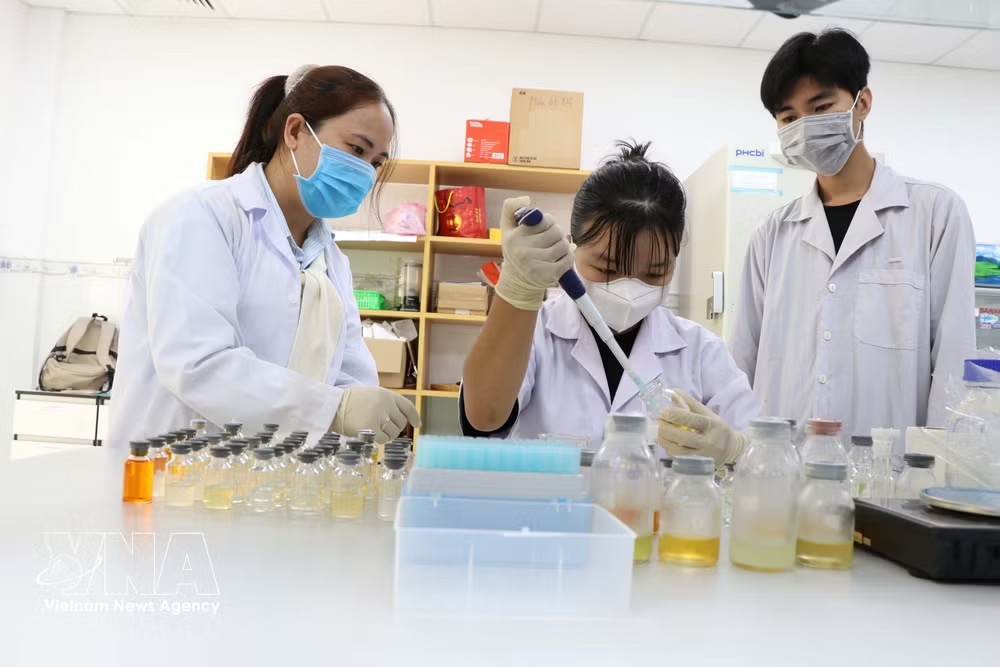
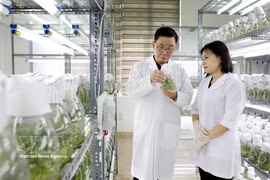
Guiding students through lab internships at Tra Vinh University (Photo: VNA)

He also called for stronger direction from municipal and provincial science and technology departments in advising municipal and provicial People’s Committees.

On sci-tech, Quan asked localities to identify challenges based on local conditions and development needs, with businesses helping tackle them.

If localities are unsure how to define tasks or lack resources, the ministry will work with them to build a priority challenge list and support implementation.

On innovation, the ministry will roll out projects to help firms adopt technology to improve productivity and quality. Quan urged localities to make effective use of investmen resources and avoid fragmented spending and duplicated models.

For digital transformation, Quan told localities to study and fully follow existing rules and report obstacles quickly so regulations can be improved.

The ministry will also push to translate mechanisms, policies and resources approved by the National Assembly and Government into concrete results, practical benefits for citizens and businesses, and contributions to national development./.
VNA

See more

The virtual assistant interface on the reception robot in Lai Hoa commune. (Photo: VNA)

Can Tho builds smart, modern administration through AI application

Amid efforts to accelerate national digital transformation, localities in Can Tho city are integrating modern technologies into State administration. Beyond conventional software and online platforms, artificial intelligence (AI) is being incorporated into public administrative service processes, leading to tangible improvements in service of people and businesses.

Delegates at the opening ceremony of Conviction 2026 (Photo: VNA)

Ho Chi Minh City urged to lead in developing, testing new technology models: Deputy PM

Conviction 2026, a national-level forum on Digital Assets and Artificial Intelligence, which opened in Ho Chi Minh City on August 14, brings together representatives from State management agencies, technology companies, financial institutions, investment funds, experts, research institutes, universities and domestic and international partners, creating opportunities to connect policies, technology, resources and markets, according to Deputy Prime Minister Ho Quoc Dung.

Students at the Ho Chi Minh City University of Technology – Vietnam National University, Ho Chi Minh City, practice applying advanced technologies (Photo: VNA)

Vietnam taps global expertise to develop world-class AI workforce

The network aims to attract global Vietnamese AI talents, strengthen links among research institutions, businesses and experts to form strong research teams and promote commercialisation, while mobilising experts to advise on policies and key national AI programmes and projects.

Vietnam moves to build quantum workforce

Vietnam moves to build quantum workforce

As the country's science, technology and innovation hub, Ho Chi Minh City is now scrambling to build capacity for the quantum age, with workforce development at the centre of its push to seize future opportunities.

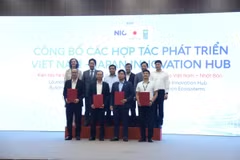
At the Vietnam – Japan Innovation Forum 2026 (Photo: tapchikinhtetaichinh.vn)

Vietnam – Japan Innovation Forum 2026 drives new models

NIC Deputy Director Hoang Trung Hieu shared that Vietnam is working to gradually make science, technology, and innovation its main growth drivers. Along the way, Japan stands out as one of its key partners, bringing strong capabilities in sci-tech, industry, and workforce, along with an extensive network of companies, research institutes, and universities.

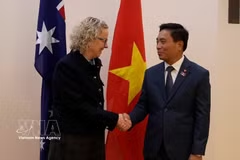
Vice President of the National Assembly Nguyen Doan Anh (R) and Deputy Speaker of the Australian House of Representatives Sharon Claydon (Photo: VNA)

Vietnam, Australia strengthen parliamentary cooperation

the Australian Parliament looks forward to close coordination with the Vietnamese NA at the Inter-Parliamentary Union (IPU) and other multilateral forums, said Deputy Speaker of the Australian House of Representatives Sharon Claydon.

Deputy Prime Minister Ho Quoc Dung (R) receives Gianluca Pettiti, President and Chief Operating Officer of US-based Thermo Fisher Scientific, in Hanoi on August 12 (Photo: VNA)

Vietnam seeks stronger cooperation with US partner in semiconductors, biomedical technology

Vietnam welcomes leading global technology groups such as Thermo Fisher Scientific to engage more deeply in the country’s science and technology ecosystem through investment, research and development, technology transfer and human resources training, as well as cooperation with domestic research institutes, universities and businesses, Deputy Prime Minister Ho Quoc Dung said.

AI-powered robots help ease the workload of civil servants in providing initial consultations, while enabling citizens to become familiar with AI applications in accessing public services. (Photo: VNA)

National programme on AI human resources development approved

The programme aims to develop an AI workforce of sufficient scale, structure and quality to meet the requirements of strategic technology sectors, enhance national technological self-reliance, promote innovation and digital transformation, and foster the digital economy and digital society.

Illustrative image (Source: techgenez.com)

VinSpace announces satellite launch contract with SpaceX

VinSpace is responsible for the research, development, manufacturing and on-orbit operation of its satellites. The satellites will support the on-orbit demonstration of in-house developed technologies, strengthen VinSpace's satellite engineering capabilities, and pave the way for future commercial space applications.

Elevating digital infrastructure to drive new era of development

Elevating digital infrastructure to drive new era of development

o create new growth momentum for the country in a new development phase, the Politburo's Resolution No. 57-NQ/TW emphasises the need to develop modern digital infrastructure, expand access to high-quality Internet services and build large-scale data centres as the foundation for a national data platform.

Visitors to UBTECH, a company major in the research and development of humanoid robots (Photo: VNA)

Sci-tech diplomacy: A new mission for diplomatic sector

The directive by General Secretary and State President Lam reflects a shift in Vietnam’s development mindset, in line with the Politburo’s Resolution 57-NQ/TW dated December 22, 2024 on breakthroughs in sci-tech, innovation and national digital transformation. For the first time, sci-tech has been placed at the very centre as a driver of growth model.

Prof. Nghiem Duc Long from University of Technology Sydney (UTS), who is also Chairman of the Vietnam-Australia Scholars & Experts Association (VASEA) (Photo: VNA)

Science, technology to become new pillar of Vietnam-Australia ties: expert

The visit to Australia by Party General Secretary and State President To Lam will open a new chapter of cooperation, enabling Vietnamese intellectuals and experts in Australia to contribute more effectively to national development and helping science, technology and innovation become an important driver of the Comprehensive Strategic Partnership.