Digital literacy campaign lays foundation for digital citizens in Phu Tho province

After nearly a year, the “Digital Literacy for All” campaign in Phu Tho is demonstrating its effectiveness through tangible results. Residents who were once hesitant about technology are becoming increasingly familiar with VNeID, online public services, cashless payments, and digital platforms for learning, production, and business.

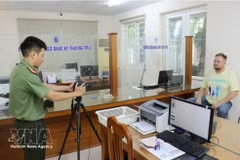
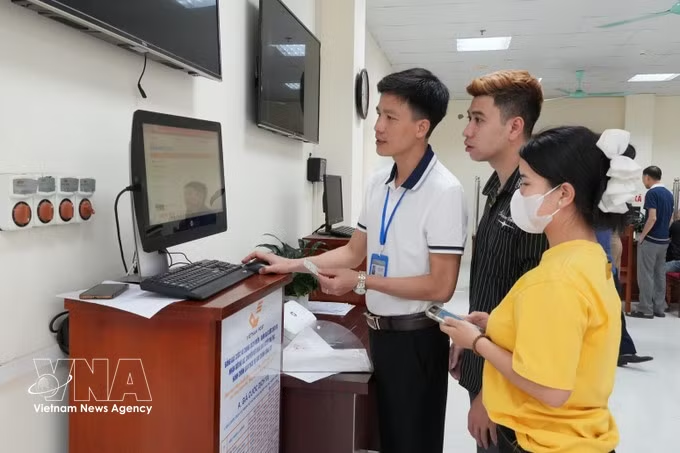
A public servant at the Public Administrative Service Centre of Vinh Yen ward, Phu Tho province, guides residents through the marriage registration process on the online public service portal. (Photo: VNA)

Phu Tho (VNA) - From hands-on digital skills classes in rural areas and community digital technology teams going door to door, to models such as “Digital family”, “Digital market - Digital rural areas” and “Every citizen - One digital identity”, the “Digital Literacy for All” campaign is gaining momentum across the northern province of Phu Tho.

After nearly a year of implementation, the campaign has helped equip people with basic digital skills and brought changes in awareness and technology use, gradually making digital transformation a driver of socio-economic development.

Bringing digital skills to every citizen

In 2025, Doan Hung commune introduced a range of thematic plans on digital transformation, digital skills training, science and technology, and innovation, while linking the campaign with Project 06, administrative reform, digital government, digital society, and the development of the rural digital economy.

A key feature of the commune's approach has been the involvement of the entire political system. Police, youth and women's organisations, farmers' associations, schools and grassroots officials have all joined efforts to promote digital platforms and guide local residents in their use. In particular, 67 community digital technology teams have remained active on a regular basis.

Doan Hung has also organised numerous awareness-raising meetings and hands-on training sessions in residential areas, helped nearly 2,000 people receive pensions and social benefits through bank accounts, promoted cashless payments, and provided guidance on using the app VNeID, online public services, personal data protection, and preventing online scams.

As a result, more than 23,580 of the commune's nearly 27,650 adults have received digital knowledge and skills training, over 25,300 electronic identification accounts have been activated, and more than 23,400 citizens have been assisted in installing VNeID. All 2,287 applications received by the commune's public administrative service centre have been processed online.

Beyond providing basic knowledge, Doan Hung has focused on creating an environment in which residents can develop regular digital habits. Social media and e-commerce platforms are also being used to promote and sell local agricultural products and OCOP products.

According to Le Thu Trang, Vice Chairwoman of the Doan Hung Commune People's Committee, the goal is not simply to meet digital literacy targets, but, more importantly, to develop the habit of using technology among residents.

The “Digital Literacy for All” campaign can only be considered successful when people actively use digital platforms in their daily lives,” she said, stressing that the commune puts people at the centre and measures success by actual use rather than simply by app installations or training sessions.

Innovative models expand community reach

Other localities in Phu Tho province have also developed innovative models to expand the campaign.

In Thinh Minh commune, 29 community digital technology teams have been established. Models such as “hands-on guidance”, “Digital weekend”, and Zalo groups connecting schools and families have helped thousands of residents, particularly older people, gradually master basic digital skills.

Bui Thi Nhi, a resident of Gieng 1 hamlet in Thinh Minh commune, said she previously did not know how to use a smartphone to complete administrative procedures. With guidance from the community digital technology team, she can now look up information and access several basic digital services.

Nguyen Thai Hoa, Vice Chairman of the Thinh Minh Commune People's Committee, said the models have made it easier for local residents to access and use digital technology.

In mountainous areas and communities inhabited by ethnic minority groups, many respected community figures have emerged as “digital champions”, helping bring the campaign closer to residents. Among them is Sung A Denh, a respected figure among the Mong ethnic community in Pa Co commune. In addition to actively improving his own digital skills, he has promoted the Party's guidelines and the State's policies and laws and encouraged local residents to attend digital transformation training courses.

Sung A Denh has directly guided local people in installing and using VNeID, accessing reliable information online, promoting local products through digital platforms, and gradually applying technology to agricultural production.

Bui Van Luyen, Vice President of the Vietnam Fatherland Front Committee of Phu Tho province, said respected community figures play a particularly important role in grassroots communications. When each respected community figure becomes a “digital champion”, the campaign can achieve a stronger and more sustainable reach.

After nearly a year, the “Digital Literacy for All” campaign in Phu Tho is demonstrating its effectiveness through tangible results. Residents who were once hesitant about technology are becoming increasingly familiar with VNeID, online public services, cashless payments, and digital platforms for learning, production, and business.

The campaign is thus laying the groundwork for digital citizens, while supporting the development of digital government, digital economy ,and digital society, with the aim of ensuring that no one is left behind in the country's digital transformation process./.

VNA

See more

Firefighters and rescue personnel deploy specialised equipment to rescue two truck drivers trapped in their cabins. (Photo: VNA)

Road accident fund to provide support from September

Under Decree No. 279/2025/ND-CP and Circular No. 126/2026/TT-BCA, injured victims with bodily injury rates of over 31% to below 81% may receive up to 10 million VND (381 USD) per case, while families of deceased victims may receive up to 20 million VND.

Ha Thanh, Chairwoman of the Ho Chi Minh City Union of Friendship Organisations and head of the advisory council for international integration, people-to-people diplomacy and overseas Vietnamese affairs under the Vietnam Fatherland Front Committee of the city (Photo: VNA)

New resolution seeks to unlock OV resources for national development

Ha Thanh, Chairwoman of the Ho Chi Minh City Union of Friendship Organisations and head of the advisory council for international integration, people-to-people diplomacy and overseas Vietnamese affairs under the Vietnam Fatherland Front Committee of the city, said Resolution No. 23 builds on the fundamental viewpoints of the Politburo's Resolution No. 36-NQ/TW issued in 2004, reaffirming that overseas Vietnamese are an inseparable part of the nation and a bridge connecting Vietnam with the world.

The Vietnamese Embassy in London's Education Section and representatives from the Department of Higher Education (Ministry of Education and Training) visit and hold a working session at Queen Mary University of London. (Photo published by VNA)

Vietnam-UK education cooperation: From market to partnership

In the 2024/25 academic year, about 3,725 Vietnamese students studied in the UK, while 13,285 enrolled in UK programmes delivered in Vietnam. Both flows are growing, but the balance is increasingly shifting towards UK education being delivered to learners in Vietnam. If managed strategically, this could enable Vietnam to expand access to international education at home while improving the quality of its workforce.

A bus picks up passengers on National Highway 22 (Le Quang Dao Street), near An Suong Bus Station. (Photo: VNA)

Free bus fares drive sharp rise in ridership in Ho Chi Minh City

As of August 12, the city’s bus network had served nearly 12 million passenger trips, up about 44% year on year. On August 12 alone, around 306,000 passengers used free buses, an increase of roughly 55%, despite students having yet to officially return to school.

Officers and soldiers bring martyrs’ remains to the sampling station at Binh Xuyen commune Martyrs’ Cemetery in Phu Tho province (Photo: VNA)

More than 1,700 war martyrs’ remains recovered

The national steering committee will continue verifying information on suspected martyrs’ graves in key areas, including Tan Son Nhat Airport in Ho Chi Minh City, Quan Y Bac Son Hill in Dong Nai, the Con Tien base area in Quang Tri and former Vi Xuyen battlefields in Tuyen Quang.

Delegates observe a minute of silence in tribute to Cuban leader Fidel Castro Ruz (Photo: VNA)

Quang Tri celebrates 100th birthday of Cuban leader Fidel Castro

Addressing the ceremony, Vice Chairman of the provincial People’s Committee Le Duc Tien said Fidel Castro was a figure of exceptional stature whose life and revolutionary career were closely associated with the victory of the Cuban Revolution and the struggle for national independence and sovereignty, as well as the aspirations of peoples around the world for independence, freedom, peace and justice.

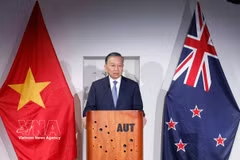
General Secretary of the Communist Party of Vietnam Central Committee and President To Lam addresses the 2026 Vietnam–New Zealand higher and vocational education forum in Auckland on August 13, 2026. (Photo: VNA)

Top leader calls for stronger Vietnam–New Zealand ties in higher and vocational education

General Secretary and President To Lam called on the two sides to jointly develop high-quality human resources for the digital, green, circular and knowledge-based economies, prioritising areas of strong demand and high complementarity such as artificial intelligence (AI), data science, digital technology, cybersecurity, biotechnology, smart agriculture, food technology, renewable energy, environmental technology, public governance and emerging occupations of the future.

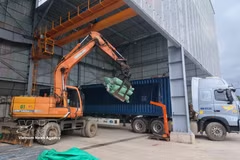
Machinery has been integrated into cargo handling lines, helping reduce labour requirements and improve import-export efficiency. (Photo: VNA)

Lang Son tackles skilled labour shortage in border-gate logistics

As the province promotes investment in logistics services and infrastructure at border gates, businesses are increasingly shifting from relying on manual labour for loading and transshipment to workers capable of operating modern equipment and handling specialised tasks.

Textbooks are sold at a bookstore operated by the Vietnam Education Publishing House. (Photo: VNA)

Hanoi to provide free textbooks from 2026–2027 school year

The municipal Department of Education and Training will work with the Department of Finance to guide wards, communes and educational institutions in implementing the student support policies adopted by central authorities and the municipal People’s Council.