Hanoi (VNA) - Deputy Prime Minister Pham Thi Thanh Tra has ordered the completion of a comprehensive database covering fallen soldiers, their graves, cemeteries and records by the end of this year.
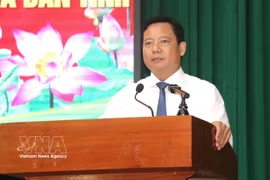
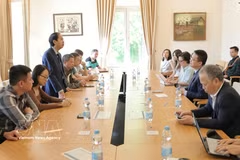
Tra, who is also head of the National Steering Committee for the Search, Collection and Identification of Martyrs’ Remains, made the request at a meeting in Hanoi on August 13 to review the 500-day campaign and set urgent tasks for the coming time.
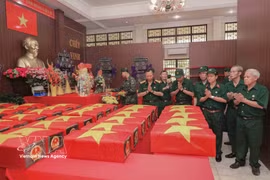
Maj. Gen. Doan Quang Hoa, chief of the committee’s office, said authorities have collected 1,715 sets of remains, or 24.5% of the target, since March 15. Of those, 691 sets were recovered in Vietnam, 174 in Laos and 850 in Cambodia. A total of 13 mass graves were found, including five in Tuyen Quang and eight at Le Thi Rieng Park in Ho Chi Minh City.
Localities have accelerated the collection and sampling, processing an average of 2,000-3,000 samples a day. Samples have been taken from 124,762 graves, or 58.4% of the target; 86,183 graves were eligible for sampling and 38,579 were not.
Nine localities have finished sampling, including Tuyen Quang, Lai Chau, Son La, Lao Cai, Quang Ninh, Ninh Binh, Ha Tinh, Hue and Lam Dong. Khanh Hoa, Tay Ninh, Ho Chi Minh City and Dong Nai have completed more than 90% of the work.
Separately, authorities have cleared mines and unexploded ordnance from 11,793.6 ha of a planned 22,725 ha, or 51.9% of the target. In the core Vi Xuyen area of Tuyen Quang, 4,075.8 ha of 4,460 ha have been cleared, or 91.39%. The work is set for completion in August to support the search and collection efforts.
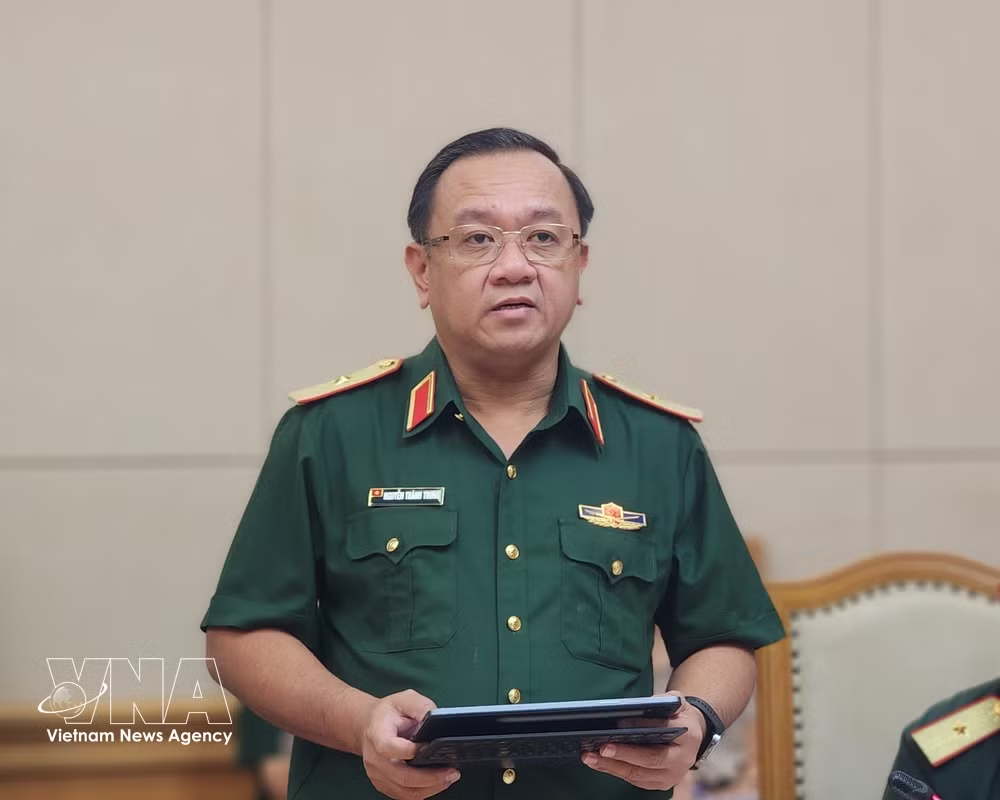
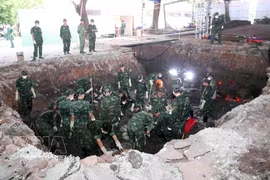
At Le Thi Rieng Park in Ho Chi Minh City’s Hoa Hung ward, 268 sets of remains were discovered and collected from June 23 – August 11, said Maj. Gen. Nguyen Thanh Trung, Political Commissar of the Ho Chi Minh City High Command.
That includes 235 individual remains and 33 sets from eight mass graves, with artifacts found alongside 158 sets.
Early results at the park show that an integrated approach is working, combining domestic and foreign archival records, historical witnesses, ground-penetrating radar and electrical resistivity technology, geophysical surveys, DNA testing, digital transformation and database development, and military historical analysis.
The operation marks the first large-scale use of a modern search model in a major urban area and could serve as a template for other localities nationwide./.