Top leader calls for stronger Vietnam–New Zealand ties in higher and vocational education

General Secretary and President To Lam called on the two sides to jointly develop high-quality human resources for the digital, green, circular and knowledge-based economies, prioritising areas of strong demand and high complementarity such as artificial intelligence (AI), data science, digital technology, cybersecurity, biotechnology, smart agriculture, food technology, renewable energy, environmental technology, public governance and emerging occupations of the future.

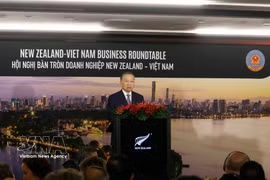
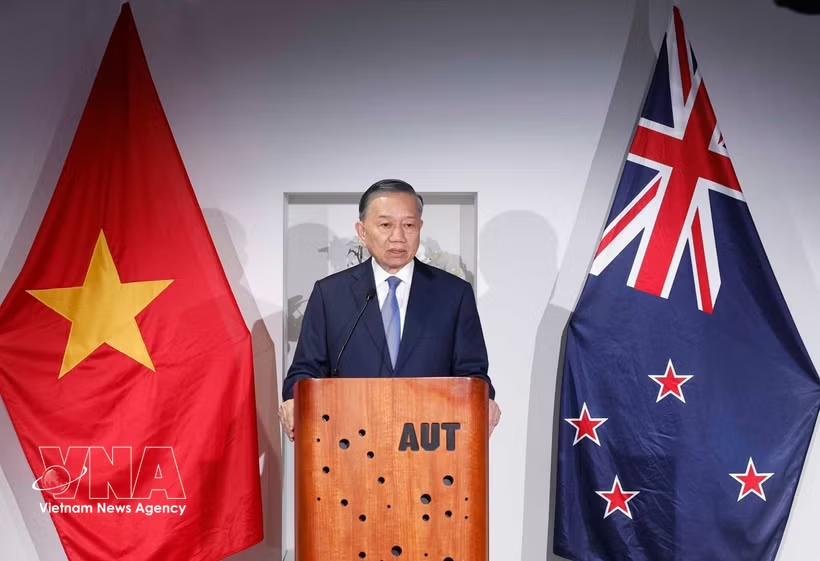
General Secretary of the Communist Party of Vietnam Central Committee and President To Lam addresses the 2026 Vietnam–New Zealand higher and vocational education forum in Auckland on August 13, 2026. (Photo: VNA)

Auckland (VNA) – General Secretary of the Communist Party of Vietnam Central Committee and President To Lam attended the 2026 Vietnam–New Zealand higher and vocational education forum in Auckland on August 13 afternoon (local time), part of his ongoing state visit to New Zealand.

At the forum, Penny Simmonds, New Zealand Minister for Tertiary Education and Minister of Science, Innovation and Technology, hailed the long-standing and wide-ranging connections between the two countries, affirming that educational cooperation has been a cornerstone of bilateral relations and will remain an important component of the Comprehensive Strategic Partnership.

Simmonds welcomed the signing of an educational cooperation agreement during the visit, saying the two sides have agreed to promote more practical and effective collaboration to build a sustainable, inclusive and resilient education system, accelerate digital transformation, develop high-quality human resources and equip learners to adapt to the rapid changes of the digital era.

Highlighting the positive results of bilateral cooperation across various fields, she expressed her hope that the two countries will continue to work together in education to equip students with the skills needed to succeed in today’s world.

The New Zealand Government will continue to support short-term English-language training courses for Vietnamese officials, facilitate exchanges of students and academics, and enhance cooperation between educational institutions of the two countries, helping Vietnamese students access New Zealand-quality education in Vietnam, the official added.

Addressing the forum, General Secretary and President Lam said Vietnam regards human development as the focus, goal and driving force of national construction and defence. The Party and State have identified education and training as a top national priority while science, technology, innovation and digital transformation are viewed as key drivers of labour productivity, national competitiveness and quality growth.

He noted that both Vietnam and New Zealand attach importance to education, promote innovation, pursue green growth and sustainable development, respect international law and place people at the centre of development policies.

New Zealand has extensive experience in building a high-quality and flexible education system centred on learners, practical skills, research, innovation and the needs of the economy. It also possesses strengths in high-tech agriculture, food technology, resources management, the green economy, digital transformation, sustainable development and modern public governance. These areas are well aligned with Vietnam’s development needs and offer numerous opportunities for practical bilateral cooperation.

To advance partnerships in higher and vocational education more substantively, General Secretary and President Lam called on the two sides to jointly develop high-quality human resources for the digital, green, circular and knowledge-based economies, prioritising areas of strong demand and high complementarity such as artificial intelligence (AI), data science, digital technology, cybersecurity, biotechnology, smart agriculture, food technology, renewable energy, environmental technology, public governance and emerging occupations of the future.

The two sides should promote cooperation in research, innovation and knowledge transfer. Universities and research institutes should become centres for creating knowledge, connecting businesses and addressing development challenges. More joint research groups, co-supervision programmes for doctoral students, innovation projects and mechanisms for translating research outcomes into practice should be established, he suggested.
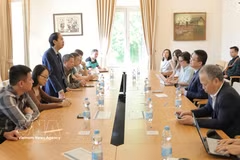
vnanet-2026-vietnamnew-zealand-higher-and-vocational-education-forum-2.jpg
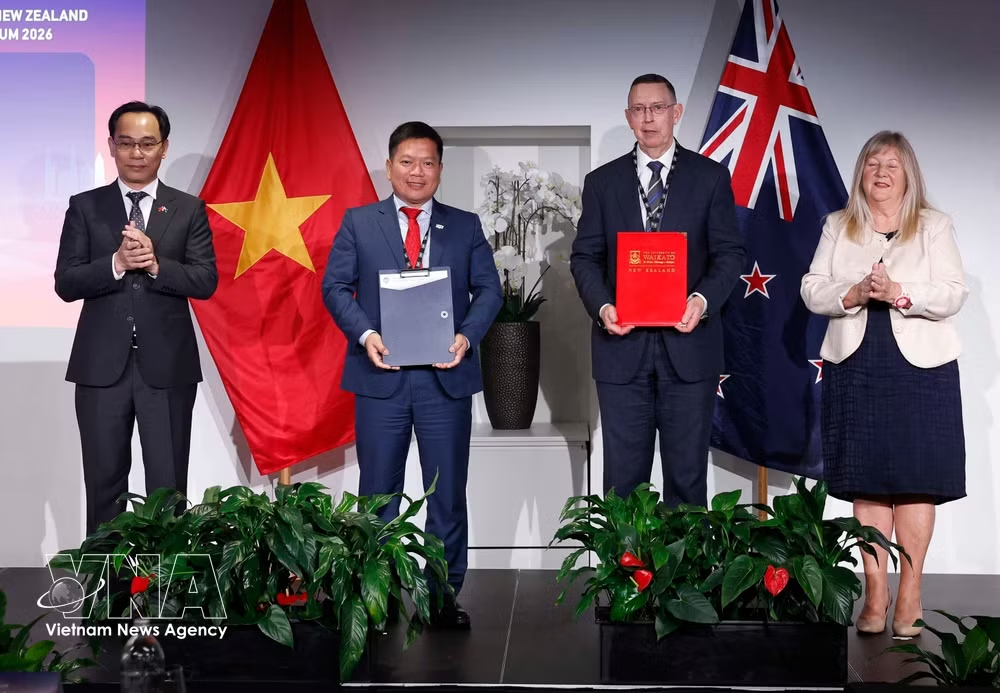
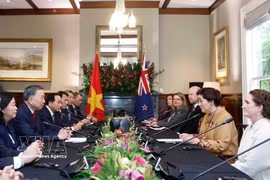
Representatives of Vietnamese and New Zealand universities exchange cooperation documents at the forum in Auckland on August 13, 2026. (Photo: VNA)

Vietnam and New Zealand also need to strengthen cooperation in vocational education and skills development by developing flexible training programmes, recognising credits and competencies, and promoting workplace training and reskilling programmes for the workforce, he added.

General Secretary and President Lam expressed his hope that the two sides will continue to expand exchanges among students, lecturers, scientists, experts and education administrators. Each lecturer, scientist and student is an ambassador of knowledge and friendship, helping to strengthen and expand the relationship between the two countries.

Cooperation agreements should soon be translated into concrete action plans with clear objectives, focal points, resources, deliverables and evaluation mechanisms. Education cooperation in the new period should be measured by tangible outcomes: learners acquire better skills, educational institutions innovate more strongly, businesses gain access to more suitable human resources, and society benefits more from knowledge and innovation.

The leader called on management agencies, universities, vocational education institutions, research institutes and businesses of both countries to select priority areas, develop joint projects capable of generating impact, and maintain regular dialogue channels so that today’s commitments can soon become practical results.

At the forum, several Vietnamese and New Zealand universities exchanged documents on educational cooperation./.
VNA

See more

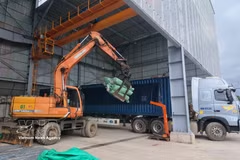
Machinery has been integrated into cargo handling lines, helping reduce labour requirements and improve import-export efficiency. (Photo: VNA)

Lang Son tackles skilled labour shortage in border-gate logistics

As the province promotes investment in logistics services and infrastructure at border gates, businesses are increasingly shifting from relying on manual labour for loading and transshipment to workers capable of operating modern equipment and handling specialised tasks.

Textbooks are sold at a bookstore operated by the Vietnam Education Publishing House. (Photo: VNA)

Hanoi to provide free textbooks from 2026–2027 school year

The municipal Department of Education and Training will work with the Department of Finance to guide wards, communes and educational institutions in implementing the student support policies adopted by central authorities and the municipal People’s Council.

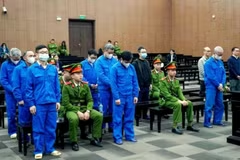
The defendants at the trial. (Photo: tuoitre.vn)

AIC case in Ca Mau: Nguyen Thi Thanh Nhan sentenced to 10 years in prison

The People's Court of Ca Mau province on August 12 sentenced former Chairwoman and General Director of the Advanced International Joint Stock Company (AIC) Nguyen Thi Thanh Nhan to ten years in prison for "violating bidding regulations, causing serious consequences" in a case involving the inflation of equipment prices for environmental monitoring stations in the former Bac Lieu province (now Ca Mau province).

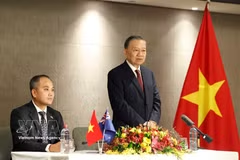
General Secretary of the Communist Party of Vietnam (CPV) Central Committee and President To Lam speaks with Vietnamese Embassy staff and representatives of the Vietnamese community in New Zealand and South Pacific island countries in Auckland on August 12 evening. (Photo: VNA)

Party General Secretary and President meets Vietnamese community in New Zealand

General Secretary of the Communist Party of Vietnam (CPV) Central Committee and President To Lam described overseas Vietnamese as “ambassadors” who help promote Vietnam's positive image internationally, and urged them to maintain solidarity, preserve national pride and cultural traditions, and make practical contributions to the country's development.

A teacher of the Canada–Vietnam Cultural and Educational Council (CVCEC) uses vivid images to illustrate the Vietnamese language. (Photo: VNA)

Vietnam’s language push abroad gains traction

The 2023–2030 project to honour the Vietnamese language overseas kicked off at a timely moment, meeting the OVs' expectations for wider language spread. More than four years since its 2022 launch, the project has produced concrete results, with a growing number of effective initiatives and novel approaches.

Aerospace engineer Tran Thang (first, left) attends the Congress of the Vietnam Fatherland Front Central Committee in January 2026. (Photo published by VNA)

Resolution 23 creates space for overseas Vietnamese to contribute to national development

After more than 20 years of implementing Resolution 36, the Party and State’s policies have been translated into numerous effective policies and actions, helping strengthen the group’ attachment to their homeland and creating favourable conditions for increasing numbers of them to return to Vietnam to visit relatives, invest, do business, work and engage in exchanges.

Layton Pike, Advisory Board Member of the Australia Vietnam Policy Institute (Photo: VNA)

Vietnam–Australia education cooperation enters new phase

The Vietnam–Australia TechConnect Forum, held on August 10 at the University of Technology Sydney during General Secretary and President To Lam’s state visit to Australia, showcased this opportunity. The event brought together representatives from both countries’ governments, universities, research institutes, and businesses, creating a space to link education with science, technology, and investment.

Tourists visit the Imperial Citadel of Hue. (Photo: VNA)

Australian tourists show growing appetite for Vietnam

Australia has become one of Vietnam’s fastest-growing long-haul tourism markets. Vietnam welcomed 490,880 Australian visitors in 2024, up 26% year on year and around 28% higher than in 2019, before the COVID-19 pandemic. In the first seven months of 2026, the country received 396,648 Australian tourists, a year-on-year increase of 25.8%, placing Australia among Vietnam’s top 10 source markets.

Head of the CPV Central Committee’s Commission for Publicity Trinh Van Quyet (centre) tours ABC facility (Photo: VNA)

Vietnam, Australia cultivate media cooperation in digital age

To match media cooperation with the weight of the Vietnam–Australia Comprehensive Strategic Partnership, he proposed five key collaboration areas, said Head of the Communist Party of Vietnam (CPV) Central Committee’s Commission for Publicity Trinh Van Quyet.

Vietnam takes effective steps to build seamless digital ecosystem for foreigners

Vietnam takes effective steps to build seamless digital ecosystem for foreigners

Despite recognising Vietnam’s progress in digital transformation, many foreigners living in the country believe that digitising individual services is only the first step. What they expect is a seamlessly connected digital ecosystem in which a single electronic identity allows users to access services and conduct transactions conveniently and securely.

Assoc. Prof. Dr. Nguyen Van Tung, a member of the Members' Council of the Vietnam Education Publishing House, speaks at a meeting with the Vietnamese Embassy. (Photo: VNA)

Vietnam-Germany cooperation strengthened in educational publishing

The VEPH is conducting a working and study visit to Germany from August 8-14 to learn from advanced models for the production and distribution of e-books and digital learning materials. The delegation is led by Assoc. Prof. Dr. Nguyen Van Tung, a member of the VEPH Members' Council.

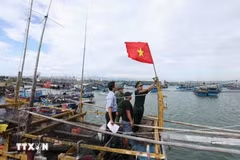
Border guards inspect vessel monitoring equipment on a fishing boat before it heads out to sea. (Photo: VNA)

Khanh Hoa aims at lifting EC ‘yellow card’, sustainable fisheries

According to the department, as of the end of June, 99.9% of eligible fishing vessels in the province had been issued fishing licences, while 100% of vessels measuring 15 metres or more had been fitted with vessel monitoring system (VMS) devices and all vessels had been marked and numbered in accordance with regulations.

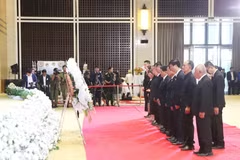
Representatives of the General Association of Vietnamese People in Laos and the Association of Vietnamese People in Vientiane lay a wreath and observe a minute of silence in memory of Lao National Assembly President Xaysomphone Phomvihane. (Photo: VNA)

Vietnamese associations in Laos pay tribute to Lao NA President

In the condolence book, representatives of the General Association of Vietnamese People in Laos and the Association of Vietnamese People in Vientiane expressed their profound sorrow over the passing of comrade Xaysomphone Phomvihane, saying his passing was not only a great loss to the Lao Party, State and people, but also meant that Vietnam lost a close and trusted friend and comrade.

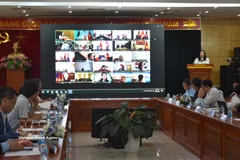
Overview of the workshop on building and developing networks of experts and intellectuals in strategic technology fields. (Photo: VNA)

Vietnam eyes global network of overseas Vietnamese experts in strategic technologies

In recent years, networks of OV experts and intellectuals have been established, with nearly 2,000 members. Five innovation and expert networks have also been formed in strategic technology areas such as artificial intelligence, semiconductors, quantum technology, cybersecurity, aviation, aerospace and unmanned aerial vehicles, connecting around 50 expert and intellectual associations overseas.