Australian tourists show growing appetite for Vietnam

Australia has become one of Vietnam’s fastest-growing long-haul tourism markets. Vietnam welcomed 490,880 Australian visitors in 2024, up 26% year on year and around 28% higher than in 2019, before the COVID-19 pandemic. In the first seven months of 2026, the country received 396,648 Australian tourists, a year-on-year increase of 25.8%, placing Australia among Vietnam’s top 10 source markets.

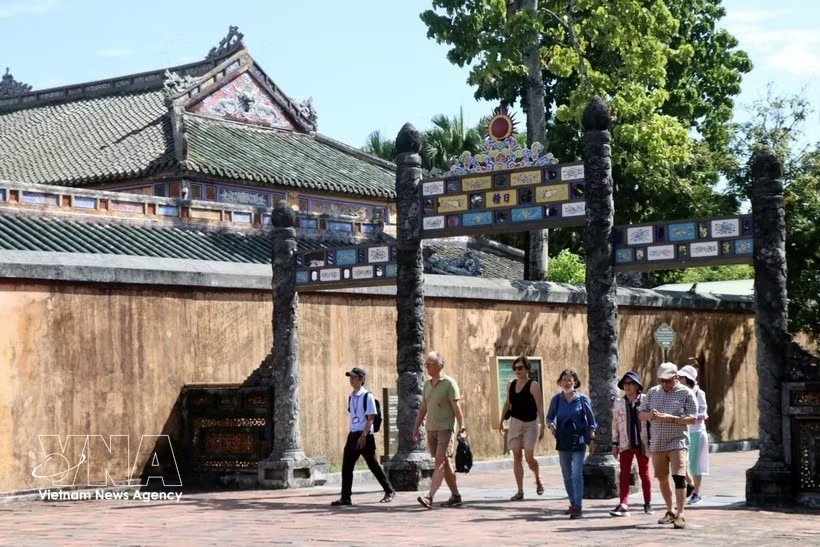
Tourists visit the Imperial Citadel of Hue. (Photo: VNA)

Hanoi (VNA) - Australia is emerging as one of Vietnam’s key tourism source markets, with visitor arrivals steadily increasing, staying longer, spending relatively more, and showing strong interest in local culture, cuisine, nature and authentic experiences.

Australia has become one of Vietnam’s fastest-growing long-haul tourism markets. Vietnam welcomed 490,880 Australian visitors in 2024, up 26% year on year and around 28% higher than in 2019, before the COVID-19 pandemic. In the first seven months of 2026, the country received 396,648 Australian tourists, a year-on-year increase of 25.8%, placing Australia among Vietnam’s top 10 source markets.

Ho Chi Minh City plays a particularly important role in attracting Australian tourists. According to Pham Huy Binh, Director of the municipal Department of Tourism, the city welcomed 253,104 Australian visitors in the first seven months of 2026, making Australia the fifth-largest among its top 20 source markets. The figure accounted for about 63.8% of all Australian arrivals in Vietnam.

Australian tourists are considered a stable, high-value market, with strong spending power and growing demand for local experiences, cuisine, history, culture, urban life, beach resorts, ecotourism and responsible tourism. These are also segments that Ho Chi Minh City is seeking to develop and improve.

For Australian travellers, Ho Chi Minh City can serve as a starting point for exploring a diverse Vietnam rich in culture and identity, Binh said.

The growing appeal of Vietnam is also reflected in the hospitality sector. Phan Trong Minh, General Director of Azerai La Residence Hue, said Australian visitors regularly rank among the hotel’s top three international markets, currently accounting for more than 10% of its international guests.

The market has many characteristics sought by Vietnam’s tourism industry, including year-round travel, longer stays, relatively high spending and a strong appetite for exploration. Australian travellers particularly value authentic and distinctive experiences rather than mass-market products and are willing to pay for quality, although they also have high expectations for a seamless overall experience, Minh said.

According to Dr. Chung Le Khang, a lecturer in Vietnamese Studies and Tourism at Ho Chi Minh City University of Education, Vietnam’s growing appeal to Australian tourists reflects a combination of factors, including improved air connectivity, competitive prices and diverse tourism products.

The distance between Australia and Vietnam is convenient for one- to two-week holidays. Visitors can also access quality accommodation, diverse cuisine and a wide range of services at relatively reasonable prices compared with many other destinations.

Another major advantage is the wide range of experiences available within a single trip, from Hanoi, Ha Long Bay and Ninh Binh to Hue, Da Nang, Hoi An, Ho Chi Minh City, the Mekong Delta and Phu Quoc.

Cuisine has also become an increasingly important travel motivator, with experiences ranging from street food and market visits to cooking classes and explorations of Vietnam’s coffee culture.

Nguyen Nguyet Van Khanh, Vietravel’s Director of Marketing and Communications, said Australian tourists tend to stay longer, visit multiple destinations and spend more time exploring local areas rather than simply visiting famous attractions.

The Vietnam-Australia tourism market is shifting from growth in visitor numbers to growth in value, she said, adding that the opportunity lies not only in attracting more visitors but also in developing deeper experiences that encourage longer stays, higher spending and repeat visits.

Despite strong growth, tourism experts and businesses believe Vietnam still has considerable room to further tap the Australian market, particularly by increasing length of stay and visitor spending.

Dr. Chung Le Khang noted that many existing tourism products still focus on quick sightseeing, packed itineraries and price competition. Australian visitors, however, could stay longer and spend more if Vietnam develops more specialised products, including culinary tourism, wellness, trekking, cycling, golf, river tourism, agricultural tourism, heritage exploration and extended stays combining several destinations.

This requires a shift from simply taking tourists through multiple destinations to enabling them to experience each destination more deeply.

Rather than selling accommodation, tickets and transportation separately, businesses could package experiences such as meeting artisans, learning to cook local dishes, exploring architecture, discovering local history and participating in community life.

Australian travellers have strong spending power but also high expectations for quality. Issues such as litter, poor hygiene, aggressive solicitation, unclear pricing, inaccurate English-language information and unprofessional complaint handling can influence their decisions to return to Vietnam or recommend the destination to others.

Vietravel suggested that instead of simply combining Hanoi, Ha Long, Hoi An and Ho Chi Minh City into a conventional itinerary, tourism products should tell a coherent story about the culture, cuisine, communities, nature and lifestyle of each destination.

The company’s strategy is to develop 10-15-day itineraries for Australian visitors, connecting multiple regions while increasing cultural, culinary, nature and local-life experiences. It also plans to expand premium, wellness, golf, MICE and specialised small-group tours.

From a management perspective, Ho Chi Minh City plans to work with Australian partners to develop new itineraries connecting urban experiences with beach resorts, ecotourism, community-based tourism and high-quality services.

The city aims to increase the value of visitor experiences, extend stays and develop a dynamic two-way tourism market. It also plans to strengthen direct links between businesses from the two countries, promote familiarisation trips, press trips and B2B activities, and deepen cooperation with airlines and travel companies. High-value segments such as premium resorts, culinary tourism, ecotourism, MICE and community-based cultural experiences will be prioritised./.
VNA

See more

Head of the CPV Central Committee’s Commission for Publicity Trinh Van Quyet tours ABC facility (Photo: VNA)

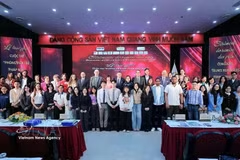
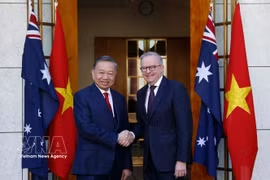
Vietnam, Australia cultivate media cooperation in digital age

Vietnam always attaches importance to people’s right to access information and is committed to building a professional, humane, and modern press. Vietnamese media do not just deliver timely news but also play a crucial role in projecting Vietnamese culture, image, land, and people to the world.

Vietnam takes effective steps to build seamless digital ecosystem for foreigners

Vietnam takes effective steps to build seamless digital ecosystem for foreigners

Despite recognising Vietnam’s progress in digital transformation, many foreigners living in the country believe that digitising individual services is only the first step. What they expect is a seamlessly connected digital ecosystem in which a single electronic identity allows users to access services and conduct transactions conveniently and securely.

Assoc. Prof. Dr. Nguyen Van Tung, a member of the Members' Council of the Vietnam Education Publishing House, speaks at a meeting with the Vietnamese Embassy. (Photo: VNA)

Vietnam-Germany cooperation strengthened in educational publishing

The VEPH is conducting a working and study visit to Germany from August 8-14 to learn from advanced models for the production and distribution of e-books and digital learning materials. The delegation is led by Assoc. Prof. Dr. Nguyen Van Tung, a member of the VEPH Members' Council.

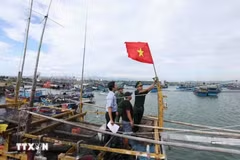
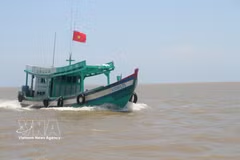
Border guards inspect vessel monitoring equipment on a fishing boat before it heads out to sea. (Photo: VNA)

Khanh Hoa aims at lifting EC ‘yellow card’, sustainable fisheries

According to the department, as of the end of June, 99.9% of eligible fishing vessels in the province had been issued fishing licences, while 100% of vessels measuring 15 metres or more had been fitted with vessel monitoring system (VMS) devices and all vessels had been marked and numbered in accordance with regulations.

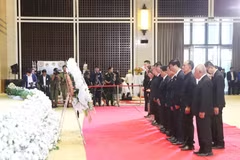
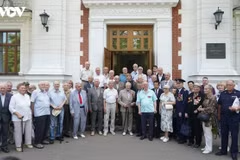
Representatives of the General Association of Vietnamese People in Laos and the Association of Vietnamese People in Vientiane lay a wreath and observe a minute of silence in memory of Lao National Assembly President Xaysomphone Phomvihane. (Photo: VNA)

Vietnamese associations in Laos pay tribute to Lao NA President

In the condolence book, representatives of the General Association of Vietnamese People in Laos and the Association of Vietnamese People in Vientiane expressed their profound sorrow over the passing of comrade Xaysomphone Phomvihane, saying his passing was not only a great loss to the Lao Party, State and people, but also meant that Vietnam lost a close and trusted friend and comrade.

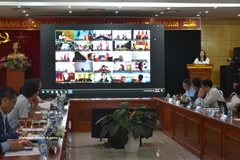
Overview of the workshop on building and developing networks of experts and intellectuals in strategic technology fields. (Photo: VNA)

Vietnam eyes global network of overseas Vietnamese experts in strategic technologies

In recent years, networks of OV experts and intellectuals have been established, with nearly 2,000 members. Five innovation and expert networks have also been formed in strategic technology areas such as artificial intelligence, semiconductors, quantum technology, cybersecurity, aviation, aerospace and unmanned aerial vehicles, connecting around 50 expert and intellectual associations overseas.

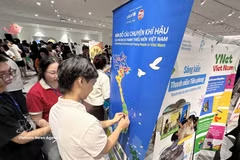
Young people take part in activities at the event to mark International Youth Day 2026 in Hanoi on August 9 (Photo: VNA)

Over 40 youth-led initiatives introduced at International Youth Day 2026

The event, organised by the Youth Advisory Group of the UN in Vietnam, brought together 44 youth groups, social enterprises, educational institutions and UN-supported programmes. Exhibition booths and interactive activities at the event introduced solutions created and led by young people.

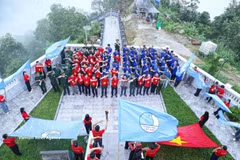
The flag-raising ceremony at the A Pa Chai flagpole in Sin Thau commune, Dien Bien province (Photo: VNA)

“I Love My Fatherland” journey reaches Dien Bien

The "I Love My Fatherland" journey is an annual nationwide programme aimed at promoting patriotism, revolutionary ideals and civic responsibility among Vietnam's youth through visits to historical, cultural and sovereignty landmarks across the country.

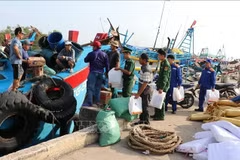
Officers of the Dong Thap provincial Border Guard give gifts and provide information on IUU fishing control and prevention to fishermen at Vam Lang fishing port, Gia Thuan commune, Dong Thap province. (Photo: VNA)

Dong Thap tightens fishing vessel management

The provincial Department of Agriculture and Environment, acting as the standing agency of Dong Thap's IUU Steering Committee, has been tasked with reviewing and updating the province's action plan to address recommendations raised during the EC's fifth inspection mission on Vietnam's anti-IUU efforts.

At the launch ceremony (Photo: VNA)

French-language newspaper launches video contest

The contest, announced this week, is a video-based evolution of the newspaper's 'Jeunes Reporters Francophones' competition, which has run for ten seasons since its 2016 launch with backing from the Asia-Pacific regional office of the International Organisation of La Francophonie (OIF).

Since the beginning of the year, Ca Mau provinces have inspected 100% of fishing vessels arriving at and departing from designated fishing ports in accordance with regulations. (Photo: VNA)

Ca Mau launches peak campaign to combat IUU fishing

As one of Vietnam’s largest fishing centres, with an extensive coastline and a sizeable offshore fleet, Ca Mau considers combating IUU fishing a top political priority. Provincial authorities said recent efforts have yielded positive results, particularly in fisheries management and law enforcement.