Vietnam forges cooperation with US to access advanced technologies for identifying fallen soldiers' remains

A key destination was the University of Georgia, home to a leading interdisciplinary research model for locating and recovering human remains. Its research teams have developed an integrated scientific ecosystem combining history, anthropology, archaeology, artificial intelligence (AI), chemical sensing, environmental DNA (eDNA), remote sensing and geophysics.

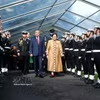
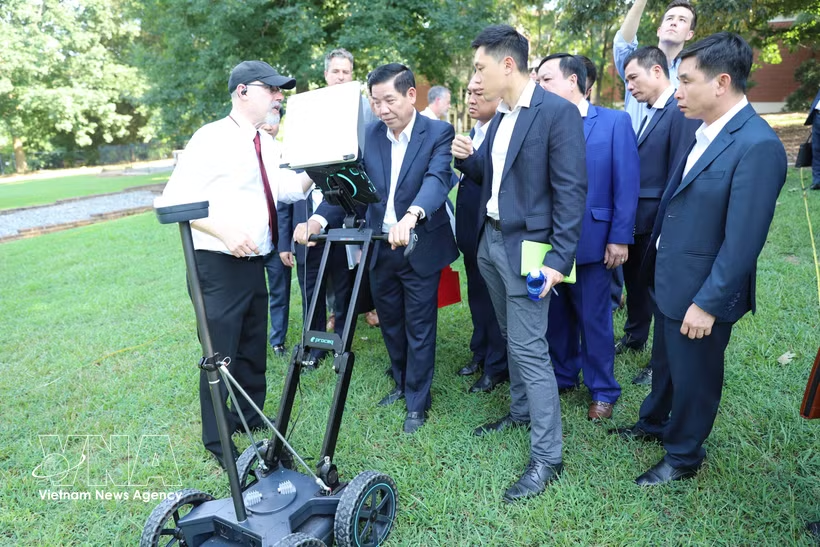
Deputy Minister of National Defence Sen. Lieut. Gen. Nguyen Van Gau (second from left) learns about advanced scientific and technological solutions to the search for and identification of the remains of fallen soldiers at University of Georgia. (Photo: VNA)

Washington D.C. (VNA) – A delegation led by Deputy Minister of National Defence Sen. Lieut. Gen. Nguyen Van Gau, who is deputy head of the National Steering Committee on the Search for, Collection and Identification of Martyrs’ Remains (Steering Committee 515), conducted in-depth working sessions on August 12 (local time) at the University of Georgia and a leading US military forensic facility.

The visit marked an important step in Vietnam’s efforts to apply advanced scientific and technological solutions to the search for and identification of the remains of fallen soldiers.

A key destination was the University of Georgia, home to a leading interdisciplinary research model for locating and recovering human remains. Its research teams have developed an integrated scientific ecosystem combining history, anthropology, archaeology, artificial intelligence (AI), chemical sensing, environmental DNA (eDNA), remote sensing and geophysics. Experts stressed that in complex terrains, no single technology can address all challenges. Instead, historical records, field observations and modern computational capabilities need to be brought together in an integrated approach.

During the in-depth discussions, the Vietnamese delegation was introduced to a range of advanced technologies, notably ground-penetrating radar (GPR). To adapt the technology to Vietnam’s wet clay soils, where signal attenuation is high, scientists have integrated magnetic sensors and image-processing algorithms to more accurately detect disturbances in soil layers associated with mass graves.

The university leadership has showed particular interest in a project to apply advanced technologies to assist Vietnam in searching for and identifying martyrs’ remains, and set up a team of leading scientists from relevant fields. Over the past 18 months, researchers have made several trips to Vietnam and developed comprehensive, highly interdisciplinary solutions. The approach is considered potentially groundbreaking, as it brings together a wider range of expertise and resources in pursuit of the ultimate goal of locating and identifying the remains of fallen soldiers.

Vietnam is particularly interested in eDNA analysis and plasma spectrometry to identify commingled remains, alongside magnetic and ground-penetrating radar technologies. A mobile eDNA analysis system could detect biological traces of human remains directly at search sites, helping recovery teams avoid unnecessary large-scale excavation.

The University of Georgia pledged to transfer technologies, provide short-term training courses for Vietnamese recovery teams and share mapping materials. The expanded international cooperation is expected to shorten the search and verification process, offering renewed hope to thousands of families of fallen soldiers in Vietnam.

Earlier, the delegation conducted a field visit and exchanged practical experience at the Armed Forces Medical Examiner System (AFMES) in Delaware where they observed the facility’s operations, biological data management system and methods for preserving remains and forensic specimens.

Discussions focused on next-generation forensic techniques and records management at the Armed Forces DNA Identification Laboratory, which specialises in DNA analysis to support the search for and identification of deceased servicemen.

Speaking at the working session, Gau affirmed that applying scientific and technological advances is crucial to the implementation of Vietnam’s policy of gratitude toward those who sacrificed their lives for national independence.

He said the knowledge and practical lessons gained from the visit will provide an important basis for Steering Committee 515 to study and recommend solutions to improve military forensic identification procedures in Vietnam. Proactively accessing international standards in data management and advanced testing technologies is also expected to create a breakthrough, helping strengthen the professional capacity of domestic DNA testing centres.

The delegation’s visit not only provided an opportunity to learn about new approaches to applying modern technologies, but also contributed to improving and standardising procedures for the forensic examination and identification of martyrs’ remains in Vietnam in the time ahead./.


VNA
See more

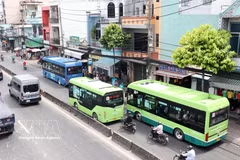
A bus picks up passengers on National Highway 22 (Le Quang Dao Street), near An Suong Bus Station. (Photo: VNA)

Free bus fares drive sharp rise in ridership in Ho Chi Minh City

As of August 12, the city’s bus network had served nearly 12 million passenger trips, up about 44% year on year. On August 12 alone, around 306,000 passengers used free buses, an increase of roughly 55%, despite students having yet to officially return to school.

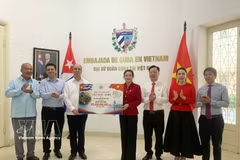
Delegates observe a minute of silence in tribute to Cuban leader Fidel Castro Ruz (Photo: VNA)

Quang Tri celebrates 100th birthday of Cuban leader Fidel Castro

Addressing the ceremony, Vice Chairman of the provincial People’s Committee Le Duc Tien said Fidel Castro was a figure of exceptional stature whose life and revolutionary career were closely associated with the victory of the Cuban Revolution and the struggle for national independence and sovereignty, as well as the aspirations of peoples around the world for independence, freedom, peace and justice.

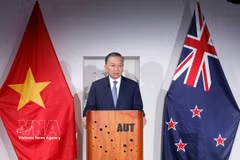
General Secretary of the Communist Party of Vietnam Central Committee and President To Lam addresses the 2026 Vietnam–New Zealand higher and vocational education forum in Auckland on August 13, 2026. (Photo: VNA)

Top leader calls for stronger Vietnam–New Zealand ties in higher and vocational education

General Secretary and President To Lam called on the two sides to jointly develop high-quality human resources for the digital, green, circular and knowledge-based economies, prioritising areas of strong demand and high complementarity such as artificial intelligence (AI), data science, digital technology, cybersecurity, biotechnology, smart agriculture, food technology, renewable energy, environmental technology, public governance and emerging occupations of the future.

Machinery has been integrated into cargo handling lines, helping reduce labour requirements and improve import-export efficiency. (Photo: VNA)

Lang Son tackles skilled labour shortage in border-gate logistics

As the province promotes investment in logistics services and infrastructure at border gates, businesses are increasingly shifting from relying on manual labour for loading and transshipment to workers capable of operating modern equipment and handling specialised tasks.

Textbooks are sold at a bookstore operated by the Vietnam Education Publishing House. (Photo: VNA)

Hanoi to provide free textbooks from 2026–2027 school year

The municipal Department of Education and Training will work with the Department of Finance to guide wards, communes and educational institutions in implementing the student support policies adopted by central authorities and the municipal People’s Council.

The defendants at the trial. (Photo: tuoitre.vn)

AIC case in Ca Mau: Nguyen Thi Thanh Nhan sentenced to 10 years in prison

The People's Court of Ca Mau province on August 12 sentenced former Chairwoman and General Director of the Advanced International Joint Stock Company (AIC) Nguyen Thi Thanh Nhan to ten years in prison for "violating bidding regulations, causing serious consequences" in a case involving the inflation of equipment prices for environmental monitoring stations in the former Bac Lieu province (now Ca Mau province).

General Secretary of the Communist Party of Vietnam (CPV) Central Committee and President To Lam speaks with Vietnamese Embassy staff and representatives of the Vietnamese community in New Zealand and South Pacific island countries in Auckland on August 12 evening. (Photo: VNA)

Party General Secretary and President meets Vietnamese community in New Zealand

General Secretary of the Communist Party of Vietnam (CPV) Central Committee and President To Lam described overseas Vietnamese as “ambassadors” who help promote Vietnam's positive image internationally, and urged them to maintain solidarity, preserve national pride and cultural traditions, and make practical contributions to the country's development.

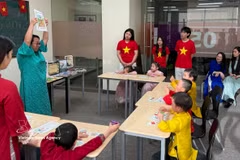
A teacher of the Canada–Vietnam Cultural and Educational Council (CVCEC) uses vivid images to illustrate the Vietnamese language. (Photo: VNA)

Vietnam’s language push abroad gains traction

The 2023–2030 project to honour the Vietnamese language overseas kicked off at a timely moment, meeting the OVs' expectations for wider language spread. More than four years since its 2022 launch, the project has produced concrete results, with a growing number of effective initiatives and novel approaches.

Aerospace engineer Tran Thang (first, left) attends the Congress of the Vietnam Fatherland Front Central Committee in January 2026. (Photo published by VNA)

Resolution 23 creates space for overseas Vietnamese to contribute to national development

After more than 20 years of implementing Resolution 36, the Party and State’s policies have been translated into numerous effective policies and actions, helping strengthen the group’ attachment to their homeland and creating favourable conditions for increasing numbers of them to return to Vietnam to visit relatives, invest, do business, work and engage in exchanges.

Layton Pike, Advisory Board Member of the Australia Vietnam Policy Institute (Photo: VNA)

Vietnam–Australia education cooperation enters new phase

The Vietnam–Australia TechConnect Forum, held on August 10 at the University of Technology Sydney during General Secretary and President To Lam’s state visit to Australia, showcased this opportunity. The event brought together representatives from both countries’ governments, universities, research institutes, and businesses, creating a space to link education with science, technology, and investment.

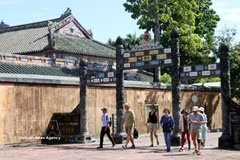
Tourists visit the Imperial Citadel of Hue. (Photo: VNA)

Australian tourists show growing appetite for Vietnam

Australia has become one of Vietnam’s fastest-growing long-haul tourism markets. Vietnam welcomed 490,880 Australian visitors in 2024, up 26% year on year and around 28% higher than in 2019, before the COVID-19 pandemic. In the first seven months of 2026, the country received 396,648 Australian tourists, a year-on-year increase of 25.8%, placing Australia among Vietnam’s top 10 source markets.

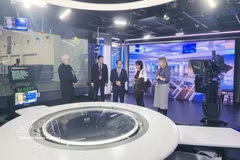
Head of the CPV Central Committee’s Commission for Publicity Trinh Van Quyet (centre) tours ABC facility (Photo: VNA)

Vietnam, Australia cultivate media cooperation in digital age

To match media cooperation with the weight of the Vietnam–Australia Comprehensive Strategic Partnership, he proposed five key collaboration areas, said Head of the Communist Party of Vietnam (CPV) Central Committee’s Commission for Publicity Trinh Van Quyet.