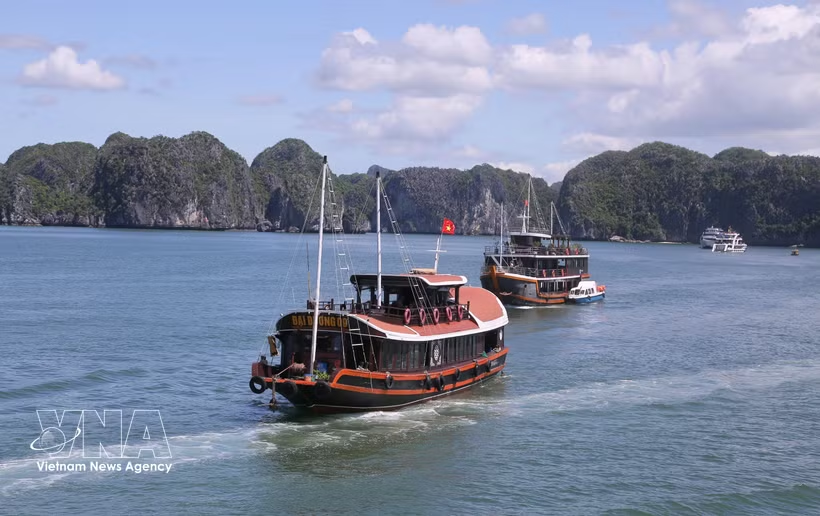
Hai Phong (VNA) - Hai Phong, the largest seaport city in northern Vietnam, boasts a unique maritime culture shaped over thousands of years. This rich heritage serves as a strong foundation for the city to carry out the Prime Minister’s Decision No. 1189/QD-TTg on national, cultural, and family value systems.
Development rooted in maritime heritage
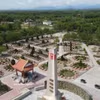
Hai Phong is home to important traces of Vietnam’s early development. According to the Cat Hai Special Zone People’s Committee, the Cai Beo archaeological site on the southeastern coast of Cat Ba island is one of the earliest cradles of Vietnam’s maritime culture, dating back around 7,000 years and predating the Ha Long culture. The site is the largest ancient fishing village discovered in Vietnam, providing vivid evidence of early human settlement and adaptation to the sea.
By the late 19th century, Hai Phong became the third-largest city in Indochina and an important industrial, commercial, transport, and financial centre. In the 20th century, the city not only emerged as an economic powerhouse but also became a cradle of the workers’ and revolutionary movements.
Following national reunification, the city continued to lead in the renewal process, gradually establishing itself as a growth pole in northern Vietnam and a leading marine economic centre. Over the centuries, Hai Phong has forged a maritime cultural identity characterised by resilience, openness, and creativity.
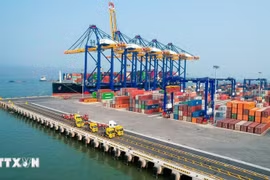
As Vietnam enters the digital era, with the marine economy, logistics, smart ports, and digital transformation emerging as key growth drivers, these cultural values continue to serve as a foundation for Hai Phong to develop into a modern international port city and maintain its role as a gateway to global integration.
These values are also reflected in the city’s strong socio-economic performance, particularly its success in attracting foreign direct investment (FDI). Hai Phong currently has 1,868 valid FDI projects with total registered capital of around 54 billion USD. The city is also studying the establishment of a free trade zone with a range of special incentives to create new growth momentum.
New stature driven by ambition to reach open sea
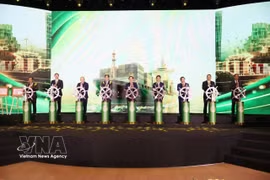
The DEEP C Industrial Park Complex is a notable example of Hai Phong city’s transition towards a green growth model.
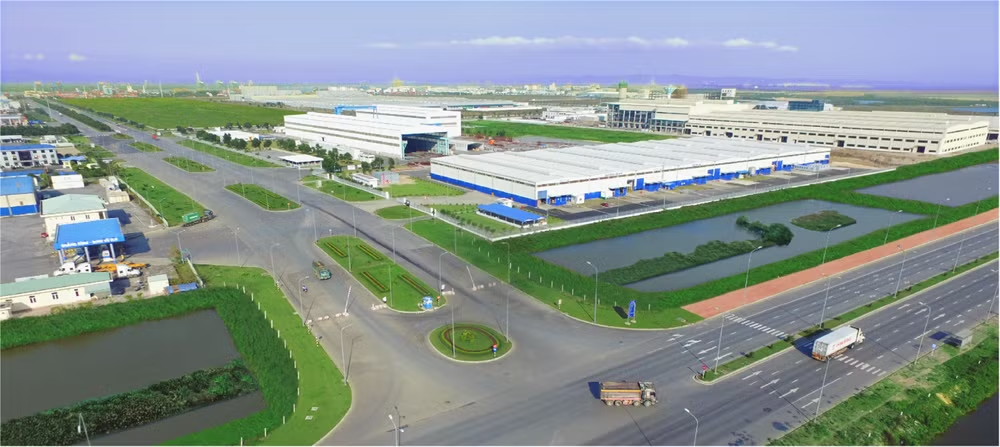
Bruno Jaspaert, General Director of the DEEP C Industrial Park Complex and Chairman of the European Chamber of Commerce in Vietnam (EuroCham), has repeatedly highlighted Hai Phong’s rapid transformation. He said administrative reforms, infrastructure investment, and the city’s long-term development vision have created an important foundation for attracting high-quality investment and becoming a modern maritime city with a strong regional position. In a recent address to students, Jaspaert said they did not need to look far for opportunities, as Hai Phong itself was a place where talent and excellence converged.
Alongside DEEP C, Nam Cau Kien Industrial Park is the country’s first green and ecological industrial park. Pham Hong Diep, Chairman of the Board of Directors of SHINEC, the park’s investor, said that in the new era of digital transformation, green and knowledge-based economy, and deeper global integration, entrepreneurs are playing an increasingly crucial role in creating sustainable growth for the country.
As an industrial, logistics, and port hub, Hai Phong is not only posting impressive economic growth but also faces an urgent need to build a new generation of resilient and innovative entrepreneurs with a strong aspiration to take the city and its businesses global.
According to Diep, for Hai Phong to become a leading industrial, service, and innovation centre, it needs a business community with strong character, national spirit, modern mindset, and an international outlook. Entrepreneurs should develop global strategic mindset while taking concrete action locally, positioning their businesses not only within the city but also across regional and global supply chains.
He also noted that decisiveness and resilience are defining characteristics of Hai Phong people. These qualities should be harnessed to overcome barriers to integration and transformation.
Tran Bao Huy, a Hai Phong native who has lived and worked in the Republic of Korea and China, said the city’s strategy to develop a 20,000-ha southern coastal economic zone towards becoming a third-generation ecological economic zone, alongside plans for port development and a free trade zone, represents an ambitious vision.
Drawing on his own experience and that of friends and colleagues, Huy said the overseas young intellectual community from Hai Phong is growing stronger, with international experience, solid scientific expertise, and a strong sense of responsibility towards their hometown.
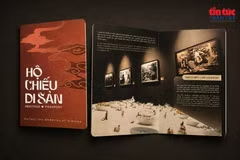
From its maritime cultural heritage shaped over thousands of years to its current aspiration for integration and innovation, Hai Phong is steadily turning its ambition of a modern regional marine economic centre into reality. Promoting its cultural value system will not only preserve the city’s identity but also unleash endogenous resources for a new phase of breakthrough development./.