Vietnamese language celebrated as first computer-based proficiency test held overseas

For Vietnamese communities overseas, Vietnamese is not merely a means of communication but also an important part of cultural identity and a bond connecting people with their homeland. For foreigners who have developed an affection for Vietnam, learning the language opens another door to a deeper understanding of the country's culture, history and people.

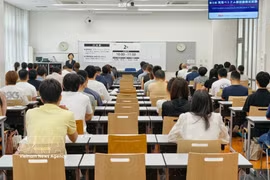
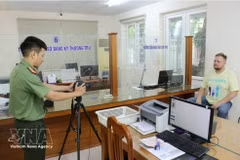
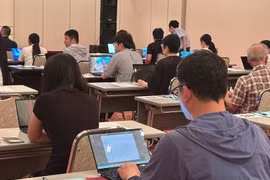
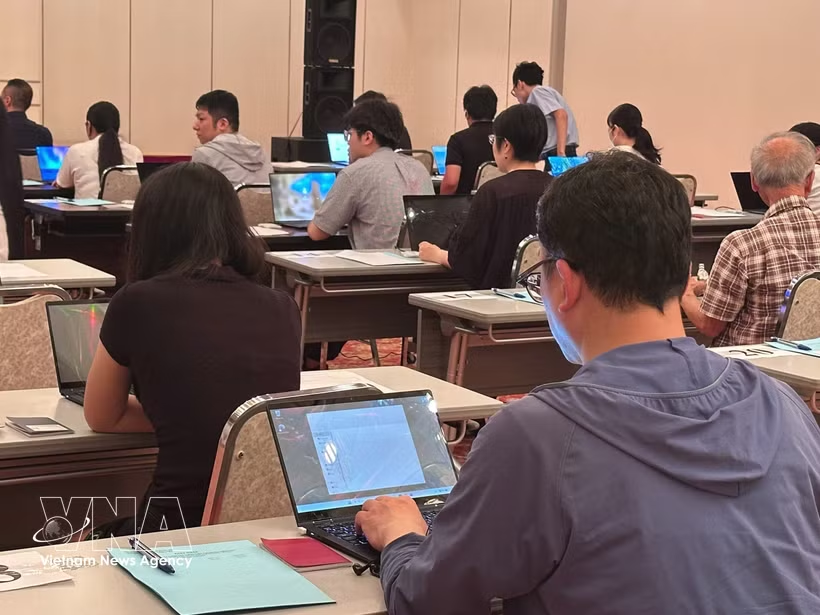
Candidates familiarise themselves with the computers before sitting the Vietnamese language proficiency assessment in Osaka on August 15, 2026. (Photo: VNA)

Hanoi (VNA) – A Vietnamese language proficiency assessment, based on the six-level Vietnamese language proficiency framework for foreigners, has been held on computers for the first time overseas at the Consulate General of Vietnam in Osaka, Japan.

The August 15 examination marked a new step forward in the teaching, assessment and international promotion of the Vietnamese language.

The test was organised academically by Hanoi National University of Education, under the auspices of the Consulate General of Vietnam in Osaka and in coordination with the Vietnam Studies Centre under the Vietnam - Japan Economic Cooperation Promotion Association. Its results will serve the needs of learners pursuing study, research, employment and cultural exchanges, as interest in the Vietnamese language continues to grow in many countries.

The Osaka examination was conducted on a pilot basis in a computer-based test room for 25 candidates. The trial was intended not only to test the computer-based format, but also to assess and refine organisational procedures, laying the groundwork for expanding the examination to more countries and territories in the future.

The diversity of candidates in terms of age, nationality and reasons for learning Vietnamese was a notable feature of the examination. The youngest was eight-year-old Kayano Emiko (Le Tra My), a Vietnamese national living in Japan, while the oldest was 69-year-old Fukumoto Takao, a Japanese national.
Vietnamese Consul General in Osaka Nguyen Truong Son stressed that the examination was a concrete step towards implementing Politburo Resolution No. 23-NQ/TW, dated August 2, 2026, on overseas Vietnamese affairs.

He affirmed that the Consulate General would continue to actively provide guidance, support and favourable conditions for the Vietnamese community in Japan to preserve, teach and use the Vietnamese language.

Le Thuong, a member of the Vietnamese examination council in Japan and Director of the Vietnam Studies Centre, said the successful organisation of the test demonstrated the role of the Vietnamese language in preserving national cultural identity and strengthening the great national unity bloc.

“We hope that, from this milestone in Osaka, the model will continue to expand to many countries, helping the Vietnamese language reach an increasingly wider international audience,” she said.

Dr Pham Thi Ngoc Quynh, Director of the Institute of International Education and Training at Hanoi National University of Education, said that in preparation for the first overseas computer-based Vietnamese proficiency examination, the university had spent considerable time completing its question bank, examination regulations, security procedures and software system. It had also worked closely with partners in Japan to review facilities, examination supervision arrangements and procedures for handling possible incidents.

The initiative is regarded as an important pilot in standardising and internationalising Vietnamese language assessment in accordance with national standards, she noted.

For Vietnamese communities overseas, Vietnamese is not merely a means of communication but also an important part of cultural identity and a bond connecting people with their homeland. For foreigners who have developed an affection for Vietnam, learning the language opens another door to a deeper understanding of the country's culture, history and people.

Yoshikawa Emiko, a second-year student at Osaka University, said she was learning Vietnamese so that she could communicate with her Vietnamese friends. She said she has been deeply impressed by the friendliness and kindness of Vietnamese people.

Imagawa Hiroshi, who works for an electricity company, began learning Vietnamese after being posted to Vietnam for three years under a programme run by the Japan International Cooperation Agency (JICA). He said the language is not particularly difficult for Japanese learners because of similarities in vocabulary. Pronunciation, however, remained a challenge for him.

Another candidate, Taniguchi Takuya, who engages in support services for international students, has been learning Vietnamese for nine years. Although he could not recall exactly what first prompted him to take up the language, he said his love for Vietnam – from its cuisine and landscapes to its culture – has motivated him to continue studying for almost a decade.

The cultural similarities between Vietnam and Japan, particularly the influence of Chinese-character culture on both countries, has also made Vietnamese feel more familiar and easier for him to remember, he said./.

VNA
See more

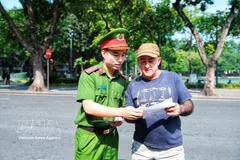
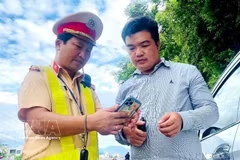
A police officer introduces a foreign visitor to the “Smart police station” kiosk, making it easier for international visitors to access police support services. (Photo: VNA)

Pilot "Smart police station" kiosk launched in Hanoi

During the pilot phase, the "Smart police station" provides five core functions: crime/incident reporting; SOS emergency calls; crime alert; finding the nearest police stations and administrative offices; and legal Q&A.

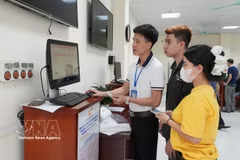
A public servant at the Public Administrative Service Centre of Vinh Yen ward, Phu Tho province, guides residents through the marriage registration process on the online public service portal. (Photo: VNA)

Digital literacy campaign lays foundation for digital citizens in Phu Tho province

After nearly a year, the “Digital Literacy for All” campaign in Phu Tho is demonstrating its effectiveness through tangible results. Residents who were once hesitant about technology are becoming increasingly familiar with VNeID, online public services, cashless payments, and digital platforms for learning, production, and business.

Firefighters and rescue personnel deploy specialised equipment to rescue two truck drivers trapped in their cabins. (Photo: VNA)

Road accident fund to provide support from September

Under Decree No. 279/2025/ND-CP and Circular No. 126/2026/TT-BCA, injured victims with bodily injury rates of over 31% to below 81% may receive up to 10 million VND (381 USD) per case, while families of deceased victims may receive up to 20 million VND.

Ha Thanh, Chairwoman of the Ho Chi Minh City Union of Friendship Organisations and head of the advisory council for international integration, people-to-people diplomacy and overseas Vietnamese affairs under the Vietnam Fatherland Front Committee of the city (Photo: VNA)

New resolution seeks to unlock OV resources for national development

Ha Thanh, Chairwoman of the Ho Chi Minh City Union of Friendship Organisations and head of the advisory council for international integration, people-to-people diplomacy and overseas Vietnamese affairs under the Vietnam Fatherland Front Committee of the city, said Resolution No. 23 builds on the fundamental viewpoints of the Politburo's Resolution No. 36-NQ/TW issued in 2004, reaffirming that overseas Vietnamese are an inseparable part of the nation and a bridge connecting Vietnam with the world.

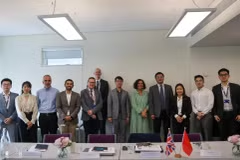
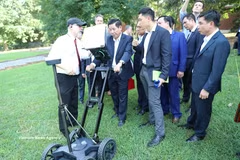
The Vietnamese Embassy in London's Education Section and representatives from the Department of Higher Education (Ministry of Education and Training) visit and hold a working session at Queen Mary University of London. (Photo published by VNA)

Vietnam-UK education cooperation: From market to partnership

In the 2024/25 academic year, about 3,725 Vietnamese students studied in the UK, while 13,285 enrolled in UK programmes delivered in Vietnam. Both flows are growing, but the balance is increasingly shifting towards UK education being delivered to learners in Vietnam. If managed strategically, this could enable Vietnam to expand access to international education at home while improving the quality of its workforce.

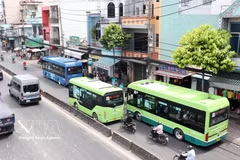
A bus picks up passengers on National Highway 22 (Le Quang Dao Street), near An Suong Bus Station. (Photo: VNA)

Free bus fares drive sharp rise in ridership in Ho Chi Minh City

As of August 12, the city’s bus network had served nearly 12 million passenger trips, up about 44% year on year. On August 12 alone, around 306,000 passengers used free buses, an increase of roughly 55%, despite students having yet to officially return to school.

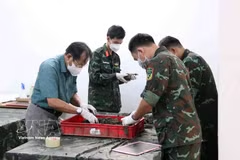
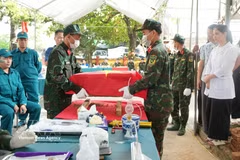
Officers and soldiers bring martyrs’ remains to the sampling station at Binh Xuyen commune Martyrs’ Cemetery in Phu Tho province (Photo: VNA)

More than 1,700 war martyrs’ remains recovered

The national steering committee will continue verifying information on suspected martyrs’ graves in key areas, including Tan Son Nhat Airport in Ho Chi Minh City, Quan Y Bac Son Hill in Dong Nai, the Con Tien base area in Quang Tri and former Vi Xuyen battlefields in Tuyen Quang.