Vietnam’s food sector urged to move up global value chains

Within Vietnam’s food industry, only a handful of firms, including Vinamilk and Masan Group, have achieved large-scale operations, while most businesses remain small. As a result, the highest value-added gains largely belong to companies that dominate branding and downstream markets.

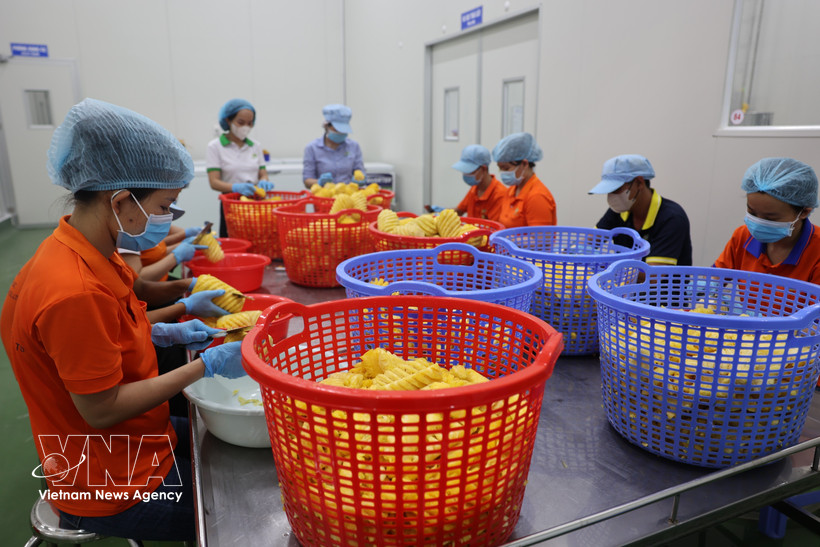
Pre-processing fruits for juice production at Wana Beverage JSC, Chau Duc Industrial Park, Ho Chi Minh City. (Photo: VNA)

Hanoi (VNA) – As one of the world’s top 20 exporting economies with deep integration into global supply networks, Vietnam is under increasing pressure to help domestic food enterprises move beyond low value-added activities and take greater control of value chains.

The global food market, valued at roughly 10 trillion USD annually, is considered one of the most stable and high-growth sectors worldwide. However, value distribution along the supply chain remains highly uneven. Raw materials generate only about 5–10% of total value, followed by processing at 10–20% and logistics at 10–15%, while distribution and retail capture up to 50–70%.

Dr. Dinh The Hien, Director of the Institute of Information and Business (IIB), said the industry’s core value lies not in production itself but in market access, branding and distribution control. This structural limitation continues to keep Vietnamese enterprises concentrated in lower value-added segments despite their strong participation in global supply chains.

The disparity is evident across product categories. Coffee beans priced at just 2.5–3 USD per kilogram at the raw stage can reach 40–60 USD per kilogram after processing, branding and retail distribution, and even higher in developed markets.

Within Vietnam’s food industry, only a handful of firms, including Vinamilk and Masan Group, have achieved large-scale operations, while most businesses remain small. As a result, the highest value-added gains largely belong to companies that dominate branding and downstream markets.

Phan Minh Thong, Chairman of Phuc Sinh Group, which specialises in deep agricultural processing, said businesses need to adopt more structured production models, invest in advanced processing, strengthen quality standards and develop differentiated products to enhance value and build brands. The emergence of billion-dollar enterprises, he noted, depends on modern business strategies supported by a stable policy environment.

Sharing this view, Hien emphasised the need for companies to transition from a production-focused approach to a value-chain mindset, moving away from contract manufacturing towards branded product development. Deep processing, brand building and participation in international distribution networks are three decisive factors for increasing value. If implemented effectively, the sector’s value-added output could grow three- to five-fold in the coming years.
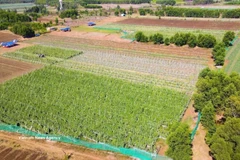
vnanet-potal-cong-ty-tnhh-thai-eco-bac-giang-ke-hoach-xuat-khau-khoang-500-tan-qua-vai-tuoi-8104942.jpg
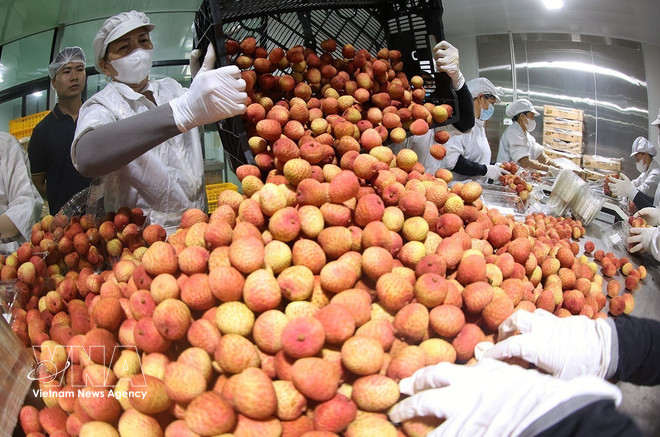
Thai ECO Co., Ltd. exports around 500 tonnes of fresh lychees to the European market. (Photo: VNA)

Beyond product quality, trust is increasingly becoming a defining competitive advantage. Experts say cost competitiveness alone is no longer sufficient in the global marketplace; credibility, transparency and corporate responsibility now determine long-term value and market access. At the same time, green transformation is emerging as an unavoidable requirement.

Dinh Hong Ky, Vice President of the Ho Chi Minh City Business Association (HUBA), noted that major markets are tightening regulations on environmental standards, emissions and traceability. Companies that fail to comply risk losing orders. However, when implemented strategically, green transition can lower long-term costs while improving efficiency and product value.

Businesses have also called for stable, transparent and predictable policies to support long-term investment, particularly in deep processing and technological innovation. Experts urged the Government to expand green finance incentives, promote technology transfer and strengthen trade promotion efforts to reduce barriers for enterprises, especially small and medium-sized firms.

Such measures are expected to serve as a crucial catalyst enabling Vietnam’s food enterprises to scale up, compete more effectively with global corporations and contribute to more sustainable agricultural growth./.

VNA

See more

The “Reunification Express” SE4 arrives in Da Nang on the occasion of the Reunification Day. (Photo: VNA)

Vietnam Railways Corporation to become Vietnam National Railways Group

Under the plan, the operating model of parent–subsidiary companies of the Vietnam Railways Corporation will be transformed into a model of parent–subsidiary companies of the Vietnam National Railways Group. The move is intended to strengthen its capacity to undertake and implement assigned tasks.

The Dung Quat refinery operates at 123.5% of its capacity, boosting domestic fuel supply. (Photo: VNA)

Dung Quat refinery operates above capacity in first quarter

The refinery produced 2.03 million tonnes of petrol products, achieving 105% of its management plan, while sales volume reached 2.02 million tonnes, equivalent to 113% of the target. As a result, key financial indicators, including revenue, profits and contributions to the state budget, all exceeded planned levels.

A VietGAP-oriented vegetable farming model adopted by farmers in An Phu commune, Quang Ngai province, has proven effective. (Photo: VNA)

Data, digitalisation key to unlocking sustainable growth in Vietnam’s agriculture

Close coordination among the State, businesses and farmers is also crucial. While the State provides regulatory frameworks, enterprises drive the market, and farmers supply data, effective incentives are needed to encourage farmers’ participation. When tangible benefits are clear, farmers will be more willing to adopt technology and engage in the digital ecosystem

Lao delegates attend the conference. (Photo: VNA)

Gia Lai, Lao provinces sign cooperation agreement

Gia Lai province signed a cooperation agreement for the 2026–2030 period with the four southern Lao provinces of Attapeu, Champasak, Salavan and Sekong at a conference held in the Vietnamese locality on March 29.

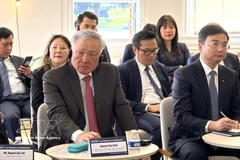
Finance Minister Nguyen Van Thang holds a working session with an HSBC delegation led by Group CEO Georges Elhedery on March 29, 2026. (Photo: Ministry of Finance)

Vietnam, HSBC accelerate push for credit upgrade and global capital inflows

At a recent meeting with an HSBC delegation led by Group CEO Georges Elhedery, Finance Minister Nguyen Van Thang highlighted the importance of an early credit upgrade to reinforce macroeconomic stability, reduce borrowing costs and strengthen investor confidence, while calling for continued technical support from the bank.

A representative of Denmark businesses speaks at the dialogue. (Photo published by VNA)

Vietnam, Denmark promote investment cooperation

Addressing the dialogue, Vietnamese Ambassador to Denmark Nguyen Le Thanh emphasised that Vietnam is intensifying comprehensive reforms to improve institutions and policies, enhance transparency and governance, and create a more stable and favourable business environment.

Permanent Deputy Prime Minister Nguyen Hoa Binh addresses the Vietnam–US Finance and Technology Dialogue. (Photo: VNA)

US firms eye expanding fintech investment in Vietnam

Addressing the Vietnam–US Finance and Technology Dialogue, themed “Technology and the future of global finance,” Permanent Deputy Prime Minister Nguyen Hoa Binh reaffirmed Vietnam’s commitment to a pro-investment environment, with breakthrough policies and stronger protections for foreign investors.

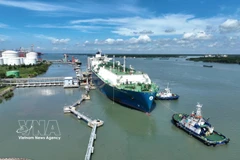
An LNG tanker docks at the Thi Vai LNG terminal in Ho Chi Minh City (Photo: VNA)

Solutions proposed to support firms amid Middle East conflict impacts

Top priority should be given to stabilising energy prices to ease input cost pressures and ensure supply stability – the most widely supported recommendation, chosen by 61.9% of surveyed firms. Businesses urged close monitoring of global fuel prices and supply risks, along with flexible measures to curb abnormal domestic price fluctuations and secure supplies of fuel and essential materials.

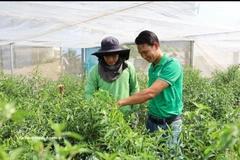
Nguyen Viet Tu (right) and a cooperative technician inspect a bird’s eye chilli field ready for harvest for export to European countries. (Photo: VNA)

Vietnamese herbs gain ground in European market

The Chau Pha Agricultural Production and Services Cooperative model is widely seen as an illustration of a new direction for Vietnam’s agriculture sector, one that combines clean production practices, modern management and proactive engagement with global markets.

Garment production for export to the EU at the TNG company in Thai Nguyen province (Photo: VNA)

Businesses pivot strategies to sustain export growth momentum

Enterprises are shifting toward reasonably priced, easy-to-consume products such as tra fish, tilapia, canned items and surimi, instead of focusing mainly on high-end products like large-sized shrimp, which are facing weaker demand in some markets.