Vietnam, Denmark promote investment cooperation

Addressing the dialogue, Vietnamese Ambassador to Denmark Nguyen Le Thanh emphasised that Vietnam is intensifying comprehensive reforms to improve institutions and policies, enhance transparency and governance, and create a more stable and favourable business environment.

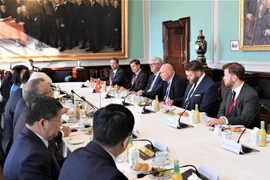
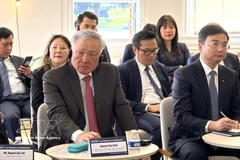
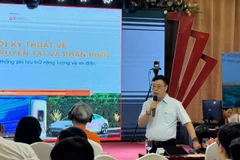
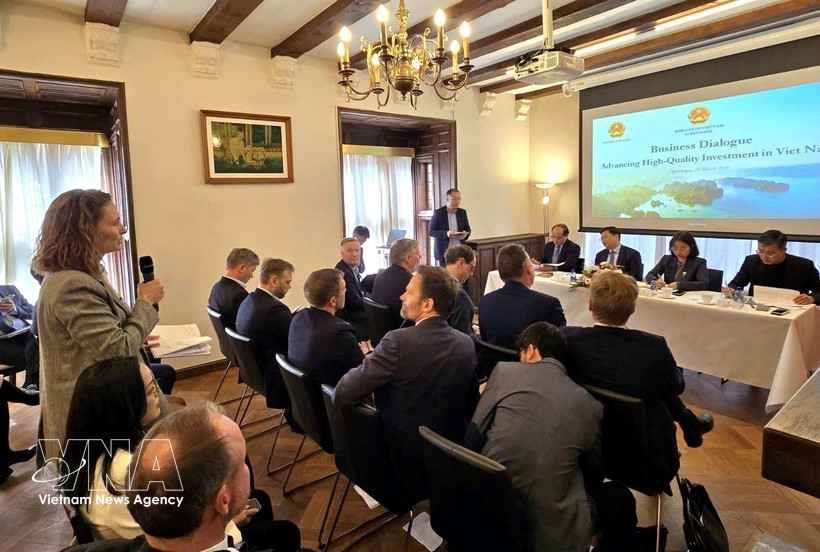
A representative of Denmark businesses speaks at the dialogue. (Photo published by VNA)

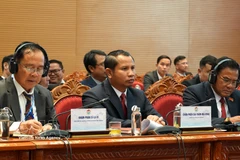
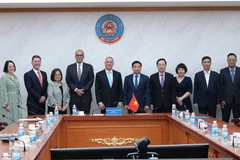
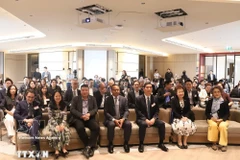
Hanoi (VNA) - A business dialogue themed "Advancing high-quality investment in Vietnam" has been held by the Vietnamese Embassy in Denmark, in coordination with the Ministry of Finance and FPT Nordics, on the occasion of a working visit by a Ministry of Finance delegation led by Deputy Minister Nguyen Duc Tam.

The event drew the participation of leaders and representatives of leading Danish corporations and organisations across trade, financial services, logistics, industry, technology and energy, including DNB, Scan Group, Novo Nordisk, Pandora, Vestas, A.P. Moller Capital, Davidsen-K, Andersen Consulting, CBrain and the Confederation of Danish Industry.

Addressing the dialogue, Vietnamese Ambassador to Denmark Nguyen Le Thanh emphasised that Vietnam is intensifying comprehensive reforms to improve institutions and policies, enhance transparency and governance, and create a more stable and favourable business environment.

He noted efforts to attract selective investment, particularly in high technology, innovation, the green economy and sustainable development.

The Ambassador said the dialogue provided Danish businesses with an opportunity to engage directly with Vietnam’s policy-making bodies, gain updated information on the investment climate, priority sectors and investment policies, especially those targeting high-quality capital.

The embassy will continue to support stronger connections and investment cooperation between businesses of the two countries, he affirmed.
vnanet-potal-doi-thoai-voi-doanh-nghiep-dan-mach-nham-thuc-day-dau-tu-chat-luong-cao-vao-viet-nam-8669241.jpg
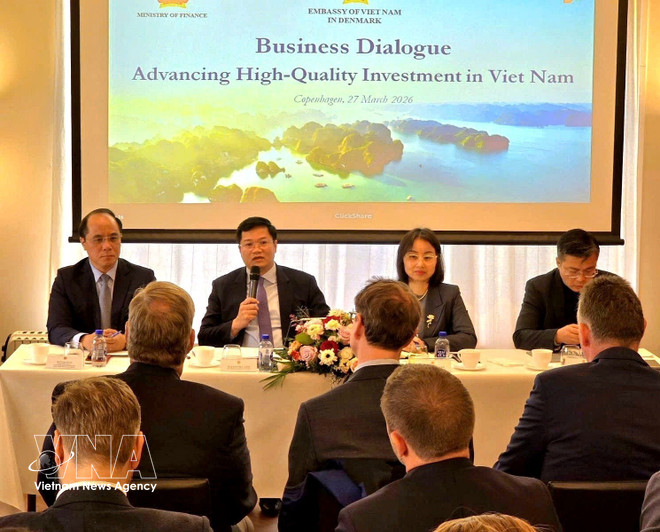
Deputy Minister of Finance Nguyen Duc Tam responds to questions at the dialogue (Photo published by VNA)

Discussions were substantive and focused, with Danish firms raising specific questions on Vietnam’s policies to overcome the “middle-income trap”, the implementation of macroeconomic policies, including public debt management, fiscal policy, inflation control and monetary management, as well as policies to attract foreign investment in logistics, particularly warehousing and supply chains.

Participants also discussed Vietnam’s shift from labour-intensive manufacturing towards high-tech industries, its green and sustainable development direction, and policies to reduce emissions, water use and promote circular economy solutions.

Deputy Minister Tam responded to questions and provided clarifications, offering updates on Vietnam’s policy directions, including special incentives for large-scale projects, strategic technology projects and those with spillover effects, as well as policies on developing international financial centres, supporting innovation, building carbon markets and expanding renewable energy towards net-zero emissions by 2050.

Vietnam continues to maintain macroeconomic stability through flexible management and close coordination between fiscal and monetary policies to control inflation, stabilise the exchange rate and ensure major economic balances, while creating a favourable environment for long-term investment, he said.

The official highlighted efforts to develop strategic infrastructure, including transport, logistics, energy and digital infrastructure, to strengthen connectivity and position in regional and global supply chains.

Danish businesses welcomed the dialogue, praising its timely organisation and expressing admiration for Vietnam’s “remarkable” development achievements, as well as the government’s measures to facilitate and encourage foreign investment.
Danish businesses welcomed the dialogue, noting Vietnam’s “remarkable” development achievements and the Government’s measures to facilitate foreign investment. They underlined the opportunity to engage directly with the Deputy Minister and the ministry delegation, showing the Ministry of Finance’s interest in supporting Danish enterprises and beefing up investment cooperation.

They expressed their interest in maintaining regular exchanges with Vietnamese relevant agencies to better tap cooperation opportunities in the coming period./.
VNA

See more

Pre-processing fruits for juice production at Wana Beverage JSC, Chau Duc Industrial Park, Ho Chi Minh City. (Photo: VNA)

Vietnam’s food sector urged to move up global value chains

Within Vietnam’s food industry, only a handful of firms, including Vinamilk and Masan Group, have achieved large-scale operations, while most businesses remain small. As a result, the highest value-added gains largely belong to companies that dominate branding and downstream markets.

The Dung Quat refinery operates at 123.5% of its capacity, boosting domestic fuel supply. (Photo: VNA)

Dung Quat refinery operates above capacity in first quarter

The refinery produced 2.03 million tonnes of petrol products, achieving 105% of its management plan, while sales volume reached 2.02 million tonnes, equivalent to 113% of the target. As a result, key financial indicators, including revenue, profits and contributions to the state budget, all exceeded planned levels.

A VietGAP-oriented vegetable farming model adopted by farmers in An Phu commune, Quang Ngai province, has proven effective. (Photo: VNA)

Data, digitalisation key to unlocking sustainable growth in Vietnam’s agriculture

Close coordination among the State, businesses and farmers is also crucial. While the State provides regulatory frameworks, enterprises drive the market, and farmers supply data, effective incentives are needed to encourage farmers’ participation. When tangible benefits are clear, farmers will be more willing to adopt technology and engage in the digital ecosystem

Lao delegates attend the conference. (Photo: VNA)

Gia Lai, Lao provinces sign cooperation agreement

Gia Lai province signed a cooperation agreement for the 2026–2030 period with the four southern Lao provinces of Attapeu, Champasak, Salavan and Sekong at a conference held in the Vietnamese locality on March 29.

Finance Minister Nguyen Van Thang holds a working session with an HSBC delegation led by Group CEO Georges Elhedery on March 29, 2026. (Photo: Ministry of Finance)

Vietnam, HSBC accelerate push for credit upgrade and global capital inflows

At a recent meeting with an HSBC delegation led by Group CEO Georges Elhedery, Finance Minister Nguyen Van Thang highlighted the importance of an early credit upgrade to reinforce macroeconomic stability, reduce borrowing costs and strengthen investor confidence, while calling for continued technical support from the bank.

Permanent Deputy Prime Minister Nguyen Hoa Binh addresses the Vietnam–US Finance and Technology Dialogue. (Photo: VNA)

US firms eye expanding fintech investment in Vietnam

Addressing the Vietnam–US Finance and Technology Dialogue, themed “Technology and the future of global finance,” Permanent Deputy Prime Minister Nguyen Hoa Binh reaffirmed Vietnam’s commitment to a pro-investment environment, with breakthrough policies and stronger protections for foreign investors.

An LNG tanker docks at the Thi Vai LNG terminal in Ho Chi Minh City (Photo: VNA)

Solutions proposed to support firms amid Middle East conflict impacts

Top priority should be given to stabilising energy prices to ease input cost pressures and ensure supply stability – the most widely supported recommendation, chosen by 61.9% of surveyed firms. Businesses urged close monitoring of global fuel prices and supply risks, along with flexible measures to curb abnormal domestic price fluctuations and secure supplies of fuel and essential materials.

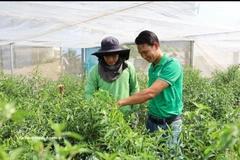
Nguyen Viet Tu (right) and a cooperative technician inspect a bird’s eye chilli field ready for harvest for export to European countries. (Photo: VNA)

Vietnamese herbs gain ground in European market

The Chau Pha Agricultural Production and Services Cooperative model is widely seen as an illustration of a new direction for Vietnam’s agriculture sector, one that combines clean production practices, modern management and proactive engagement with global markets.

Garment production for export to the EU at the TNG company in Thai Nguyen province (Photo: VNA)

Businesses pivot strategies to sustain export growth momentum

Enterprises are shifting toward reasonably priced, easy-to-consume products such as tra fish, tilapia, canned items and surimi, instead of focusing mainly on high-end products like large-sized shrimp, which are facing weaker demand in some markets.

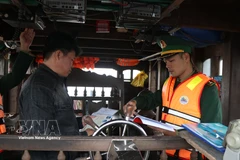
Border guards inspect and verify fishing vessels’ documents and procedural records before departure. (Photo: VNA)

Hue accelerates tech upgrades, strengthens vessel monitoring to combat IUU fishing

During the first quarter, the Department of Agriculture and Environment worked closely with city police and the Border Guard Command to inspect and supervise so-called “three-no” fishing vessels — those lacking registration, licences, or inspection certification — along with boats deemed ineligible for operation in Thuan An, Quang Dien, Vinh Loc, and Chan May–Lang Co.

Officials of former Ninh Thuan province (which is part of Khanh Hoa province now) inspect the progress of Bac Ai pumped-storage hydropower plant. (Photo: VNA)

Efforts made to keep Bac Ai pumped-storage hydropower project on schedule

The project, which is included in the approved National Power Development Plan for 2021–2030 with a vision towards 2050, is developed to strengthen national energy security, support a circular economy and contribute to Vietnam’s commitment to achieving net-zero emissions by 2050, as pledged at the COP26 climate conference.

NSMO Chairman Nguyen Duc Cuong speaks at the event (Photo: VNA)

Experts seek to improve power dispatch in new energy era

Electricity demand is expected to rise strongly, while global energy markets remain volatile. In this context, rooftop solar and BESS are emerging as key solutions to improve flexibility and ensure supply, especially during peak periods.