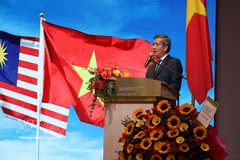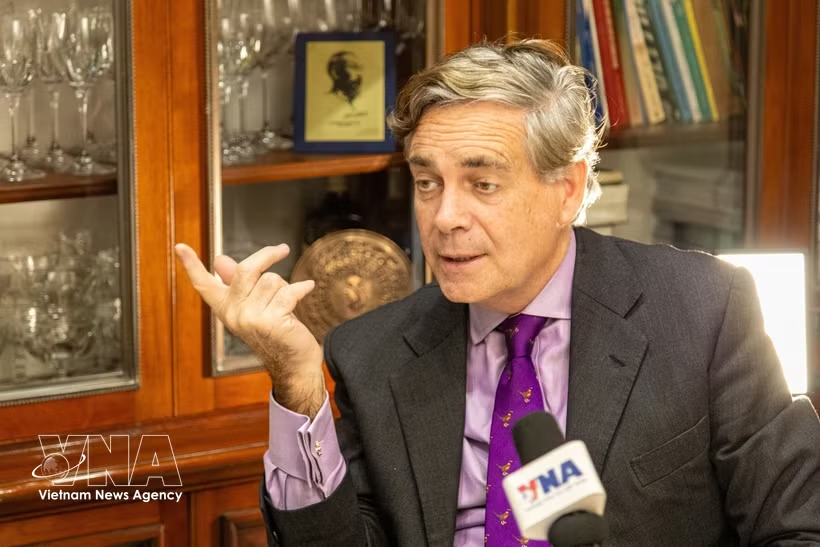
Buenos Aires (VNA) - “Vietnam maintains an independent and autonomous foreign policy while diversifying its relations,” said Argentine expert Patricio Carmody, highlighting the country's ability to combine global integration, economic development, and strategic autonomy.
In an interview with the Vietnam News Agency (VNA)’s correspondent in Buenos Aires on the occasion of Vietnam’s National Day (September 2), Carmody, an advisory member of the Argentine Council for International Relations (CARI), emphasised the rapid socio-economic changes Vietnam has undergone, as well as its growing influence on the international stage.
Drawing on years of work and research experience in Asia, along with numerous visits to Vietnam, most recently in late 2025, Carmody noted that one of the aspects that impressed him most is the profound transformation of Vietnamese society and the country's "surging developmental energy."
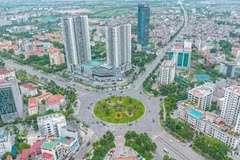
Carmody was also struck by the development of cities and tourist hubs, as well as Vietnam's openness to the outside world. He particularly emphasised the country's readiness to welcome tourists from all over the globe and the open-minded attitude of the Vietnamese people toward foreigners.
Analysing the factors behind Vietnam's transformation, Carmody specifically highlighted the reforms initiated in 1986, which brought about a significant opening of the economy.
According to the expert, Vietnam transitioned from a centrally planned socialist economy to incorporating market mechanisms, and above all, undertook an opening-up process that allowed it to become a heavily export-oriented economy.
This openness also facilitated the influx of investments from international companies based in China, the US, Europe, the Republic of Korea, Japan, and other nations.
Carmody cited the presence of companies like Samsung, Nike, and Apple as examples, noting that their operations are primarily integrated into global value chains.
This integration, he added, is also evident in the textile industry and other manufacturing sectors.
For the Argentine expert, this international integration is one of the fundamental drivers of Vietnam's development. In his view, the fact that around 13 million people have joined the middle class in the last three years demonstrates the sheer scale of the country's socio-economic transformation.
Touching upon Vietnamese foreign policy, Carmody highlighted three elements he considers particularly important: the pursuit of an independent and autonomous foreign policy, the diversification of relations, and pragmatism.
First, he noted that Vietnam seeks to maintain an autonomous and independent foreign policy, which he finds especially significant for a country that had endured numerous conflicts.
Second, he underscored the decision to diversify foreign relations and avoid excessive reliance on any single major power. This diversification, he explained, not only enhances the country's prestige but also contributes to its development.
Carmody also praised the pragmatism of Vietnam's foreign policy. He observed that political, ideological, or religious differences do not hinder Vietnam from establishing relations with other nations. In his view, this is a lesson from which other countries can learn.
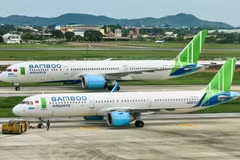
Carmody mentioned Vietnam's "bamboo diplomacy," which, in his opinion, reflects Vietnam's ability to maintain relations with major powers without breaking or getting caught up in their rivalries.
He explained that Vietnam does not seek to form one alliance against another, but rather to sustain relations with various countries without aligning itself in confrontations between major powers.
The Argentine expert said he believes this policy is also reflected in the principles of not participating in military alliances, not siding with one country against another, and not allowing foreign military bases on its territory.
For Carmody, this ability to maintain diversified relations while simultaneously preserving autonomy constitutes one of the greatest strengths of Vietnamese foreign policy.
Over relations between Argentina and Vietnam, Carmody assessed that there is immense potential for cooperation due to the complementary nature of both economies.
He noted that Vietnam, with a population of over 100 million, is a highly dynamic market with growing consumer power. Meanwhile, Argentina holds significant advantages in commodities such as wheat, soy, and beef, alongside other agricultural products.
However, he noted that bilateral trade still faces constraints due to the lack of a preferential trade agreement. Therefore, he said he believes that moving toward such an agreement, whether directly between Argentina and Vietnam or within the Mercosur framework, could be vital for expanding commercial opportunities.
Argentine expert affirmed that Vietnam's development proves that global integration and autonomy are not contradictory concepts. On the contrary, the combination of an open economy, a broad network of international relations, and an independent foreign policy has allowed the country to expand its development opportunities and strengthen its international standing, he concluded./.
VNA