Chinese firms praise Vietnam’s investment environment

Vietnam’s political stability, fast-growing economy, and increasing focus on science and technology, with many policies that promote the sector’s growth, create ideal conditions for Chinese tech firms looking to invest and expand in the country.

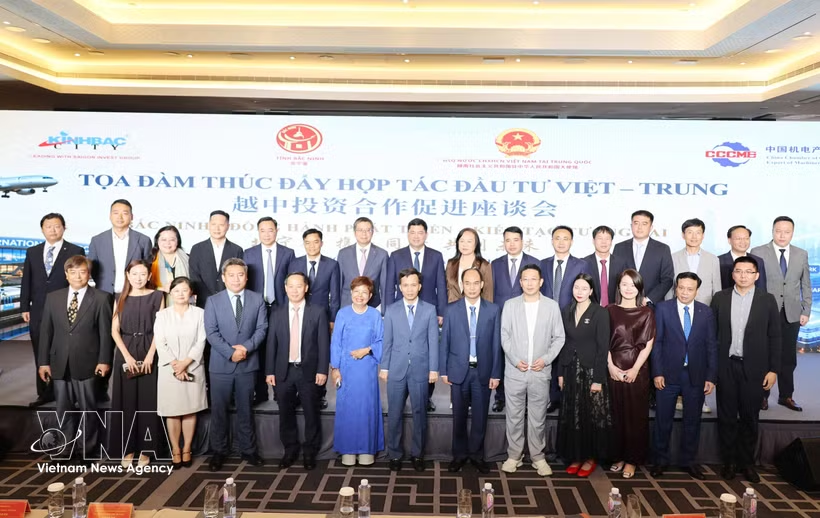
Delegates at the Vietnam-China investment cooperation promotion seminar jointly organised in Beijing on August 24 pose for a photo. (Photo: VNA)

Beijing (VNA) - Chinese businesses have praised Vietnam’s investment environment, highlighting its prime location, improved infrastructure, a thriving industrial ecosystem, supportive business policies, and the strong support and cooperation of local authorities.

The assessment was shared by representatives of Chinese companies and business associations at a Vietnam-China investment cooperation promotion seminar jointly organised in Beijing on August 24 by the People’s Committee of the northern province of Bac Ninh and the Vietnamese Embassy in China.

Pham Van Thinh, Standing Deputy Secretary of the Bac Ninh Party Committee and Vice Chairman of the provincial People’s Committee, said the event was intended to provide investors with comprehensive information and address their concerns and difficulties. Beijing is home to many major investors, making it well suited to Bac Ninh's investment attraction efforts in the coming period, he noted.

Wang Maotai, General Director of SUNWODA Vietnam Co., Ltd., told the Vietnam News Agency that Bac Ninh is among the company’s preferred investment destinations in Vietnam. He highlighted the province’s strategic location and strong transport connectivity, particularly as international aviation infrastructure in the region continues to expand.

Bac Ninh’s concentration of electronics manufacturers, together with its supporting industries and relatively well-developed supply chains, is another major advantage for companies operating in industrial manufacturing and high-tech sectors, he said.

Wang also praised the province’s living environment and local authorities’ support for businesses and workers.

Lu Peng, General Director of China’s Zhongguancun International Holdings, also said Chinese businesses have a positive view of the economic and investment environment in Vietnam, particularly Bac Ninh.

He said Vietnam’s political stability, fast-growing economy, and increasing focus on science and technology, with many policies that promote the sector’s growth, create ideal conditions for Chinese tech firms looking to invest and expand in the country.

For Bac Ninh, Lu highlighted its proximity to Hanoi and its well-developed network of production facilities, industrial parks and technology zones. Following a field survey in Vietnam, the company found that the province has attracted a number of major Chinese businesses and formed modern industrial parks and production facilities.

He said Bac Ninh’s business support policies and investment environment are generally well suited to the needs of Chinese investors.

Lu suggested that Vietnamese and Bac Ninh authorities continue strengthening support for Chinese businesses, particularly in taxation, human resources and infrastructure.

From an industry association perspective, Liu Chun, Chairwoman of the China Chamber of Commerce for Import and Export of Machinery and Electronic Products (CCCME), said economic, trade and investment between Vietnam and China have grown steadily amid fluctuations in the global economy and deeper regional cooperation. China has remained Vietnam’s largest trading partner for many years, while Vietnam is also one of China’s important trading partners in ASEAN, she noted. The CCCME has more than 10,000 member companies across 25 industry divisions, covering a broad range of sectors, including power, new energy, petrochemicals, railways, transport, telecommunications, home appliances and automobiles. Its members are engaged in manufacturing, import-export, investment and international economic cooperation.

Liu said the chamber will continue to serve as a bridge between businesses, promoting regular information exchanges between Vietnamese and Chinese localities and enterprises, particularly on investment policies, market demand and business matchmaking.

A number of its members, including China Energy Engineering Corporation, Dongfang Electric, JA Solar, Trina Solar and Jiangsu Tianying, have already implemented projects in Vietnam, serving as notable examples of economic and trade cooperation between the two countries, she said.

The CCCME also plans to strengthen coordination with the Vietnamese Embassy in China and Vietnamese industry associations, while developing business-matching platforms and promoting substantive cooperation. In April, it signed a memorandum of understanding with the Vietnam Association of Small and Medium Enterprises, laying a foundation for further business networking activities.

Liu described Bac Ninh as one of Vietnam’s important industrial production and export hubs, with an established presence in electronics, high technology and smart manufacturing. Given its members’ strengths in energy, power, infrastructure, electronics and telecommunications, the chamber sees considerable potential for cooperation with the province.

The CCCME is ready to continue supporting Bac Ninh in organising trade and investment promotion activities and building a platform for long-term exchanges and cooperation between businesses of the two countries, she affirmed./.

VNA
See more

Illustrative photo (Photo: VNA)

FDI businesses look for deeper administrative reforms

While appreciating the progress, FDI firms said the next stage of reforms should go beyond putting procedures online. They want administrative processes to be simplified on digital platforms, data systems to be better connected, information to be provided only once and regulations to be applied consistently.

A view of the Vietnam–Singapore Industrial Park in Ho Chi Minh City (Photo: VNA)

Vietnam witnesses surge in Singapore investment inflows

The strong investment flow reflects not only the potential of the Vietnamese market but also the close bilateral relationship, particularly since the two countries upgraded ties to a Comprehensive Strategic Partnership in March 2025.

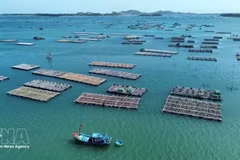
Mariculture – new growth driver for Vietnam’s ocean economy (Photo: VNA)

Mariculture – new growth driver for Vietnam’s ocean economy

Resolution No 20-NQ/TW on building and developing Vietnam into a strong maritime nation identifies marine farming as a new pillar of the marine economy. It targets mariculture production value growing by an average of around 8% annually and accounting for 15% of the total fisheries sector value.

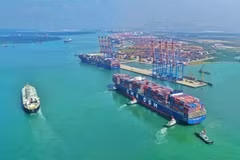
A view of the deep-water port Gemalink. (Photo: gemadept.com.vn)

Seaport profits surge as trade growth supports positive second-half outlook

Profit contributions from joint ventures and associates rose 58%, with Gemalink alone increasing 43%. The improvement provided a clearer indication of core operating performance, while Gemadept also recorded an extraordinary gain of more than 600 billion VND from a divestment move in the second quarter.

Online shopping is becoming increasingly common, but unlike traditional transactions, consumers often cannot directly see products, meet sellers or immediately verify information. - Illustrative image (Photo: VNA)

Consumer trust key to sustainable e-commerce growth

Management agencies should strengthen coordination and data sharing with digital platforms, preserve electronic evidence and prevent sellers whose accounts have been blocked from quickly resuming business under new identities.

An organic vegetable model in Hanoi. (Illustrative photo: VNA)

Vietnam fine-tuning Extended Producer Responsibility policy to promote circular economy

Vietnam’s revised EPR framework is therefore expected to build a more comprehensive ecosystem covering collection, transportation, sorting, recycling, data management and supervision, making producers’ responsibilities closely linked to actual recycling outcomes. This will help EPR become a genuine driver of the recycling market and Vietnam’s transition toward the circular economy.

Visitors look for traditional Vietnamese handicrafts at Paris Fair (Photo: VNA)

Vietnamese firms urged to join global value chains

Vietnam should develop a strong domestic business force capable of absorbing technology, standards, management practices and market access from major corporations. At the same time, it is necessary to issue policies that encourage FIEs to actively seek, develop and use Vietnamese suppliers.

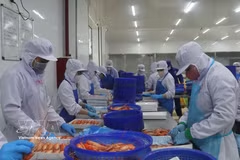
Processing prawns for export (Photo: VNA).

Vietnam's economy expected to grow 11% in 2027

AFP reported that Vietnam’s economy grew 8.4% year-on-year in the second quarter of 2026, exceeding the previous forecast of 7%. In the first half of the year, GDP expanded 8.2%, with industry and construction remaining key drivers of growth, alongside a recovery in manufacturing activity and domestic demand.

Vietnamese businesses connect with importers, distribution systems and partners at the Vietnam Coffee Festival 2026 in Singapore (Photo: VNA.)

Vietnam-Singapore ties gain new momentum through SME cooperation

From the Digital Economy-Green Economy Partnership to connectivity programmes between Enterprise Singapore and Vietnam’s Ministry of Science and Technology, policy mechanisms are no longer merely on paper but have become practical resources, creating a secure and favourable legal framework for businesses.

The total investment for VSIP Ha Tinh is more than 1.5 trillion VND (57.4 million USD) (Photo: VNA)

Vietnam-Singapore economic ties enter new phase of cooperation

As complementary economies, Vietnam and Singapore have promoted the implementation of trade agreements to strengthen bilateral economic ties. Both members of the Comprehensive and Progressive Agreement for Trans-Pacific Partnership (CPTPP) and the Regional Comprehensive Economic Partnership (RCEP), the two countries have effectively tapped the benefits offered by these free trade agreements.