SEAJust members strengthen cooperation against transnational organised crime

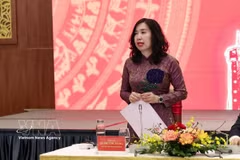
Vice-President of the Supreme People’s Procuracy Nguyen Quang Dung said transnational crime has become increasingly complex in recent years, with more sophisticated methods and an expanding operational reach.

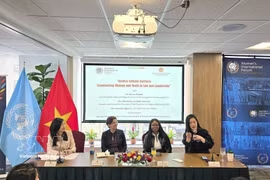
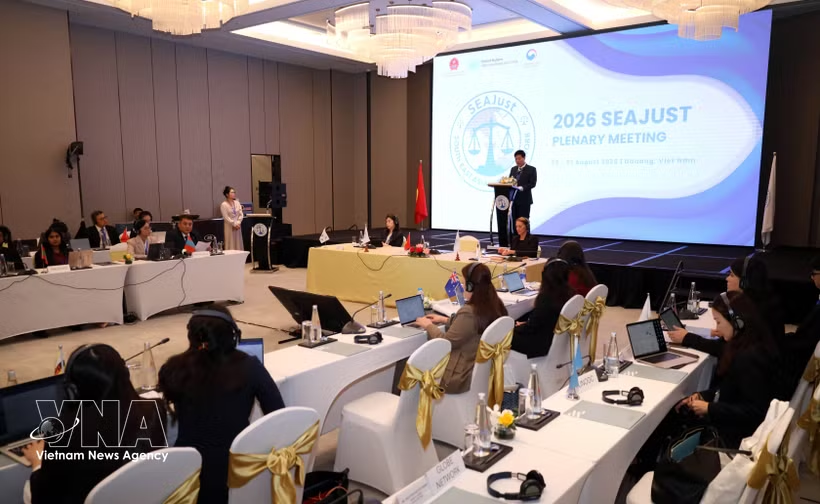
At the 2026 Plenary Meeting of the Southeast Asia Justice Network (SEAJust) in Da Nang on August 25, 2026. (Photo: VNA)

Da Nang (VNA) – The 2026 Plenary Meeting of the Southeast Asia Justice Network (SEAJust) opened in the central city of Da Nang on August 25, bringing together representatives from 22 member countries, justice networks and international partners to strengthen cooperation in combating increasingly complex forms of transnational organised crime.

The three-day meeting was jointly organised by the UN Office on Drugs and Crime (UNODC) and the Supreme People’s Procuracy of Vietnam, with financial support from the Government of the Republic of Korea.

Addressing the opening, Vice-President of the Supreme People’s Procuracy Nguyen Quang Dung said transnational crime has become increasingly complex in recent years, with more sophisticated methods and an expanding operational reach.

Technological advances and digital transformation are being exploited by criminals to commit cross-border offences, including organised crime, cybercrime, drug trafficking, money laundering, human trafficking and transnational fraud, he said.

Dung emphasised that no country can tackle cross-border challenges on its own, urging stronger information sharing, better coordination in investigation, prosecution, and adjudication, as well as more effective mutual legal assistance in criminal cases.

He noted that requests for mutual legal assistance in criminal matters are increasing in both volume and complexity. They now involve not only serving documents, taking statements and gathering evidence, but also electronic evidence and digital data, as well as tracing and recovering criminal assets and financial flows. This requires countries to renew their cooperation methods and mechanisms to ensure mutual legal assistance is delivered more quickly, substantively and effectively, he said.

Delphine Schantz, UNODC Regional Representative for Southeast Asia and the Pacific, highlighted the rapidly changing nature of organised crime in Southeast Asia and the urgent need for stronger cross-border cooperation.

According to UNODC’s latest assessment of transnational organised crime threats in Southeast Asia, criminal networks are becoming increasingly interconnected across countries and illicit markets. Cyber-enabled fraud, human trafficking, money laundering, online gambling and other crimes are linked through shared infrastructure, technology and financial channels.

Fraud alone caused estimated losses of between 88.3 billion USD and 114.1 billion USD in East and Southeast Asia, Australia and New Zealand in 2025. Human trafficking for forced criminal activities is also becoming increasingly global, with victims and people forced into such operations identified from at least 80 countries and territories at scam centres across the region.

Schantz said that as criminal networks become more connected, responses must be interconnected accordingly. Cross-border evidence gathering, tracing and recovery of criminal assets, identification and arrest of suspects, and assistance in criminal proceedings are essential to bringing transnational criminals to justice.

According to UNODC, since its establishment in 2020, SEAJust has facilitated cooperation in more than 300 cases involving mutual legal assistance in criminal matters and extradition, including over 125 cases handled in 2025 alone. From eight founding members, the network has expanded to 24 members across more than four continents. Canada and Kazakhstan joined as new members at this year’s plenary meeting.

Participants exchanged developments in international criminal cooperation law, Kazakhstan’s mutual legal assistance system, and ASEAN initiatives, including the ASEAN Treaty on Extradition. They also updated each other on activities of partner networks, including the European Judicial Network (EJN), Eurojust, GlobE and ARIN-AP.

The 2026 SEAJust Plenary Meeting reaffirms the shared commitment to strengthening criminal justice cooperation in response to increasingly interconnected and cross-border organised crime, contributing to regional security, justice and sustainable development./.
VNA

See more

Singaporean Senior Minister of State for Defence Desmond Choo sees Standing Member of the CPV Central Committee’s Secretariat Tran Cam Tu off at Changi International Airport. (Photo: VNA)

Key Vietnamese leader concludes successful official visit to Singapore

Politburo Member and Standing Member of the Communist Party of Vietnam (CPV) Central Committee’s Secretariat Tran Cam Tu and a high-ranking CPV delegation left Singapore on August 25 afternoon, concluding their successful official visit to Singapore and co-chairing of the first Vietnam-Singapore Strategic Dialogue on August 24–25.

Politburo Member, Deputy Secretary of the Central Military Commission, Deputy Prime Minister, and Minister of National Defence General Phan Van Giang (R) and outgoing French Ambassador to Vietnam Olivier Brochet in Hanoi on August 25, 2026. (Photo: chinhphu.vn)

Vietnam, France boost defence cooperation across multiple areas

Vietnam attaches importance to cooperation with France, an important member of the European Union (EU) and Vietnam’s first comprehensive strategic partner within the EU. Bilateral relations have made effective progress in a wide range of areas, including economy and trade, science and technology, education and training, culture and tourism, as well as defence and security.

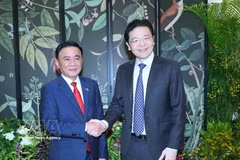
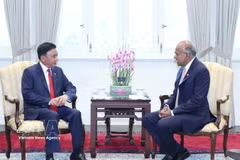
Politburo member and Standing member of the Communist Party of Vietnam Central Committee’s Secretariat Tran Cam Tu (L) meets with Secretary-General of the People’s Action Party and Prime Minister of Singapore Lawrence Wong on August 25. (Photo: VNA)

Vietnamese, Singaporean leaders agree to deepen bilateral ties

The two sides agreed that the dialogue will help establish a direct, regular and strategic channel for exchanges between the two Parties, through which they can conduct in-depth discussions on Party building, policy making, governance and national development, while sharing views on strategic issues of mutual concern, thereby strengthening the Party-to-Party channel’s role in providing strategic orientations for the bilateral ties.

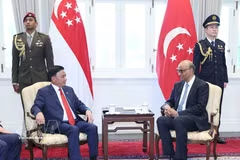
Politburo Member and Standing Member of the Communist Party of Vietnam (CPV) Central Committee’s Secretariat Tran Cam Tu (L) and Singaporean President Tharman Shanmugaratnam in Singapore on August 25, 2026. (Photo: VNA)

Key Vietnamese leader meets Singaporean President

Vietnam consistently attaches importance to its relations with Singapore, one of its top partners in the region. The establishment of the Strategic Partnership in 2013 and its upgrade to a Comprehensive Strategic Partnership in 2025 were important milestones, reflecting the maturity of bilateral ties and the shared vision of the two countries’ leaders for long-term cooperation.

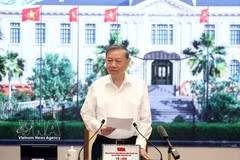
General Secretary of the Communist Party of Vietnam Central Committee and President To Lam speaks at the working session in Hanoi with the Government’s Party Committee and relevant agencies on the implementation of social welfare policies. (Photo: VNA)

Top leader calls for ensuring every citizen access to essential services, development opportunities

According to the top leader, by 2030, Vietnam should basically establish a multi-layer, inclusive and digitalised social welfare system that guarantees minimum social protection for all citizens. By 2045, the system should approach the standards of developed, high-income countries, featuring quality services, sustainable financing, transparent governance and the capacity to respond rapidly to emerging risks.

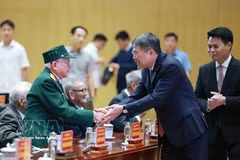
Prime Minister Le Minh Hung (R) with a veteran Party member of the Hai Phong Party Organisation at the event. (Photo: VNA)

Prime Minister calls for better care for veteran Party members

Prime Minister Le Minh Hung affirmed that every badge presented to Party members in Hai Phong on the occasion served as a reminder that the Party has grown from the people, fought for the people, sacrificed for the people, and pursued reform and development for the people.

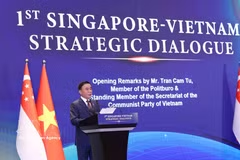
Politburo Member and Standing Member of the Communist Party of Vietnam (CPV) Central Committee’s Secretariat Tran Cam Tu speaks at the first Vietnam-Singapore Strategic Dialogue in Singapore on August 25, 2026. (Photo: VNA)

Vietnam, Singapore pursue resilient shared future

The first Vietnam-Singapore Strategic Dialogue helped translate political trust between the two Parties into practical cooperation orientations and programmes, contributing to substantive and sustainable development of the Vietnam-Singapore Comprehensive Strategic Partnership and meeting the development needs of both countries in the new era.

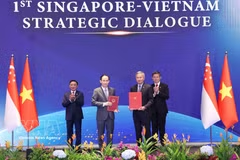
Vietnam's Politburo member and Minister of Foreign Affairs Le Hoai Trung (first row, left) and Singaporean Minister for Foreign Affairs Vivian Balakrishnan exchange the Vietnam-Singapore Joint Statement on Technology Connectivity Strategy. (Photo: VNA)

Vietnam, Singapore issue Joint Statement on Technology Connectivity Strategy

Building on the Plan of Action to Implement the Comprehensive Strategic Partnership between Singapore and Vietnam, signed on October 28, 2025, both countries reaffirm their mutual interest and commitment to deepen cooperation in the areas of science and technology, innovation, connectivity, and the digital economy.

General Secretary of the Communist Party of Vietnam Central Committee and President To Lam speaks at the August 25 meeting that reviews the first year of implementing Resolution No. 71-NQ/TW. (Photo: VNA)

Top leader orders substantive education reform

The sector should reduce rote and exam-oriented learning and promote self-study, practical experience, independent thinking, creativity and problem-solving, while cutting administrative and formalistic burdens on teachers.

Minister of Agriculture and Environment Trinh Viet Hung (L) meets with Chinese Minister of Agriculture and Rural Affairs Zhang Zhu on August 24 (Photo: VNA)

Vietnam, China strengthen agricultural cooperation

Agriculture is an important area of cooperation that contributes to realising the common perceptions reached by the two countries’ high-ranking leaders and creates fresh momentum for the Vietnam-China comprehensive strategic cooperative partnership towards mutual benefit, shared development and a shared future.

Deputy Prime Minister Nguyen Van Thang attends the Vietnam Leadership Programme (VLP) 2026 at Columbia University in New York. (Photo: VNA)

Vietnam Leadership Programme 2026 highlights new drivers for national growth

Deputy Prime Minister Nguyen Van Thang emphasised Vietnam is entering a new strategic development phase with a long-term vision and strong aspiration to realise its two centenary goals, becoming a developing country with modern industry and upper-middle income by 2030, and a high-income developed country by 2045.

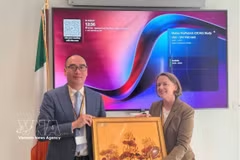
Deputy State Auditor General of the State Audit Office of Vietnam Bui Quoc Dung (left) and Secretary and Director of the Audit in the Office of the Comptroller and Auditor General of Ireland Colette Drinan exchange souvenirs. (Photo: VNA)

Vietnam, Ireland audit bodies seek stronger cooperation, exchange of expertise

Secretary and Director of the Audit in C&AG Colette Drinan highlighted the significance of the visit and affirmed Ireland’s readiness to share experience in developing its 2026-2030 audit strategy, particularly in strengthening the legal framework, performance auditing, and the use of artificial intelligence (AI) and big data analytics.