Top leader orders substantive education reform

The sector should reduce rote and exam-oriented learning and promote self-study, practical experience, independent thinking, creativity and problem-solving, while cutting administrative and formalistic burdens on teachers.

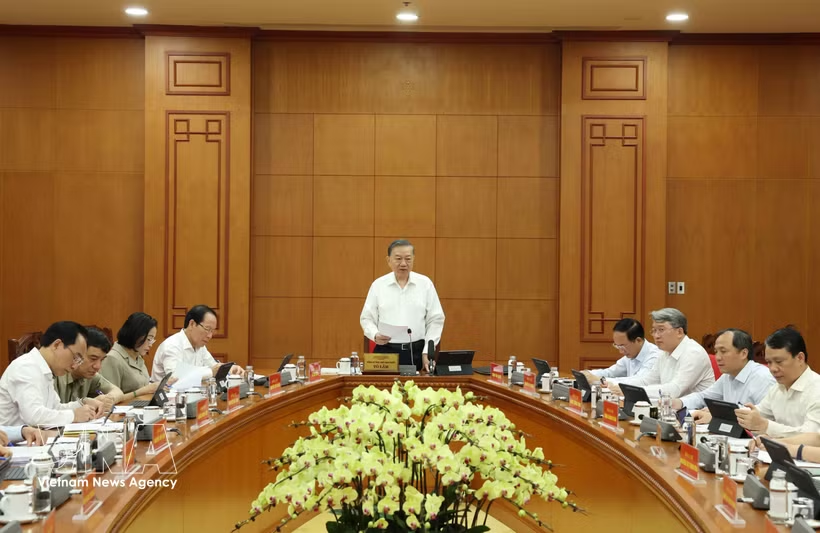
General Secretary of the Communist Party of Vietnam Central Committee and President To Lam speaks at the August 25 meeting that reviews the first year of implementing Resolution No. 71-NQ/TW. (Photo: VNA)

Hanoi (VNA) General Secretary of the Communist Party of Vietnam (CPV) Central Committee and President To Lam called for substantive reform in school governance, teaching staff, curricula, teaching and learning methods, examinations and assessment, while addressing a meeting on August 25 to review the first year of implementing Resolution No. 71-NQ/TW.

On August 22, 2025, the top leader signed Resolution No. 71 on breakthroughs in education and training, which sets a vision for Vietnam to build a modern, equitable and high-quality national education system by 2045.

At the review meeting, the leader acknowledged efforts by the Government, the Ministry of Education and Training, relevant agencies, localities, educational institutions and teachers nationwide in implementing the resolution, but noted that the past year had mainly laid the groundwork for breakthroughs, with qualitative improvements in education, teachers, learners and human resources yet to become clearly evident. Many longstanding shortcomings remain unresolved, he said.

He stressed that Resolution No. 71 requires not only fundamental and comprehensive reform but also breakthroughs in education and training. The leader urged a decisive shift from refining institutions and policies to implementation, putting the resolution into practice and delivering concrete results.
vnanet-tl2.jpg
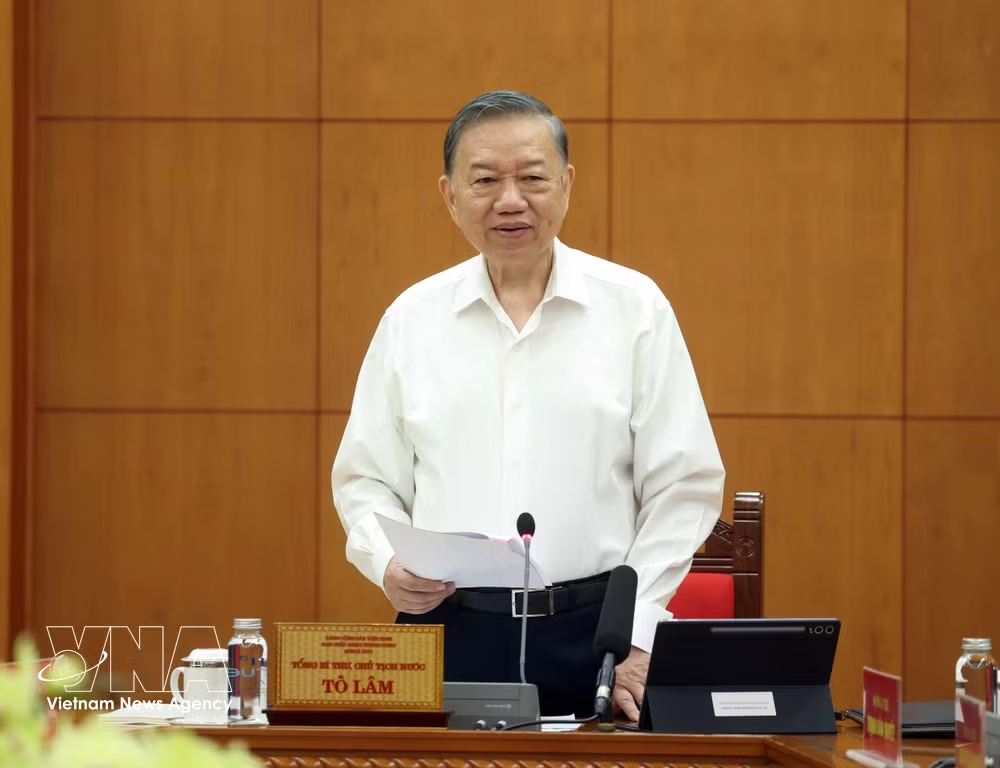
General Secretary of the Communist Party of Vietnam Central Committee and President To Lam speaks at the meeting. (Photo: VNA)

Relevant agencies should review the action programme, add missing tasks and promptly address new bottlenecks, while focusing resources on key tasks capable of generating major changes instead of launching unnecessary programmes and projects.

A priority is ensuring enough schools, classrooms and teachers, he said, calling on the Government, the ministry and localities to set clear roadmaps, responsibilities and deadlines to address shortages. No student should have their learning opportunities limited by a lack of schools, classrooms or teachers, while equitable access to quality education should be a key benchmark for implementing the resolution.

The sector should reduce rote and exam-oriented learning and promote self-study, practical experience, independent thinking, creativity and problem-solving, while cutting administrative and formalistic burdens on teachers.

He stressed that the ultimate goal of education is not scores, degrees or school rankings, but the development of well-rounded people, with greater attention to ethics, character, physical and mental health, culture, history and the arts, alongside digital skills, foreign languages, STEM, scientific thinking, creativity and adaptability.

The education sector must also firmly address negative practices such as achievement chasing, academic and examination fraud, and disguised forms of extra teaching. The action programme should set specific goals, responsibilities and measurable indicators for building an educational culture based on ethics and discipline.

Education must take the lead in preparing human resources and talent for the country’s future, he said, calling for closer links among workforce forecasting, enrolment, training, research, businesses and employment.

Regarding digital transformation and artificial intelligence, he said technology should serve education rather than replace its essence. AI should help students think more deeply and creatively, while teachers should increasingly guide thinking, inspire learners, develop their potential and nurture character.

He described education data as strategic infrastructure, calling for unified, accurate and shared databases on students and national diplomas, alongside lifelong digital learning records. Diplomas and certificates should be fully digitised to facilitate management and combat fake credentials.

As the 2026-2027 academic year approaches, the top leader said the new school year should mark a transition from laying the foundation for reforms to delivering substantive change. He affirmed that the Party, State and society would continue providing the best possible conditions for education./.

VNA

See more

General Secretary of the Communist Party of Vietnam Central Committee and President To Lam, and his spouse Ngo Phuong Ly leave Hanoi on September 7 for a state visit to Russia, an official visit to France and attendance at the International Space Summit in Paris, from September 7 to 12. (Photo: VNA)

Top leader departs for visits to Russia, France, attendance at Int’l Space Summit

The trip is of great importance both bilaterally and multilaterally, as it aims to strongly implement the foreign policy outlined by the 14th National Party Congress, strengthen political trust and create an external environment conducive to Vietnam’s development in the new era. The trip is also expected to help mobilise international resources for national development.

Stéphanie Do (centre) at a discussion with French readers and the Vietnamese community in France about her book, titled The Journey to Parliament of the First Vietnamese-French Female Lawmaker. (Photo published by VNA)

Vietnam–France relations: From cooperation to co-creation

Vietnam and France are facing a “historic opportunity” as Vietnam undergoes rapid transformation, while France is also seeking to strengthen partnerships with dynamic economies in Asia. The two countries therefore share a common interest in moving forward together and seizing the current opportunity to bring bilateral relations into a new phase of development.

A view of the meeting between Politburo member and Minister of Foreign Affairs Le Hoai Trung and Governor of Nara prefecture Yamashita Makoto in Hue city on September 6, 2026. (Photo: VNA)

Foreign Minister receives Japanese officials in Hue

Minister of Foreign Affairs Le Hoai Trung affirmed that locality-to-locality cooperation is an effective channel for implementing commitments and agreements reached by the two countries’ high-ranking leaders, while strengthening connectivity and people-to-people exchanges between Vietnam and Japan.

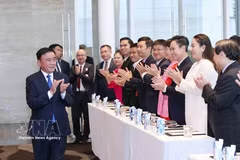
National Assembly President Tran Thanh Man speaks at a meeting with Korean friends in Seoul on September 6. (Photo: VNA)

National Assembly President meets Korean friends in Seoul

National Assembly (NA) President Tran Thanh Man stressed that Korean non-governmental organisations, associations, scientists and businesses have contributed significantly to major achievements recorded in Vietnam-RoK relations over the past years.

An overview of the meeting between Prime Minister Le Minh Hung and a delegation of Japanese localities in Hue city on September 6. (Photo: VNA)

Local cooperation a distinctive feature of Vietnam-Japan relations: PM

Prime Minister Le Minh Hung emphasised that local collaboration is an important and distinctive feature of Vietnam-Japan relations, and that the Vietnamese Government considers it a practical and effective channel that contributes to the overall development of bilateral ties.

National Assembly President Tran Thanh Man and his spouse meet with Vietnamese Embassy officials and staff, and representatives of the Vietnamese community in the Republic of Korea in Seoul on September 6. (Photo: VNA)

NA President meets Vietnamese community in RoK

The NA President called on Vietnamese people in the RoK to continue strengthening solidarity, abiding by local laws, and contributing to the host country and bilateral ties, while preserving the Vietnamese language, national cultural identity and traditions.

Myanmar President Min Aung Hlaing and his spouse, Kyu Kyu Hla, lay a wreath at the Monument to Heroic Martyrs on Bac Son Street in Hanoi. (Photo: VNA)

Myanmar President concludes official visit to Vietnam

The visit contributes to strengthening political trust and creating momentum for increasingly substantive and effective cooperation between the two countries, for the benefit of their peoples and development, while contributing to peace, stability and development in the region.

National Assembly President Tran Thanh Man and his spouse Nguyen Thi Thanh Nga arrive in Seoul on the afternoon of September 6 (local time), beginning an official visit to the Republic of Korea. (Photo: VNA)

National Assembly President begins official visit to RoK

The visit aims to promote parliamentary diplomacy between the two countries, contributing to breakthroughs in economic, trade and investment cooperation, particularly by making effective use of the new pillar of science and technology collaboration.

Vietnamese National Assembly President Tran Thanh Man and then-RoK National Assembly Speaker Woo Won Shik sign memorandum of understanding on cooperation between the two legislatures in 2025. (Photo: VNA)

Parliamentary diplomacy helps strengthen Vietnam–RoK comprehensive strategic partnership

The official visit to the Republic of Korea (RoK) by National Assembly President Tran Thanh Man affirms the consistent importance that the Party, State and NA of Vietnam attach to the bilateral Comprehensive Strategic Partnership. It is not only aimed at strengthening political trust, but also at discussing specific measures to translate high-level agreements into concrete outcomes.

National Assembly (NA) President Tran Thanh Man and his spouse, Nguyen Thi Thanh Nga, leave Hanoi on September 6 for official visits to the Republic of Korea (RoK) and Mongolia. (Photo: VNA)

NA President departs for official visits to RoK, Mongolia

The visits affirm Vietnam's commitment and desire to further advance its comprehensive strategic partnership with the RoK and comprehensive partnership with Mongolia in an increasingly substantive, effective and sustainable manner.