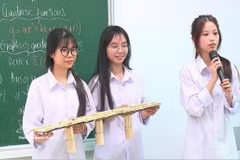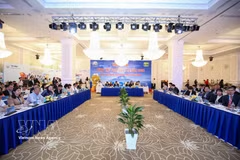
Hanoi (VNA) – The year 2026 marks a major turning point for Vietnam’s education sector as ambitious goals and unprecedented policies under the Politburo’s Resolution No. 71-NQ/TW on breakthroughs in education development have been institutionalised by the National Assembly and come into force.
Resolution No. 71 aims to elevate Vietnam’s education quality to match that of developed nations. By 2030, preschool and general education will reach advanced levels in Asia. By 2045, Vietnam seeks to build a modern, equitable, and high-quality system ranking among the world’s top 20.
The resolution also targets gradually making English a second language in schools and integrating artificial intelligence (AI) and STEM education into curricula.
For higher education, Vietnam aims to have at least eight universities ranked among Asia’s top 200 by 2030, and at least five institutions listed among the world’s top 100 in certain disciplines by 2045.
Professor Nguyen Dinh Duc of the University of Engineering and Technology under the Vietnam National University, Hanoi, described these targets as highly ambitious given the current state of the education system, reflecting the Party’s strong aspirations and long-term strategic vision.
")
To implement these goals, the National Assembly adopted Resolution No. 249/2025/QH15, approving the investment policy for the national target programme on education and training development for 2026–2030.
By 2030, Vietnam aims to complete universalising education from age three to lower secondary level, ensure all classrooms are solidly built, and enable 30% of educational institutions to teach certain subjects in English. At least 20 college-level programmes are expected to be competitive within ASEAN, while around 30 universities will be upgraded to standards comparable with developed Asian countries. The targets also include eight universities in Asia’s top 200 and at least one in the world’s top 100 in selected fields.
By 2035, all educational institutions are expected to have the capacity to teach some subjects in English. Around 60 colleges will approach ASEAN-4 standards, with six reaching levels comparable to developed G20 countries. Between 15 and 20 college-level programmes are expected to achieve strong regional and global competitiveness. In higher education, at least 12 universities are targeted to rank among Asia’s top 200, with two entering the world’s top 100 in specific disciplines.
To support implementation, the National Assembly approved total funding of more than 580.1 trillion VND (22 billion USD), including 174.67 trillion VND for the 2026–2030 period.
Accelerating implementation
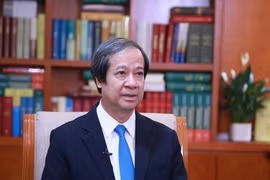
Minister of Education and Training Nguyen Kim Son said that as Vietnam aims to become a developed and high-income country by 2045, education and training must be developed with greater intensity, speed, and quality than in previous periods.
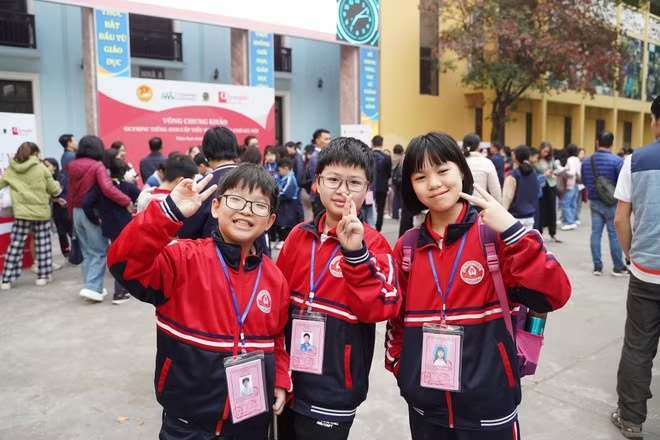
The Ministry of Education and Training began rolling out implementation efforts in late 2025 and is pushing forward with a strong commitment.
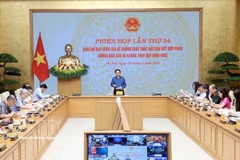
In December 2025, the ministry convened a meeting on the implementation of a project to make English a second language in schools for 2025–2035, with a vision to 2045, focusing on roadmap development, teacher capacity, and funding. Son acknowledged numerous challenges but expressed confidence that with coordinated efforts and strong Government direction, progress will be achieved.
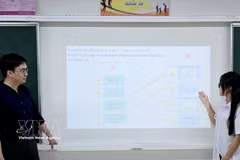
The ministry also issued a pilot framework for teaching AI in general education. The framework focuses on four areas: human-centred thinking, AI ethics, AI techniques and applications, and AI system design, and is designed for both foundational and career-oriented education stages.
Schools are encouraged to adopt flexible approaches, including integrating AI into existing subjects, offering elective modules, or organising extracurricular activities. Priority is given to integration to ensure accessibility without overloading the curriculum, while maintaining academic integrity and scientific standards in the use of AI./.