Bac Ninh seeks to attract Chinese investors to high-tech industries

With strengths in technology, manufacturing and new energy, Chinese companies have considerable room to expand investment in Vietnam. Meanwhile, Bac Ninh's strategic location, well-developed infrastructure and dynamic policies make it an attractive destination for Chinese investors.

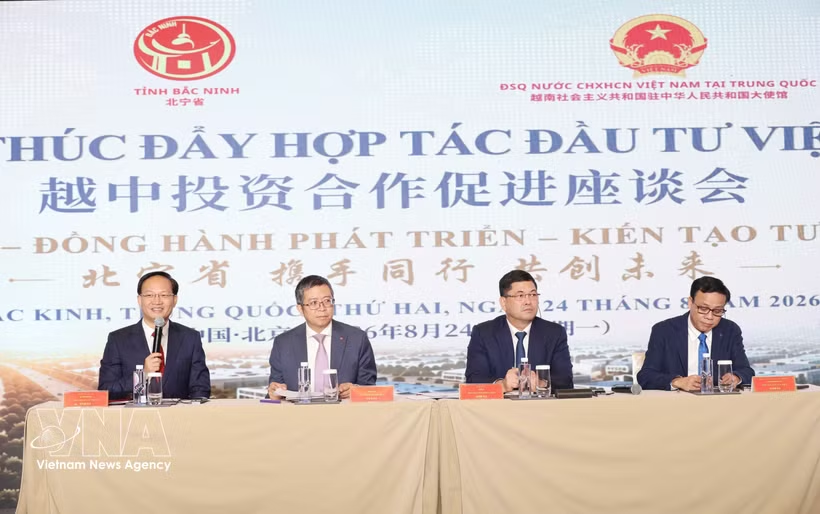
Representatives of the Vietnamese Embassy in China and Bac Ninh province at the seminar in Beijing on August 21. (Photo: VNA)

Beijing (VNA) – The Vietnamese Embassy in China and the northern province of Bac Ninh co-hosted a seminar in Beijing on August 24 to promote investment cooperation between Vietnam and China, with nearly 300 representatives from Chinese agencies, organisations, business associations and companies in attendance.

Addressing the seminar, Vietnamese Ambassador to China Pham Thanh Binh said the state visit to China by General Secretary of the Communist Party of Vietnam Central Committee and President To Lam in April 2026 opened up a new phase in bilateral relations and created a solid foundation for investment cooperation.

The seminar offered an opportunity for Chinese businesses to gain a better understanding of investment potential and opportunities in Bac Ninh, he said, adding that Vietnam is seeking high-tech projects with high added value.

With strengths in technology, manufacturing and new energy, Chinese companies have considerable room to expand investment in Vietnam. Meanwhile, Bac Ninh's strategic location, well-developed infrastructure and dynamic policies make it an attractive destination for Chinese investors, he said.
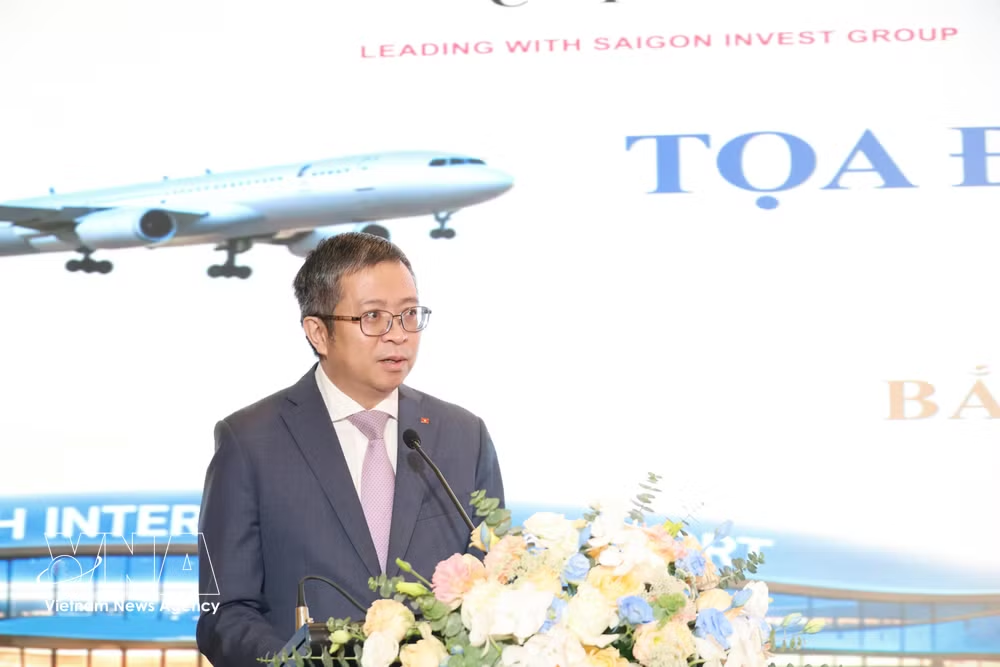
Vietnamese Ambassador to China Pham Thanh Binh speaks at the seminar. (Photo: VNA)

Vietnamese Ambassador to China Pham Thanh Binh speaks at the seminar. (Photo: VNA)

Vice Chairman of the Bac Ninh People's Committee Pham Van Thinh said the province is working towards becoming a centrally run city, with the goal of developing into a leading semiconductor and artificial intelligence (AI) hub in Vietnam. Its gross regional domestic product (GRDP) grew 10.27% in 2025 and 10.56% in the first half of 2026.

Major enterprises, including MCC, Goertek, Luxshare-ICT, and JA Solar, have invested in the province. Bac Ninh plans to develop 70 industrial parks, 39 of which are currently operational with total area covering 11,387ha. It has around 600ha of ready-to-use industrial land and expects the figure to reach 1,000ha the first quarter of 2027.

The province is encouraging investment in five strategic areas: semiconductors, integrated circuits and new materials; aviation, unmanned aerial vehicles (UAVs) and smart logistics; robotics, AI and smart manufacturing; pharmaceuticals, biomedicine and advanced medical equipment; and green energy, smart electrical equipment and sustainable industries, according to Thinh.

Liu Chun, Chairman of the China Chamber of Commerce for Import and Export of Machinery and Electronic Products (CCCME), said the chamber and Bac Ninh have built a solid foundation since 2023 through trade and investment activities and the establishment of a government-to-business connection channel.

A CCCME delegation visited Bac Ninh's industrial parks in March 2024 and identified the province as a leading electronics manufacturing centre in northern Vietnam and a key destination for Chinese machinery and electronics companies, he said.

Liu proposed strengthening government-to-business connectivity, expanding collaboration in smart manufacturing and green transformation, enhancing legal compliance guidance, and deepening cooperation between CCCME, the Vietnamese Embassy, and industry associations.

Representatives of Kinh Bac City Development Holding Corporation and Chinese investors in Bac Ninh, including JA Solar, Sunwoda, and Tarry, shared their experience in implementing projects in the province.

At the closing session, Secretary of the Bac Ninh provincial Party Committee Nguyen Hong Thai said it’s a strategic milestone for Bac Ninh to become a centrally run city. He affirmed that the province regards Chinese businesses as important partners and prioritises high-tech, environmentally friendly, and high-value-added projects.

The province will accompany investors throughout the life cycle of their projects and welcomes Chinese businesses to visit and explore investment opportunities in Bac Ninh, he added./.​

VNA

See more

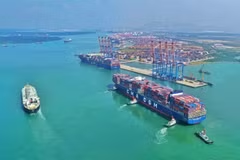
A view of the deep-water port Gemalink. (Photo: gemadept.com.vn)

Seaport profits surge as trade growth supports positive second-half outlook

Profit contributions from joint ventures and associates rose 58%, with Gemalink alone increasing 43%. The improvement provided a clearer indication of core operating performance, while Gemadept also recorded an extraordinary gain of more than 600 billion VND from a divestment move in the second quarter.

Online shopping is becoming increasingly common, but unlike traditional transactions, consumers often cannot directly see products, meet sellers or immediately verify information. - Illustrative image (Photo: VNA)

Consumer trust key to sustainable e-commerce growth

Management agencies should strengthen coordination and data sharing with digital platforms, preserve electronic evidence and prevent sellers whose accounts have been blocked from quickly resuming business under new identities.

An organic vegetable model in Hanoi. (Illustrative photo: VNA)

Vietnam fine-tuning Extended Producer Responsibility policy to promote circular economy

Vietnam’s revised EPR framework is therefore expected to build a more comprehensive ecosystem covering collection, transportation, sorting, recycling, data management and supervision, making producers’ responsibilities closely linked to actual recycling outcomes. This will help EPR become a genuine driver of the recycling market and Vietnam’s transition toward the circular economy.

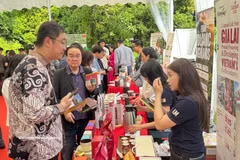
Visitors look for traditional Vietnamese handicrafts at Paris Fair (Photo: VNA)

Vietnamese firms urged to join global value chains

Vietnam should develop a strong domestic business force capable of absorbing technology, standards, management practices and market access from major corporations. At the same time, it is necessary to issue policies that encourage FIEs to actively seek, develop and use Vietnamese suppliers.

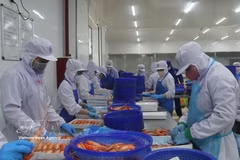
Processing prawns for export (Photo: VNA).

Vietnam's economy expected to grow 11% in 2027

AFP reported that Vietnam’s economy grew 8.4% year-on-year in the second quarter of 2026, exceeding the previous forecast of 7%. In the first half of the year, GDP expanded 8.2%, with industry and construction remaining key drivers of growth, alongside a recovery in manufacturing activity and domestic demand.

Vietnamese businesses connect with importers, distribution systems and partners at the Vietnam Coffee Festival 2026 in Singapore (Photo: VNA.)

Vietnam-Singapore ties gain new momentum through SME cooperation

From the Digital Economy-Green Economy Partnership to connectivity programmes between Enterprise Singapore and Vietnam’s Ministry of Science and Technology, policy mechanisms are no longer merely on paper but have become practical resources, creating a secure and favourable legal framework for businesses.

The total investment for VSIP Ha Tinh is more than 1.5 trillion VND (57.4 million USD) (Photo: VNA)

Vietnam-Singapore economic ties enter new phase of cooperation

As complementary economies, Vietnam and Singapore have promoted the implementation of trade agreements to strengthen bilateral economic ties. Both members of the Comprehensive and Progressive Agreement for Trans-Pacific Partnership (CPTPP) and the Regional Comprehensive Economic Partnership (RCEP), the two countries have effectively tapped the benefits offered by these free trade agreements.

Package XL3 of the Ho Chi Minh City Ring Road 3 passing through Vinhomes Grand Park urban area, Long Binh ward. (Photo: VNA)

Ho Chi Minh City to start works, inaugurate 16 projects on National Day

According to the Ho Chi Minh City Department of Construction, the southern metropolis will start 11 projects and put five works into operation in transport, technical infrastructure, housing, civil construction and industry, with total investment exceeding 249.4 trillion VND (9.5 billion USD).

All fishing vessels operating in Ca Mau must use the electronic catch documentation and traceability (eCDT) system when entering or leaving designated fishing ports. (Photo: VNA)

Ca Mau tightens controls to combat IUU fishing

The southernmost province of Ca Mau is among the localities facing significant pressure in implementing the EC’s recommendations on IUU fishing. Vice Chairman of the provincial People’s Committee Le Van Su has urged local authorities, particularly leaders, to take greater responsibility, stressing the principle of “no formal reporting, no excuses and no evasion of responsibility.”

E.town office complex on Cong Hoa street, Ho Chi Minh City. (Photo: VNA)

AI drives new standards for office market

With GCCs, technology and sustainability converging, Ho Chi Minh City’s office market is entering a new phase in which operational quality and adaptability are becoming increasingly important, alongside location.

The inauguration of Tokuyama Vietnam's polysilicon plant in Ho Chi Minh City (Photo: Ho Chi Minh City Portal)

Japanese firm to produce key chip material in Vietnam, Malaysia

Tokuyama's Vietnam plant, inaugurated last week, will grind, clean and analyse polysilicon, an essential raw material for semiconductor wafers. Tokuyama is investing 60 million USD in the facility, which is ultimately expected to reach an annual capacity of 4,000 tonnes.

Farmers tend to rice crops in Can Tho city. (Photo: VNA)

Can Tho to host second Vietnam International Rice Festival

The second Vietnam International Rice Festival in Can Tho city from November 23-26 aims to showcase Vietnam’s rice industry, promote its rice heritage, strengthen the country’s position in global food security, and develop a sustainable rice value chain.

A discussion at the forum "Vietnam-ASEAN in Global Value Chains: From Signal to Action". (Photo: VNA)

Vietnamese firms urged to strengthen capacity as ASEAN pushes deeper digital integration

Vietnamese businesses have established leading positions in some supply chains, including seafood, wood processing, cashew and coffee processing. However, in manufacturing and electronics, many firms remain concentrated in assembly and the supply of simple components. Data transparency, traceability and effective supply-chain management are key to helping leading businesses maintain their positions.

Members of the Vietnam-ASEAN value chain cooperation initiative make debut (Photo: VNA)

Ho Chi Minh City launches VSM 70 pilot programme to upgrade factory competitiveness

Selected companies will have their operations assessed and benchmarked against international best practices. They will get tailored improvement roadmaps and direct support from experts at their factories. They will also join a business community to share real-world experience, and must name one point of contact, share accurate operational data, and keep leaders involved throughout the process.