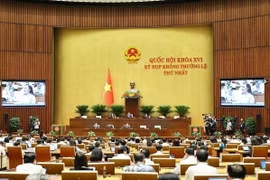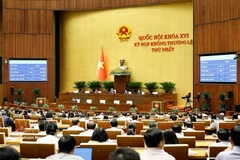
Hanoi (VNA) – The 16th National Assembly, during its first extraordinary session on August 24, adopted a resolution introducing special mechanisms to remove obstacles facing projects serving the 2027 APEC Economic Leaders' Week in Phu Quoc special zone in the Mekong Delta province of An Giang, with 92.8% of deputies voting in favour.
The resolution is expected to provide an important legal basis for addressing issues arising during the implementation of projects subject to particularly urgent deadlines, while maintaining strict oversight and accountability.
Removing obstacles for ongoing projects
Minister of Finance Ngo Van Tuan said the Government had clarified the scope of the resolution to cover projects and works that had been initiated and were under construction from March 2025 to before May 18, 2026.
The Government, ministries, and the provincial authorities will monitor, inspect, and supervise implementation to ensure the special mechanisms are applied only to eligible projects. The scope will not be expanded or used as a precedent for other cases.
The resolution addresses the urgent situation in which some APEC projects had to begin construction within a very short timeframe while procedures related to investment, construction, land, acceptance, handover, payment and final settlement had not been fully completed.
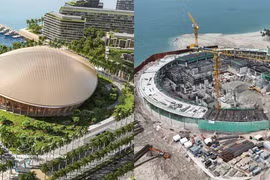
The mechanisms apply to projects on the list approved by the Prime Minister under Decision No. 948/QD-TTg dated May 17, 2025; works under reciprocal projects implemented on land used to pay investors of the APEC Convention Centre project under the build-transfer (BT) model; and certain mineral exploitation and recovery and waste disposal activities serving eligible projects.
Projects eligible for the mechanism must also meet specific timing requirements, focusing on those whose implementation or construction began between March 2025 and May 18, 2026.
Clearly defining the eligible projects, scope and timeframe is important to address the practical difficulties facing APEC projects while avoiding an overly broad application or setting a precedent for other cases.
Tackling mineral and waste issues
Mineral exploitation and recovery and construction waste treatment are among the specific challenges arising during construction projects in Phu Quoc.
The Government has introduced coordinated controls between An Giang and relevant ministries over waste disposal and reception, mineral recovery and exploitation, and project appraisal and acceptance, with a view to ensuring environmental, fire safety and labour safety requirements.
Streamlining certain procedures does not mean relaxing management. Instead, some controls will shift from prior checks to post-inspection, while project owners, investors and contractors remain responsible under existing laws.
For minerals, financial obligations will be determined based on contracts, invoices, payment documents, and other records proving that minerals were exploited or recovered for construction. Those providing such documents are responsible for their accuracy and authenticity.
Eligible projects may handle construction waste under the special mechanism, while projects carried out after May 18, 2026 must comply with existing laws. Environmental responsibilities also remain in place, including site restoration and compensation for any environmental damage.
Easing resource pressure
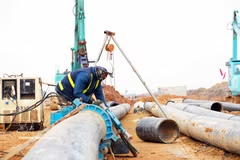
Another major challenge is the shortage of labour and other resources as numerous large projects are being implemented simultaneously.
According to the provincial People’s Committee, 21 major APEC projects have increased labour demand on Phu Quoc by about 50%. The airport project alone employs around 4,000 workers but remains short of about 2,000, while many construction packages have only 30-40% of the workforce needed to meet deadlines.
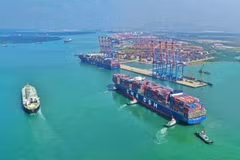
As an island, Phu Quoc must bring in workers, materials, machinery and equipment from the mainland, increasing transportation and construction costs. Fuel price fluctuations, higher material costs and seasonal weather conditions have also affected project implementation.
The resolution does not introduce an immediate separate mechanism for newly arising construction norms and prices. Instead, the provincial People’s Committee and investors are tasked with clarifying completed work, volumes and actual costs for submission to the Government and competent authorities.
The resolution thus establishes a special legal framework to help agencies, investors and contractors complete procedures, address emerging problems and accelerate APEC-related projects, while ensuring that progress goes hand in hand with quality, safety, efficiency and accountability./.