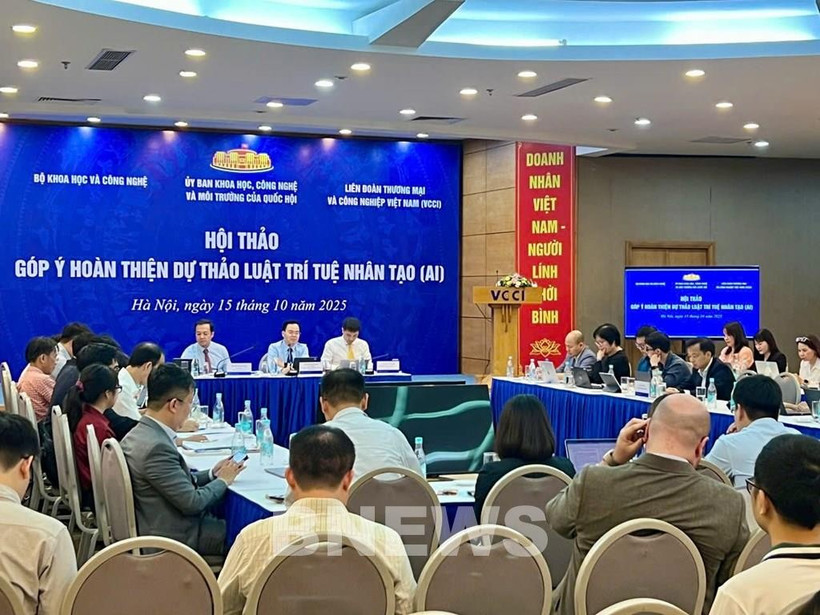
Hanoi (VNA) – A workshop to gather feedback on the draft law on artificial intelligence (AI) took place in Hanoi on October 15, attracting numerous experts, scholars, lawyers, journalists, and representatives from the business community.
The event was co-organised by the Vietnam Chamber of Commerce and Industry (VCCI), the National Assembly (NA)’s Committee on Science, Technology and Environment, and the Ministry of Science and Technology,
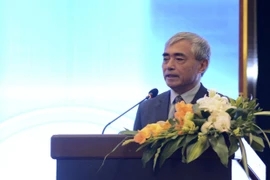
Opening the workshop, Tran Van Khai, deputy head of the NA committee, noted that AI has been identified as one of Vietnam’s national priority technologies, playing a key role in digital transformation and the knowledge-based economy. Vietnam aims to become one of the leading countries in Southeast Asia in AI research and development.
The rapid AI development poses many legal, moral, and safety challenges, requiring an appropriate legal corridor. Given this, an AI law is of critical importance to creating a legal cornerstone for promoting AI research, development, and governance in a safe and responsible manner, he went on.
The draft AI law has been developed on the principle of sustainable, transparent, and responsible development, Khai said.
In his co-opening remarks, Dau Anh Tuan, VCCI Vice Secretary-General and Director of the Legal Affairs Department, said the business community highly values the scientific and open-minded approach taken in drafting the law despite the short preparation time. Many of its key aspects are aligned with international standards, such as risk-based management, controlled testing mechanisms, human rights, and ethical safeguards.
Tuan expressed hope that the draft will ensure flexibility and adaptability to avoid rigidity that could hinder innovation. He also called for simplifying administrative procedures, streamlining registration and disclosure processes, and strengthening investment in data infrastructure and computing capacity to reduce dependence on external systems.
In addition, he highlighted the importance of clearly defining legal liability, insurance mechanisms, and risk-sharing frameworks while drawing on international experience yet maintaining Vietnam’s distinct regulatory characteristics.
From a technical perspective, Tran Vu Ha Minh, chief advisor for responsible AI at FPT Software, shared that a recent survey by the National Institute for Digital Technologies and Digital Transformation identified data – the foundational element of all AI systems – as one of the major bottlenecks in Vietnam’s current AI development.
Minh recommended that as it is still in the early stages of building and applying AI, the country has a unique opportunity to design its AI systems with strong governance and compliance standards from the outset.
She further suggested the need for guidelines on responsible digital transformation, ensuring compliance with ethical and technical standards from the initial implementation stages. For high-risk or key AI projects, detailed policies, regulations, and technical standards should be established so that businesses can confidently move forward without concerns about legal or technical barriers.
The most important is to provide training for and improve AI-related awareness from grassroots to high-level leaders, equip SMEs with necessary knowledge, and organise in-depth refresher courses for senior managers, data engineers, and technology legal experts, she added./.
See more
PM directs acceleration of scientific-technological development, digital transformation
The rate of end-to-end online public services has reached only 39.98%, far below this year's target of 80%. Data quality across national and sectoral databases remains inconsistent, complicating information sharing and reuse. Cybersecurity and incident response capacity also remain inadequate.
Experts propose anti-scam solutions suited to Vietnam’s conditions
Vietnam’s digital transformation has achieved remarkable progress. However, similar to other countries in the region, online scams and fraud cases are on the rise. Last year, authorities recorded 10,000 online fraud cases, with estimated losses of nearly 759 million USD.
A Generation coded with the AI-First gene
Maya - a virtual HR assistant developed by FPT - sends over 20,000 appointment reminders, answers queries, and compiles feedback within just a few hours.
Lawmakers call for post-implementation review in technology transfer
Lawmakers highlighted the need to introduce a post-implementation review mechanism to enhance transparency and prevent abuse in technology valuation and transfer.
Vietnam looks to develop, master digital technology through open standards
Vietnam has chosen to pursue this direction — developing open technologies, open-source software, and open data — to enable individuals and enterprises to co-create new values. With this approach, it will become a technology-driven nation that both benefits from and contributes to global knowledge.
Vietnam urged to develop high-quality human resources for digital industry
According to statistics, Vietnam currently has nearly 78,000 digital technology companies with approximately 1.9 million workers in the information technology (IT) sector. However, these firms still face difficulties in recruiting high-quality human resources in the current context.
Vietnam, Taiwan (China) promote cooperation in training semiconductor human resources
The forum focused on sharing experience and strategies for building a skilled semiconductor workforce, updating recruitment trends, and promoting university–industry cooperation to establish a sustainable talent ecosystem for Vietnam’s fast-growing semiconductor sector.
Young scientists, female sci-tech students of 2025 honoured
Ten young scientists under 35 years won the 2025 Golden Globe Science and Technology Award while 20 outstanding female students were honoured with. the 2025 Vietnam Female Students in Science and Technology Award
Vietnam learns UK's sci-tech, innovation, digital transformation experience
At the Catapult Network, the delegation learnt about the sustainable public – private partnership, exemplified by the “one-third funding” structure, in which financing is shared equally among the government, commercial contracts, and collaborative R&D projects.
Dong Nai accelerates shift to tech-driven growth model
Dong Nai aims for the digital economy to account for at least 30% of GRDP by 2030, making it a central driver of the province’s exceptional growth trajectory.
Vietnamese Party chief attends seminar on AI, technology in London
With its aspiration to become a pioneer in digital economy, Vietnam seeks to learn from the UK - the cradle of the Industrial Revolution and the homeland of great minds such as Isaac Newton, John Locke, Adam Smith, Alan Turing, William Shakespeare, and Charles Dickens - to build an innovative, human-centred, and sustainable technological ecosystem.
Minister-level roundtable on AI governance held in Ninh Binh
Nearly 300 delegates representing government agencies, international organisations and leading enterprises convened in Ninh Binh province on October 27 for a ministerial roundtable on artificial intelligence (AI) governance.
Int'l press conference highlights key outcomes of Hanoi Convention signing
As many as 72 countries from around the world signed the United Nations Convention against Cybercrime (also known as Hanoi Convention) at the recent Signing Ceremony and High-Level Conference held in Hanoi on October 25–26.
Int'l press conference highlights key outcomes of Hanoi Convention signing
The Ministry of Public Security and the Ministry of Foreign Affairs jointly held an international press conference to announce the outcomes of the Signing Ceremony and High-Level Conference of the United Nations Convention against Cybercrime (also known as Hanoi Convention) in Hanoi on October 26.
Hanoi Convention: Fostering global cooperation in combating cybercrime
A policy discussion focusing on promoting international cooperation in combating cybercrime, with national approaches to implementing the United Nations Convention against Cybercrime (the Hanoi Convention), took place in Hanoi on October 26 on the sidelines of the convention's signing ceremony.
Ecuador Vice President commends Vietnam’s role in global efforts to combat cybercrime
Vice President of Ecuador Maria Jose Pinto Gonzalez Artigas has hailed Vietnam’s leadership role in the global anti-cybercrime efforts as the Southeast Asian country was selected as the host of the signing ceremony of the United Nations Convention against Cybercrime (Hanoi Convention).
Hanoi Convention: Protecting human rights, citizens’ rights in digital era
Protecting human rights and citizens’ rights in cyberspace is a vital foundation for building a safe, inclusive and people-centred digital future, heard at a high-level discussion held on October 25 in Hanoi.
Hanoi Convention: Discussion shares experience in collecting electronic evidence
The United Nations Convention against Cybercrime is therefore expected to help harmonise laws, establish international standards, and build a round-the-clock cooperation network to support member states in cybercrime investigations, they underscored.
Vietnamese intellectuals in Thailand share opinions on bilateral cooperation, talent attraction policies
Participants discussed ways to connect the Vietnamese intellectual community in Thailand and offered feedback on the draft documents for the upcoming 14th National Congress of the Communist Party of Vietnam.
Dutch cyber affairs official hails Vietnam’s hosting of Hanoi Convention signing
Ernst Noorman, Ambassador-at-large for Cyber Affairs of the Netherlands, spoke highly of Vietnam’s efforts in hosting the signing ceremony of the UN Convention against Cybercrime (Hanoi Convention), as the event demonstrated the country’s strong commitment to tackling global cyber threats and advancing international cooperation.