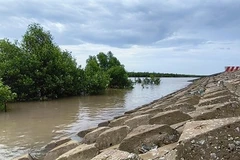
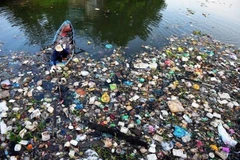
The Mekong Delta suffers from severe coastal erosion. (Photo: VNA)
Hanoi (VNA) – Vietnam continued making considerable progress in adapting to climate change last year by updating Nationally Determined Contribution (NDC) and issuing the National Climate Change Adaption Plan (NAP) for the 2021 – 2030 period, with a vision to 2050.
The country is seeking public feedback on the draft of a new master plan for the Mekong Delta, aiming to effectively mobilise and use all resources to boost the regional development by 2050.
Adverse and unpredictable impacts of climate change have been taking toll on all social and economic aspects in Vietnam, said Deputy Minister of Environment and Natural Resources Le Cong Thanh at the conference “Climate Resilient and Sustainable Development of Vietnam’s Mekong Delta” in Hanoi last week.
The event connected the speakers and participants in Ho Chi Minh City, China’s Hong Kong, and the Netherlands. It discussed Vietnam’s recently approved NAP, the climate vulnerability and adaptation in the Mekong Delta, as well as the "living with nature" adaptation perspectives.
Thanh highlighted the updated NDC and NAP as major steps taken by Vietnam last year, saying the first has set strategic tasks on enhancing State governance; strengthening climate resilience and capacity building for communities, economic actors and ecosystems; mitigating disaster risks and easing damage; and improving preparedness against natural disasters and extreme climate conditions.
The NPA, he continued, focuses on implementing tasks in seven sectors that are the most vulnerable to impacts of climate change. Several tasks seek to enhance climate resilience in the Mekong Delta – a region hit the hardest by climate change in Vietnam.
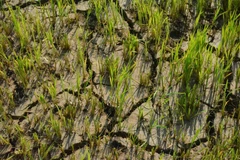
 Saline intrusion destroys thousands of hectares of rice fields in the Mekong Delta province of Kien Giang. (Photo: VNA)
In 2017, the Government issued Resolution 120/NQ-CP on sustainable development of the Mekong Delta in response to climate change, outlining both short-term and long-term solutions. It marks a big step forward by policymakers, reflected by the adoption of a comprehensive, integrated approach and a long-term vision in shaping strategies for the sustainable growth of the region.
Tran Anh Thu, Vice Chairman of the People’s Committee of the Mekong Delta province of Long An, said the historic drought and saltwater intrusion from 2015 – 2016 has wreaked havoc on the economy of the regional provinces, except for Bac Lieu and Ca Mau which sustained positive economic growth as their agricultural production has become resilient to saline environment.
The situation got better lately since seven out of the 12 regional provinces reported economic growth of 1 – 3 percent, though a more severe and lengthier drought occurred between 2019 and 2020, Thu said.
“If we see climate change as an opportunity, then saltwater, fresh water or brackish water are all resources,” he said, adding that if the sea level rises, saline ecosystem-based production should account for a bigger share of agriculture, rather than that of the freshwater ecosystem.
“Thus, the Mekong Delta will export more shrimp than rice.”
He proposed the government to invest more on developing logistics and address labour-related issues in the region so it can support the development of Ho Chi Minh City and the country at large.
Once approved, the new master plan for the Mekong Delta will lay a basis for effectively mobilising and allocating investment into the region, said Tran Quoc Phuong, Deputy Minister of Planning and Investment. It will thereby contribute to fulfilling the climate resilient and sustainable development goals set by Resolution 120 and to Vietnam’s concerted efforts in implementing specific solutions and activities to join the global climate change response.
Giving the remarks at the conference, Netherlands Ambassador Elsbeth Akkerman highlighted the urgency to act. “I have a message for you: we need to collectively take care of our planet and climate; as well as take charge of a more sustainable future.”
As Vietnam and the Netherlands are both vulnerable to climate change, the two countries need to continue cooperating in addressing the issue, particularly in the Mekong Delta, the diplomat stressed./.