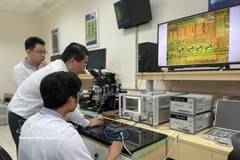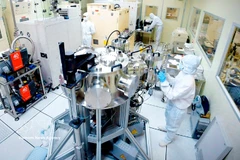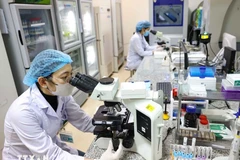
Hanoi (VNA) - With a population of over 100 million, Vietnam has an advantage in providing a large workforce for the science and technology sector. However, many existing limitations are causing challenges for domestic technology companies, even on their home turf, when it comes to recruiting labourers.
According to statistics, Vietnam currently has nearly 78,000 digital technology companies with approximately 1.9 million workers in the information technology (IT) sector. However, these firms still face difficulties in recruiting high-quality human resources in the current context.
According to experts, most companies want to hire employees who can start working immediately. However, achieving this is very difficult. One of the reasons is that many high-tech industries in Vietnam, including those considered key for the future like artificial intelligence (AI) and robotics, are still relatively new. At the same time, the education sector has limited programmes to train workers in these fields, leading to a gap between the needs of businesses and the capabilities of educational institutions to provide relevant training.
Many enterprises have chosen to re-train their workforce, but this effort also faces certain challenges. For workers, it may take only a few months, or even just a few weeks, to become familiar with their jobs. But for high-tech industries, the process takes much longer. For example, it can take nearly a year for an engineer to reach full proficiency. Meanwhile, not many businesses have the patience or resources to sustain such training efforts.
In fact, foreign direct investment (FDI) enterprises, with their strong financial capacity and years of experience, are able to attract more talents. In contrast, most Vietnamese technology companies are small- and medium-sized enterprises with limited capital and experience, so they face numerous difficulties.
To solve the obstacles hindering the development of high-quality human resources, it is essential to strengthen coordination among the “three key stakeholders”: the State, educational institutions, and businesses. In addition, strong policies should be established to encourage enterprises to invest in research and development (R&D), cooperate with research institutes and universities to apply scientific results in practical production and business activities, and at the same time, develop markets for science and technology products.
Alongside this, the role of education and training institutions must be emphasised. In high-tech sectors, the most significant investment is not in machinery, but in people. Human resources are the greatest asset in this field. Therefore, universities and colleges should proactively update and innovate their training programmes to align with the real demands of the market amid the rapid development of science and technology.
In recent years, the Government has paid great attention to formulating policies aimed at developing high-quality human resources and creating a solid foundation for domestic digital technology enterprises.
According to Nguyen Thi Nga, Deputy Director of the Department of Personnel and Organisation under the Ministry of Science and Technology, the ministry is currently leading the drafting of decrees guiding the implementation of the Law on Science, Technology, and Innovation. Among them is a decree on mechanisms and policies for high-quality human resources, focusing on three main aspects. First, the State will prioritise assigning science and technology tasks directly to organisations and enterprises that are successful in attracting talented individuals. Second, regarding the working environment, the State will focus on developing national key laboratories equipped with modern, comprehensive facilities to serve science, technology, and innovation activities. Third, individuals will be able to enjoy commensurate benefits from their contributions to innovation activities.
However, localities and enterprises should not solely rely on State policies but must also establish concrete plans for developing their own human resources.
In Hanoi, Nguyen Viet Hung, Deputy Director of the municipal Department of Science and Technology, said that the city will soon issue a resolution specifically focused on developing high-quality human resources. Currently, its high-quality workforce comes from research institutions, educational organisations, enterprises, and the civil service. Therefore, the Hanoi People’s Committee will collaborate with research and training institutions to develop additional support and incentive policies to foster high-quality human resource development in the coming period./.
See more
PM pushes for reforms in sci-tech, innovation, digital transformation
Prime Minister Pham Minh Chinh asked participants to propose priority tasks and breakthrough measures ahead, including removing obstacles, accelerating capital disbursement, simplifying procedures, promoting data reuse to cut paperwork, and offering maximum support to citizens and enterprises.
Da Nang remains Vietnam’s fastest 5G city
The city has held the top spot since the start of this year. Its 5G performance is almost 1.5 times higher than runner-up Hai Phong (429.53 Mbps) and even the capital Hanoi (415.73 Mbps).
Startup Flight 2025 boosts Vietnam–India tech, startup cooperation
Innovation and science–technology serve as key pillars to achieving the development goals of both Vietnam and India, while startup acts as a vital bridge to deepen ecosystem linkages and open future industries.
Da Nang invests over 200 billion VND in semiconductor chip design, AI development
With a vision to become an innovation and high-tech hub of central Vietnam, Da Nang has issued several key resolutions and policies to foster human resources, infrastructure and enterprises in the AI and semiconductor sectors.
Vietnam, India boost innovation cooperation
Bui Trung Thuong, Trade Counsellor at the Vietnamese Embassy in India, highlighted the shift in Vietnam–India relations from traditional cooperation to partnerships based on innovation, technology, and digital transformation.
Vietnam emerges as new hotspot for AI data centre investment
A wave of investment in artificial intelligence (AI) data centres is sweeping across Vietnam, with both domestic and international corporations announcing multi-billion-USD projects that are set to transform the country into a rising hub in the regional AI infrastructure map.
PM directs acceleration of scientific-technological development, digital transformation
The rate of end-to-end online public services has reached only 39.98%, far below this year's target of 80%. Data quality across national and sectoral databases remains inconsistent, complicating information sharing and reuse. Cybersecurity and incident response capacity also remain inadequate.
Experts propose anti-scam solutions suited to Vietnam’s conditions
Vietnam’s digital transformation has achieved remarkable progress. However, similar to other countries in the region, online scams and fraud cases are on the rise. Last year, authorities recorded 10,000 online fraud cases, with estimated losses of nearly 759 million USD.
A Generation coded with the AI-First gene
Maya - a virtual HR assistant developed by FPT - sends over 20,000 appointment reminders, answers queries, and compiles feedback within just a few hours.
Lawmakers call for post-implementation review in technology transfer
Lawmakers highlighted the need to introduce a post-implementation review mechanism to enhance transparency and prevent abuse in technology valuation and transfer.
Vietnam looks to develop, master digital technology through open standards
Vietnam has chosen to pursue this direction — developing open technologies, open-source software, and open data — to enable individuals and enterprises to co-create new values. With this approach, it will become a technology-driven nation that both benefits from and contributes to global knowledge.
Vietnam, Taiwan (China) promote cooperation in training semiconductor human resources
The forum focused on sharing experience and strategies for building a skilled semiconductor workforce, updating recruitment trends, and promoting university–industry cooperation to establish a sustainable talent ecosystem for Vietnam’s fast-growing semiconductor sector.
Young scientists, female sci-tech students of 2025 honoured
Ten young scientists under 35 years won the 2025 Golden Globe Science and Technology Award while 20 outstanding female students were honoured with. the 2025 Vietnam Female Students in Science and Technology Award
Dong Nai accelerates shift to tech-driven growth model
Dong Nai aims for the digital economy to account for at least 30% of GRDP by 2030, making it a central driver of the province’s exceptional growth trajectory.
Vietnamese Party chief attends seminar on AI, technology in London
With its aspiration to become a pioneer in digital economy, Vietnam seeks to learn from the UK - the cradle of the Industrial Revolution and the homeland of great minds such as Isaac Newton, John Locke, Adam Smith, Alan Turing, William Shakespeare, and Charles Dickens - to build an innovative, human-centred, and sustainable technological ecosystem.
Minister-level roundtable on AI governance held in Ninh Binh
Nearly 300 delegates representing government agencies, international organisations and leading enterprises convened in Ninh Binh province on October 27 for a ministerial roundtable on artificial intelligence (AI) governance.
Int'l press conference highlights key outcomes of Hanoi Convention signing
As many as 72 countries from around the world signed the United Nations Convention against Cybercrime (also known as Hanoi Convention) at the recent Signing Ceremony and High-Level Conference held in Hanoi on October 25–26.
Int'l press conference highlights key outcomes of Hanoi Convention signing
The Ministry of Public Security and the Ministry of Foreign Affairs jointly held an international press conference to announce the outcomes of the Signing Ceremony and High-Level Conference of the United Nations Convention against Cybercrime (also known as Hanoi Convention) in Hanoi on October 26.
Hanoi Convention: Fostering global cooperation in combating cybercrime
A policy discussion focusing on promoting international cooperation in combating cybercrime, with national approaches to implementing the United Nations Convention against Cybercrime (the Hanoi Convention), took place in Hanoi on October 26 on the sidelines of the convention's signing ceremony.
Ecuador Vice President commends Vietnam’s role in global efforts to combat cybercrime
Vice President of Ecuador Maria Jose Pinto Gonzalez Artigas has hailed Vietnam’s leadership role in the global anti-cybercrime efforts as the Southeast Asian country was selected as the host of the signing ceremony of the United Nations Convention against Cybercrime (Hanoi Convention).