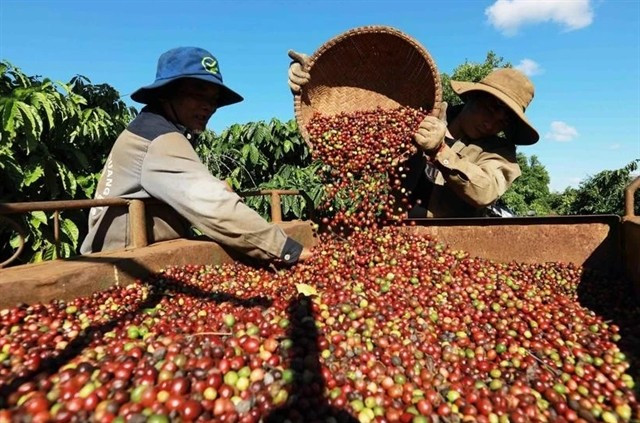
Hanoi (VNS/VNA) - As global coffee prices surge, Vietnam's coffee industry is presented with a significant opportunity to expand its export market share, industry insiders say.
A recent study by the Food and Agriculture Organization noted that coffee prices rose globally by around 40% in 2024, largely due to unfavourable weather conditions caused by climate change.
This has reduced production in Brazil, Colombia and Indonesia, while demand in Europe, the US and Asia has soared.
Last month, Vietnam's coffee export turnover reached more than 560 million USD, bringing the total export value for the first seven months of the year to 3.6 billion USD and marking an impressive year-on-year growth of 20%, according to data from the Ministry of Agriculture and Environment.
The industry's growth is mostly attributed to the jump in global coffee prices.
Vietnam is the largest exporter of Robusta coffee in the world, accounting for about 40% of global market share. The country is now looking to seize the opportunity to expand its market share.
Nguyen Nam Hai, president of the Vietnam Coffee Cocoa Association (Vicofa), said that the international coffee market has never been as favourable as it is now.
With high prices and growing demand, coupled with Vietnam’s stable supply, the country is in an advantageous position, he said.
However, to fully capitalise on this opportunity, Vietnam needs to delve deeper into processing, rather than relying on raw bean exports, he added.
Although exports have increased in value, the product structure of Vietnam’s coffee exports still reveals significant limitations.
The share of deep-processed coffee, including roasted, instant and specialty coffee, currently accounts for only 12-15% of total exports, according to Vicofa.
This figure is modest compared to the products' potential. In Brazil and Colombia, the ratio ranges from 30-40%.
Thoi bao Ngan hang (The Banking Times) quoted founder and CEO of TNI King Coffee Le Hoang Diep Thao as saying that investing in deep processing helps companies multiply the value of their products significantly.
But initial investments can be substantial, especially for instant coffee technology, which she said requires hundreds of billions of Vietnamese dong in capital. Not all businesses are financially capable of such investments.
Other reasons Vietnam’s coffee sector has been slow to transition to deep processing are technological challenges and branding issues, she added.
Technology and branding challenges
The technology for processing instant coffee and specialty coffee in Vietnam is still not uniformly developed.
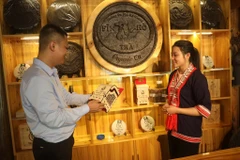
Large enterprises like Vinacafé, Trung Nguyen and Nestlé have made significant investments, but the number of small and medium-sized enterprises with sufficient capabilities is limited.
Vietnamese coffee brands have not yet been firmly established on the international market. While Vietnam is well known for its production volume, when it comes to global brands, consumers often think of Starbucks (USA), Lavazza (Italy) or Nestlé (Switzerland). This makes it difficult for processed coffee products from Vietnam to compete in the premium segment.
Dinh Van Thanh, an agricultural economics expert, said that if Vietnam continued to depend on raw coffee exports, it would remain only an "ingredient factory" for large corporations.
A long-term strategy for investment in deep processing is needed, along with efforts to elevate the national coffee brand on the global stage, he added.
Despite these challenges, positive signals are emerging from businesses. Trung Nguyen Legend, for example, is expanding its instant coffee exports to the Middle East and Eastern Europe.
Vinacafé is focusing on developing the ASEAN market, while several start-ups in Lam Dong and Gia Lai are boldly building specialty coffee brands for markets like Japan and the Republic of Korea.
Instead of selling raw beans, they are partnering with companies to process roasted coffee and sell it directly to the South Korean market, said Thao. The selling price is double that of raw beans, while farmers also earn better profits.
To capitalise on high coffee prices and expand export potential, experts recommended three key strategies for Vietnam’s coffee industry.
Vietnam should first invest in deep processing technology. The Government should offer preferential credit policies to businesses that invest in production lines for instant and specialty coffee, rather than leaving them to manage on their own.
Experts also suggest that the country focus on building a national coffee brand, similar to Thailand's Jasmine rice or Colombia’s Arabica coffee. A strong, internationally recognised coffee brand is essential for Vietnam.
Finally, Vietnam should prioritise emerging markets like the Middle East, South Asia and Eastern Europe, where coffee demand is growing rapidly. This presents an opportunity for processed Vietnamese coffee to expand its distribution channels./.
See more
Vietnam OCOP Festival 2025 opens in Hanoi
The festival functions as a space to bring together regional OCOP excellence, a forum connecting OCOP stakeholders with distributors, investors, experts and consumers, and a platform to spread pride in indigenous culture, local knowledge, and the aspiration for legitimate prosperity.
Top projects honoured at Startup Festival 2025 finals
The Startup Festival 2025 marked the largest annual event summarising a year-long startup support programme.
Modern, comprehensive infrastructure – a need for fast, sustainable development: PM
The Party and State continue to define infrastructure development as one of the three strategic breakthroughs, with priority given to building comprehensive and modern infrastructure, particularly transport facilities, technological infrastructure, and green – digital transition infrastructure, to help realise the national target of double-digit growth, the PM said.
Mercosur, Vietnam launch preferential trade agreement negotiations
The parties are finalising terms of reference that will define the scope, structure, and methodology for talks, according to a statement posted on the Brazilian government's website.
Green transition emerges as new engine of growth
Green growth and sustainable development are not an easy path, but they promise many “sweet fruits” commensurate with businesses’ efforts.
Vietnam’s International Financial Centre officially comes into being
The IFC establishment is an urgent requirement in reality and based on Vietnam’s potential, advantages, and epochal vision for fast and sustainable development.
Vietnam’s textile-garment industry under pressure for deeper restructuring
To achieve the industry's targets, enterprises must accelerate market, product, and customer diversification while boosting investment attraction to the supply segments Vietnam still faces shortages in, and developing human resources in parallel with science and technology promotion.
Vietnam stands as Ireland’s promising economic partner in ASEAN: Irish official
Pat O’Riordan, ASEAN Director at Enterprise Ireland – the Irish Government’s enterprise development agency, underscored Vietnam’s increasingly important role in Ireland’s cooperation strategy in ASEAN.
PM pushes trust, breakthroughs to accelerate private sector growth
Prime Minister Pham Minh Chinh noted that since the rollout of Resolution 68, alongside supporting resolutions from the National Assembly (NA) and Government, there has been a marked change in understanding the private sector’s critical position and role in Vietnam’s socialist-oriented market economy.
Private sector thrives eight months after Resolution 68’s launch: PM
The private sector has shown marked progress eight months after the launch of Resolution 68, registering about 18,000 new enterprises monthly and pushing the nationwide total to nearly 1.1 million, Prime Minister Pham Minh Chinh told the third meeting of the National Steering Committee in Hanoi on December 20.
Hoa Lac Hi-Tech Park poised to become Vietnam’s innovation hub
Under the revised Law on the Capital, Hoa Lac is set to benefit from special mechanisms, aimed at addressing long-standing infrastructure bottlenecks, strengthening regional linkages and mobilising financial resources
Hanoi to host Vietnam OCOP Festival 2025
The festival is seen a practical activity celebrating the achievements made by the capital and the country in 2025, affirming OCOP’s role in rural economic development, contributing to realising Vietnam’s aspiration for strong economic growth in the context of deep integration.
EVN launches major power projects
Among the flagship projects inaugurated was the expanded Hoa Binh Hydropower Plant with a total installed capacity of 480MW per year and average annual output of about 488 million kWh.
Fisheries take the lead in the Mekong Delta’s green transition
Across the Mekong Delta, leading aquaculture producers, processors and exporters, along with suppliers of inputs, are transitioning to circular, high-tech and clean production models that cut greenhouse gas emissions and comply with international certification standards.
HCM City targets nearly 200,000 social housing units by 2028
Ho Chi Minh City aims to have 199,400 social housing units by 2028, two years ahead of the target set by the Government, according to information released at a conference held on December 18.
ADB, BIDV support Vietnam’s green agriculture with 250 million USD financing package
According to ADB, to realise its goal of becoming one of the world’s top 15 agricultural exporters by 2030, Vietnam will need substantial capital, estimated at nearly 100 billion USD. The newly signed 250 million USD loan package represents part of the solution to this challenge.
Vietjet tops out hangars, launches first flight to Long Thanh airport
Vietjet on December 19 operated its inaugural flight to Long Thanh International Airport. Flight VJ038, operated by an Airbus A321neo, departed from Tan Son Nhat Airport and landed safely, comfortably and on schedule at Long Thanh.
Sun Group commences construction of casino tourism complex in Quang Ninh
Upon completion, the complex is expected to become the first large-scale resort city in Northern Vietnam, welcoming a substantial number of visitors from Northeast Asia and the domestic market, generating strong momentum for commercial activities, services, and resort real estate.
Works starts on Hanoi’s Red River Landscape Boulevard Axis project
The project is among the 234 key works and projects being launched, inaugurated or technically opened simultaneously across 34 cities and provinces nationwide to mark the 14th National Party Congress. Its launch contributes to implementing the country’s strategic development orientations while concretising Hanoi’s development goals in the new period.
Steering council for International Financial Centre set up
The council is tasked with setting development strategies, roadmaps, and plans for the International Financial Centre, based on the current conditions and potential of HCM City and Da Nang.