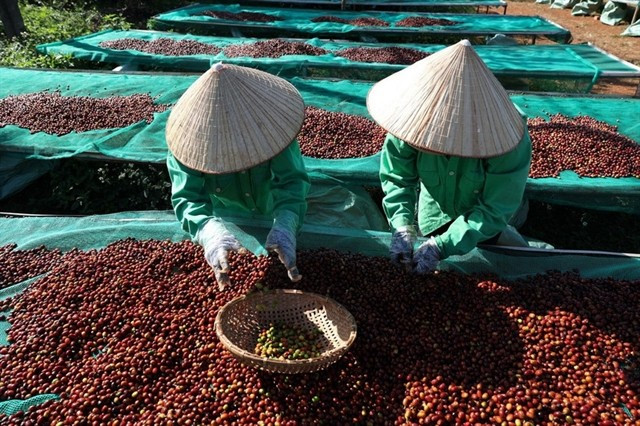
Hanoi (VNS/VNA) - Coffee has once again emerged as a star performer among agro-forestry-fishery exports in the first half of 2025, with both volume and value registering strong growth despite ongoing global challenges in supply and climate conditions.
According to the Ministry of Agriculture and Environment (MAE), Vietnam exported an estimated 953,900 tonnes of coffee worth 5.45 billion USD in the first six months of 2025, increasing by 5.3% in volume and 67.5% in value compared to the same period in 2024.
The average export price surged by 59.1% year-on-year, reaching 5,708 USD per tonne.
Germany, Italy and Spain remained Vietnam’s top three coffee importers, accounting for 16.3, 7.9, and 7.4% of total exports respectively. Notably, export value to Germany more than doubled in the first five months of the year, while Italy saw a 45.1% rise and Spain 55.8%.
Among Vietnam’s top 15 export markets, the most significant increase came from Mexico, with export value soaring 71.6 times, while China recorded the lowest increase at 22.9%.
Deputy Minister Phung Duc Tien highlighted that Vietnam has already met its original 2025 coffee export target of 5.5 billion USD in just six months. With several months still ahead, the country is now expected to reach 7.5 billion USD in coffee exports by year-end, an increase of 36.9% year-on-year.
“The bulk of coffee production typically occurs between December and April,” he said.
“So, exports in the second half of the year are not expected to be as high as in the first half. But if Vietnam earns 2 billion USD in the final six months, the 7.5 billion USD target is well within reach,” Tien said.
The outlook for Vietnam’s coffee sector remains favourable despite some production concerns.
The US Department of Agriculture (USDA) has forecast that global coffee production in the 2024–25 season will reach 174.4 million bags, up 2.98% compared to the previous crop. Meanwhile, global consumption is expected to be only 169.36 million bags, creating a potential surplus of more than nine million bags.
Major producers are expected to boost output, with Brazil reaching 65 million bags, Indonesia 11.25 million bags (up 2%) and Vietnam 31 million bags after October 2025 (up 6.9%), expected to be harvested from October 2025.
Meanwhile, global coffee prices maintained their upward momentum. Robusta prices on the London exchange on July 9 rose sharply, with September 2025 futures reaching 3,568 USD per tonne (up 42 USD per tonne), while Arabica prices on the New York exchange climbed to 285.60 cents per pound for the same delivery month (up 2.6%).
Looking ahead, Vietnam’s coffee sector sees opportunities to strengthen its presence in premium markets. The US, the world’s largest coffee consumer, remains a key target for Vietnam’s high-quality, processed and instant coffee products. Brazil continues to dominate supply to the US, but Vietnam’s robusta coffee is gaining traction in specialty and value-added segments.
Meanwhile, the European Union – currently the largest export market for Vietnamese coffee – is tightening sustainability standards under its new anti-deforestation regulation (EUDR).
Vietnam is classified as a 'low-risk' country under the EU’s forest-risk commodity categorisation, which significantly reduces inspection rates on its exports to just 1% instead of 3% for the "medium-risk" group or 9% for the "high-risk" group.
Nguyen Do Anh Tuan, Director of the MAE’s International Cooperation Department, emphasised that full traceability and data transparency are critical for Vietnamese exporters to comply with the EUDR. He added that local-level data collection must be synchronised and secure, yet accessible for both State management and enterprise reporting.
Deputy Minister Hoang Trung urged swift action to move from the pilot stage to full implementation of the EUDR, ensuring that all export data, documentation, and technical requirements are completed before the January 1, 2026, enforcement deadline.
He believes that Vietnam’s compliance with EU standards opens up new avenues for cooperation not only within Europe, but also in Asia and the Middle East. In particular, the coffee sector is encouraged to explore further opportunities in Northeast Asia, notably China, Japan and the Republic of Korea, as well as India – where competitive pricing and low transport costs favour Vietnam’s exports. /.
VNA