Hanoi (VNA) – With a victim-centred approach, authorities are stepping up information sharing, joint investigations, and public awareness to dismantle cross-border trafficking and scam networks.
Human trafficking has grown increasingly complex across the region and the world in recent years. Criminal networks are exploiting online platforms, social media, and emerging technologies, particularly Artificial Intelligence, to set traps such as “easy jobs with high pay”, romance scams, and fraudulent investment schemes.
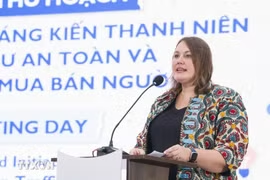
Against this backdrop, the Ministry of Foreign Affairs, in coordination with the United Nations Office on Drugs and Crime (UNODC), organised an awareness event on trafficking for forced criminality in scam centres, while launching the UNODC’s #TrappedInScamCrime campaign in Vietnam.
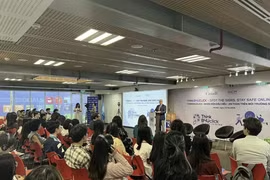
The event, held on March 9 in Hanoi, brought together nearly 140 delegates, including ambassadors, heads of diplomatic missions, representatives of international organisations, ministries, local authorities, non-governmental organisations, and students from the Diplomatic Academy of Vietnam and the Procuracy University.
In her opening remarks, Deputy Minister of Foreign Affairs Le Thi Thu Hang highlighted that traffickers increasingly target individuals seeking overseas employment, forcing them into labour exploitation and criminal activities. Scam centres are expanding globally, recruiting victims from dozens of countries, posing serious threats to security, social order, and human safety, while causing significant economic losses.
She reaffirmed that Vietnam attaches great importance to combating human trafficking, considering it a responsibility of the whole society and the entire political system. This commitment is reflected in the 2024 Law on Prevention and Combat of Human Trafficking and the national programme for the 2026–2030 period.
Amid global challenges, the Deputy Minister underscored the role of the UNODC and partners in supporting the United Nations Convention against Transnational Organised Crime. Vietnam stands ready to strengthen international cooperation with ministries, localities, and partners to prevent human trafficking.
According to the UNODC Regional Coordinator for Southeast Asia and the Pacific, Dr. Rebecca Miller, the region is witnessing large-scale exploitation, with many trafficking victims forced into online scam operations. The UNODC estimates that scams targeting victims in East and Southeast Asia caused losses of between 18 - 37 billion USD in 2023, while hundreds of thousands of people worldwide are believed to be held in scam compounds and coerced into criminal activities.
Miller stressed the need to treat trafficked persons as victims rather than offenders, and to focus efforts on dismantling transnational organised crime networks that are generating billions of dollars in illicit profits.
UN Resident Coordinator in Vietnam Pauline Tamesis noted that human trafficking is not only a law enforcement issue but also a fundamental human right concern. Effective prevention requires stronger cooperation with technology companies and online platforms, where traffickers often recruit victims, she said.
Meanwhile, Chargé d'Affaires of the US Embassy in Hanoi John McIntyre affirmed that the US will work with Vietnam, the UNODC, the International Justice Mission, and regional partners to raise awareness, enhance prevention, strengthen law enforcement, and support victims.
In 2024 alone, online scam networks operating in Southeast Asia defrauded more than 10 billion USD from US citizens, with many victims lured by fake job offers before being coerced into participating in criminal activities./.