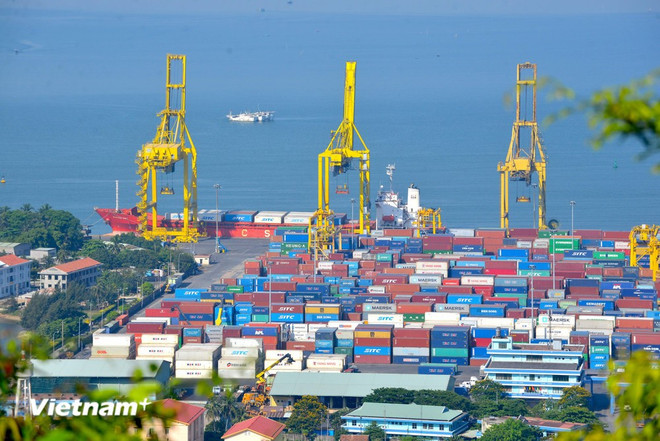
Hanoi (VNA) - With its infrastructure advantages and strategic location, Da Nang is affirming its role as an export engine and an international logistics hub, creating a new foundation for Vietnam to elevate its position on the global trade map.
Located at the geographic center of Vietnam, Da Nang is entering a new phase of development with the ambition to become one of the region’s leading export and logistics centers - shaping a new strategic position for Vietnam in global trade networks.
In the first eight months of 2025, Da Nang’s total trade turnover exceeded 5.9 billion USD, up nearly 13% year-on-year.
Goods from Da Nang are now present in over 120 countries and territories, spanning textiles, seafood, wood products, machinery, and electronics. This rise reflects the growing capacity of Da Nang’s business community in the process of international integration.
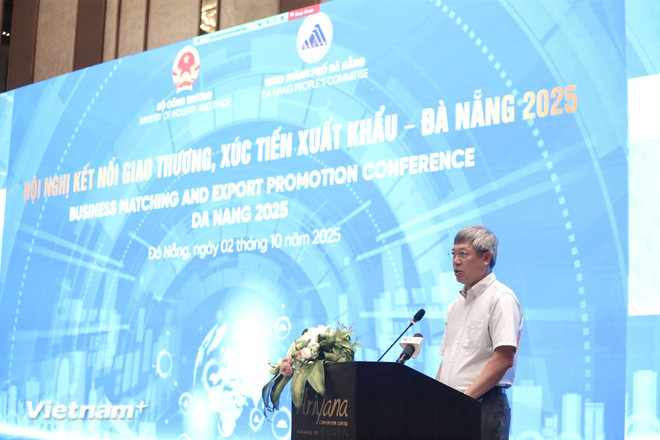
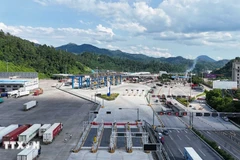
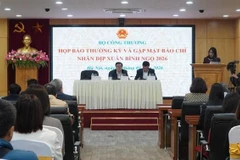
Speaking at the Business Matching and Export Promotion Conference held on October 2, Vice Chairman of the municipal People's Committee Ho Quang Buu stated that after the merger, Da Nang has become one of the largest cities in the country, equipped with strategic infrastructure, including two airports, two seaports, the Nam Giang international border gate, and a transport network connecting the North–South axis and the East–West Economic Corridor.
"This is a crucial foundation for Da Nang to not only maintain its role as the economic hub of Central Vietnam but also rise to become a regional transshipment center for goods and services," he said.
Da Nang - new launchpad for Vietnam’s export goods
Despite global trade fluctuations, Vietnam’s export turnover in August 2025 stood at 42.23 billion USD, with an eight-month cumulative total of nearly 305 billion USD - up 14.4% year-on-year.
Among key export groups, agriculture and fisheries brought home 28.54 billion USD, up 12.7%, with coffee surging nearly 60%.
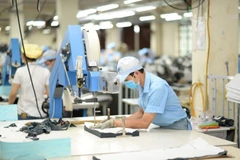
Manufacturing and processing continued to dominate, posting double-digit growth in items such as phones, components, computers, garment-textile, and footwear.
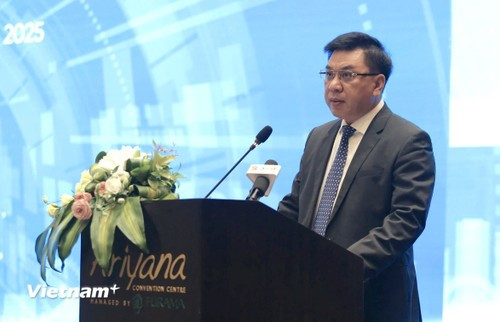
These are impressive results in the context of global uncertainty and rising logistics costs. However, Deputy Director of the Trade Promotion Agency under the Ministry of Industry and Trade Le Hoang Tai noted that Vietnam’s export structure still relies heavily on processing, with low added value.
Small and medium-sized enterprises continue to face technological and international standards challenges, he said.
Against this backdrop, Da Nang is emerging as a new anchor for Vietnam’s export growth. As the eastern terminus of the East–West Economic Corridor, the city serves not only as a maritime gateway for Laos, Thailand, and Myanmar, but also as a connecting hub with ASEAN, China, Japan, the Republic of Korea, Europe, and the US.
Market diversification – Inevitable strategy
Diversification is seen as a survival strategy amid major global market fluctuations, according to insiders.
Le Thi Thanh Minh from the Department of Foreign Market Development (Ministry of Industry and Trade) shared that diversifying export markets and products is no longer just a slogan - it is an essential path to reducing risks, enhancing resilience, and building a sustainable export base.
According to Minh, Vietnam must continue strengthening its presence in traditional markets such as the US, the EU, Japan, the Republic of Korea, and China, while expanding into emerging regions like the Middle East, Africa, South Asia, and Latin America.
At the same time, the country should shift from raw exports to deep processing and develop high-tech and green–organic products, Linh suggested.
With nearly 1,900-hectare Free Trade Zone, an International Financial Center, and a High-Tech Park, Da Nang is well positioned to realise this strategic direction.
Da Nang – Vietnam’s gateway to global integration
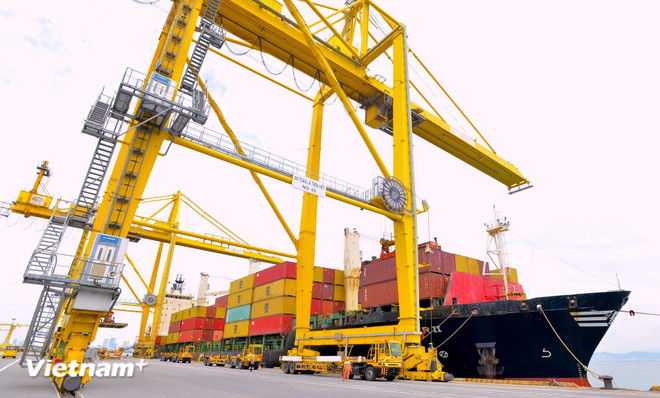
Strategically located in the region, Da Nang forms the eastern endpoint of the East–West Economic Corridor, linking Myanmar, Thailand, and Laos to the East Sea. This makes the city not only the commercial center of central Vietnam but also the natural “gateway” for Vietnam to access global markets.
According to Deputy Director Le Hoang Tai, Da Nang is not only the economic heart of central Vietnam but also an important maritime gateway to the East Sea. Its position is further strengthened as the eastern terminus of the East–West Economic Corridor.
“This turns Da Nang into a natural logistics hub - not only serving domestic goods but also an ideal transshipment point for goods from the broader Mekong subregion seeking access to the global market,” he added.
The merger of Da Nang and Quang Nam has also significantly amplified the region’s advantages. Expanded urban–industrial space, abundant human resources, and a combined market of nearly three million people create new momentum, enabling Da Nang to compete with major logistics centers such as the southern economic hub of Ho Chi Minh City and the northern port city of Hai Phong.
These factors make Da Nang a true “gateway of integration”: a hub for international cargo transshipment and a center for investment, technology, and services - deepening Vietnam’s participation in global value chains./.