Da Nang moves to be positioned as Vietnam’s AI hub

According to Le Son Phong, Deputy Director of the Da Nang Department of Science and Technology, the city’s AI development strategy is built on 25 years of experience in software development and digital transformation, with the advantage of a skilled workforce.

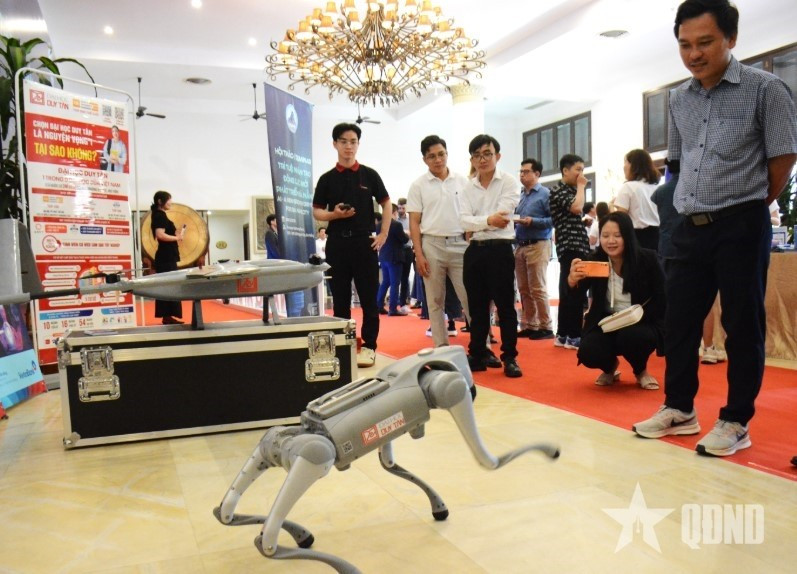
Delegates experience artificial intelligence products displayed at a workshop themed "Artificial Intelligence - New driving force for Da Nang's development". (Photo: qdnd.vn)

Hanoi (VNA) - As the main city of the central region, Da Nang possesses significant potential and advantages to become a national high-tech centre, with a strategic focus on semiconductors and artificial intelligence (AI).

According to experts, to achieve this vision, the city must implement a comprehensive set of both short-term and long-term solutions.

Inherent potential, advantages

The Fourth Industrial Revolution is reshaping the global socio-economic landscape. AI, in particular, is emerging as a critical foundation for digital transformation, innovation, and enhanced competitiveness at both national and local levels. As an inevitable trend, AI offers cities like Da Nang new opportunities to optimise governance, stimulate economic growth, and improve quality of life.

According to Le Son Phong, Deputy Director of the Da Nang Department of Science and Technology, the city’s AI development strategy is built on 25 years of experience in software development and digital transformation, with the advantage of a skilled workforce. AI is being integrated not only within the tech sector but across various aspects of daily life to accelerate economic restructuring and the application of high technology.

Da Nang’s approach was developed upon the three pillars of human resources, infrastructure, and policy. Policy and infrastructure development are guided by close collaboration with universities and businesses. Following the National Assembly’s Resolution No. 136/2024/QH15, which introduces special mechanisms for Da Nang’s urban governance, the municipal People’s Council has issued policies to implement the resolution. Currently, 30% of the AI workforce in Da Nang Software Park No. 2 are top-tier experts, demonstrating the city’s growing capacity in semiconductors and AI.

Dr Le Quang Dam, General Director of Marvell Technology Vietnam, explained that Marvell’s decision to open a Da Nang office in May 2024 and its recognition as a strategic partner in AI and semiconductors were driven by the city’s strong potential. Government support, infrastructure readiness, and a young, increasingly skilled workforce have made Da Nang a prime candidate to lead in these fields.

Anthony Tuan Phan, Founder and CEO of AIAIVN, noted that the city offers advanced data centres, a functioning smart city governance model, and an open, enabling environment, which are favourable conditions for AI growth.

Assoc Prof Dr Huynh Cong Phap, Rector of the Vietnam-Korea University of Information and Communication Technology (University of Da Nang), highlighted the growing focus on semiconductor education. Three universities have begun offering training, with 250 seats available for incoming students. His university has enrolled 60 students in its first intake for semiconductor design engineering, with targets to train 600–1,000 engineers by 2028. Da Nang is also developing generous support policies for semiconductor and AI professionals, including attractive salaries, living allowances, and housing subsidies.

Coordinated solutions needed

At a recent seminar hosted by the Da Nang People's Committee, experts proposed several strategic measures. Vu Anh Tu, Chief Technology Officer of FPT Group, stressed the importance of attracting high-quality talent, international tech companies, and investment in research and data centres. To support this, Da Nang must develop modern working environments and social infrastructure to retain professionals.

Dr Christopher Cuong Nguyen, Founder and Chairman of Aitomatic Inc., identified five key priorities for Da Nang and Vietnam, namely establishing an innovation centre, creating a capital market for tech enterprises, developing a tech ecosystem, launching a venture capital fund, and scaling up education and recruitment of high-quality tech talent. He also suggested building an R&D centre specialising in AI research and development to attract global companies.

AI expert Albert Antoine highlighted the importance of a clear and flexible strategy, along with dedicated funding for AI development, based on Singapore's experience. He noted that Singapore's success is attributed to strategic investments in infrastructure, transparent governance, and a policy environment that fosters innovation. Antoine urged Da Nang to develop a comprehensive AI strategy that aligns with economic goals and aims to improve the quality of life. He also recommended strengthening partnerships between government, universities, and businesses, as well as creating strong incentives to attract technology investments.

The development of AI is a long-term journey that requires strategic vision, global partnerships, and consistent policy support, as well as the steadfast companionship and spirit of innovation of the young business community.

Permanent Vice Chairman of the Da Nang People’s Committee, Ho Ky Minh, stated that the city is actively pursuing digital transformation and the integration of AI in various sectors, including healthcare, education, tourism, logistics, public services, and smart urban governance. Additionally, the city has been preparing land, infrastructure, and talent while refining policies to attract both domestic and international investments.

He affirmed the city’s commitment to supporting all organisations, businesses, and researchers in developing a comprehensive and sustainable AI ecosystem./.

VNA

See more

Deputy Prime Minister Ho Quoc Dung speaks at the meeting. (Photo: VNA)

Deputy PM demands full disbursement for sci-tech in 2026

As of May 12, total disbursed capital reached 7.95 trillion VND, equivalent to 14.78% of the Prime Minister’s plan. Of this, central budget disbursement hit 4.06 trillion VND, or 14.8% of the target, while local budget disbursement exceeded 3.88 trillion VND, or 14.75%.

Using drones to spray pesticides in the An Nhut rice fields in Long Dien commune of Ho Chi Minh City. (Photo: VNA)

Solving technology challenge through the “three-party linkage”

According to Pham Duc Nghiem, Deputy Director of the Department of Startups and Technology Enterprises under the Ministry of Science and Technology, the “three party” linkage model involving the State, research institutes/universities and enterprises is becoming essential for developing strategic technologies. Enterprises provide practical problems, universities and research institutes develop technological solutions, while the State creates support mechanisms and policies to accelerate commercialisation.

Da Nang city's leaders present flowers to congratulate the Union of Science and Technology Associations in Da Nang on Vietnam Science and Technology Day (May 18). (Photo: VNA)

Human capital key to Da Nang’s digital economy ambitions: experts

Vo Cong Tri, Chairman of the Union of Science and Technology Associations (VUSTA) in Da Nang, described high-quality human resources as a “key driver” in the city’s transformation. Da Nang is already regarded as one of Vietnam’s leading “university cities,” with 19 higher education institutions and a high concentration of students and skilled workers. The city is also home to a growing network of science and technology organisations that are helping to foster an innovation ecosystem.

Delegates at the publication launching ceremony. (Photo: VNA)

Vietnam News Agency debuts monthly technology publication

Each 40-page issue is expected to pack 3-5 chapters, delivering a panoramic view of the global sci-tech landscape alongside in-depth analyses of emerging technology trends. The publication aims to explain strategic shifts that will shape the country’s development and examine the sci-tech, innovation and digital transformation policies of other nations.

A worker assembles ultra-precision micro-components used in semiconductor chip production. (Photo: VNA)

Vietnam prioritises 70 high technologies for strategic development

Issued under Decision No. 23/2026/QD-TTg dated May 15, 2026, the list covers a wide range of technologies, including artificial intelligence (AI), big data and data analytics, cloud and edge computing, distributed and high-performance computing, Internet of Things (IoT), blockchain, quantum technology, renewable and clean energy, advanced energy storage, AI-powered real-time disaster forecasting and warning systems, and next-generation microbiology technologies.

Vietnamese Ambassador to France Trinh Duc Hai (sixth from the right) and the leadership of Global Connect Vietnam France. (Photo: VNA)

Vietnamese association launched in France to foster technology, AI cooperation

In the context of the growing Comprehensive Strategic Partnership between Vietnam and France, Hai said GCVF should position itself as a bridge for knowledge and technology transfer, bringing scientific and technological achievements from France and Europe to support Vietnam’s practical development needs.

Party General Secretary and State President To Lam presents a statute of President Ho Chi Minh to VNU-Hanoi. (Photo: VNA)

Top Vietnamese leader’s vision puts scientists at core of growth drive

As the country enters a new era, the Party and State have designated sci-tech and and innovation as central priorities, Kiem said, adding that VNU-Hanoi, alongside other higher education establishments, must not only produce high-caliber talents but also function as a hub for knowledge transfer and groundbreaking innovation.

Illustrative image (Photo: VNA)

Korean robotics, AI firms interested in Vietnam

KOTRA said it is teaming up with the Korea Institute for Robot Industry Advancement to run the “K-Robot Pavilion"” at the 23rd Vietnam International Exhibition on Machinery, Equipment, Technology and Industrial Products (VINAMAC EXPO 2026) in Hanoi from May 14-16.

Party General Secretary and State President To Lam (left) and Sri Lankan President Anura Kumara Dissanayake come to lay flowers in tribute to late President Ho Chi Minh at the Colombo Public Library on May 8. (Photo: VNA)

Sri Lanka eyes breakthrough sci-tech cooperation with Vietnam

A Sri Lankan official has expressed confidence that science, technology and digital transformation will become a key driver in shifting bilateral ties from traditional friendship to a partnership grounded in innovation and inclusive economic growth.

Vietnam promotes cooperation with United Nations on crime prevention

Vietnam promotes cooperation with United Nations on crime prevention

Vietnam highly values the support of the United Nations Office on Drugs and Crime (UNODC) in strengthening national capacity in crime prevention and criminal justice, drug control, and addressing emerging challenges, particularly cybercrime, said Ambassador Vu Le Thai Hoang.