Digital tools reshape public administration

Nationwide, more service centres are setting up dedicated counters to help residents log into the National Public Service Portal – a central gateway where users can submit applications, monitor progress, make payments and evaluate services with a single login.

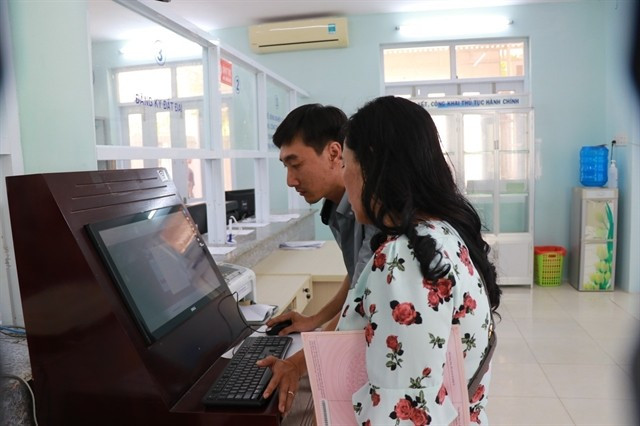
An official in Khanh Vinh commune, Khanh Hoa province, guides a woman to use the National Public Service Portal. Photo: VNA)

Hanoi (VNS/VNA) - From standing in queues to clicking online, Vietnam’s public services are undergoing a digital makeover that is changing how the Government interacts with its people.

Officials describe the transformation as an effort not just to modernise paperwork but to rethink how the government interacts with the people it serves.

In the south central province of Khanh Hoa, officials have rolled out a broad set of tools to improve day-to-day administration. The E-Office platform, which monitors performance through KPIs and cross-checks documents automatically, has made routine tasks faster and less prone to error.

Administrative procedures are now QR-coded, allowing residents to file applications and check status online.

The province’s Public Administration Service Centre follows a 'one-stop, many-services' approach, with staff drawn from 16 provincial departments working on-site to handle issues ranging from land and civil status records to construction permits and tax filings.

To strengthen the system, the centre collaborates closely with provincial police and telecom providers to safeguard data while youth volunteers assist citizens in navigating online forms and services.

Initiatives such as 'No Paper Printing Day' and 'Paperless Work Week' have reinforced the shift, and today every provincial document except those classified as confidential is digitally signed and issued online.

In the Mekong Delta, Can Tho city has taken a different path, introducing what it calls 'borderless' administration. Citizens can process paperwork at any public service centre, regardless of their place of residence or the office that issued their original documents.

The system is supported by 17 interconnected information platforms linking 120 government units, including 14 departments and 103 communes and wards.
Nearly 9,000 accounts have been created for officials, residents and businesses. Thousands of local-level procedures have already been synchronised with the National Public Service Portal.

"These changes prove that digital transformation is moving from visions to real action," said Director of the city’s Department of Science and Technology Ngo Anh Tin.

Nationwide, more service centres are setting up dedicated counters to help residents log into the National Public Service Portal – a central gateway where users can submit applications, monitor progress, make payments and evaluate services with a single login.

Other upgrades include automated queuing systems, touchscreen kiosks, internet-connected workstations and scanners for digitising documents.
Some provinces and cities are also experimenting with artificial intelligence, using chatbots and virtual assistants to answer basic questions and free up staff for more complex cases.

Authorities have also recognised the need to help citizens build digital skills. A nationwide 'Digital Literacy Campaign' offers online classes and step-by-step guides so that people in rural or remote areas can learn to use online services without depending on in-person staff.

Despite the progress, gaps remain. Infrastructure and technology capacity vary sharply between localities, especially at the commune and ward level. Outdated systems make it difficult to integrate data across agencies.

Provinces and cities are being urged to accelerate digitisation and strengthen connections with national databases. Building digital data repositories for individuals and organisations is also expected to reduce duplication and shorten waiting times.

Access to financial services is another priority. Authorities are working with banks to expand ATM networks so that every commune and ward has at least one withdrawal point.

Post offices, health stations and telecom-linked payment services such as ViettelPay and VNPTPay are also being tapped to fill gaps.

Observers note that the transformation is about more than faster queues or digitised forms. By making services easier to use and more transparent, the reforms are also strengthening public confidence in government.

As more provinces and cities follow the examples of Khanh Hoa and Can Tho, Vietnam’s digital transition in public administration is gathering pace. The country is moving closer to a system where efficiency and citizen satisfaction, not paperwork, define success./.

VNA

See more

Prime Minister Pham Minh Chinh and delegates visit booths showcasing products at TechFest Vietnam 2025. Photo: VNA

Vietnam to become attractive destination for tech talent, innovative startups: PM

TechFest Vietnam 2025, held from December 12 to 14, is expected to attract more than 60,000 participants both in person and online, with the participation of over 20 corporations, 50 investment funds, more than 100 supporting organisations and incubators, and delegates from Southeast Asia, Northeast Asia, Central Asia, the Middle East, North America, and Europe.

Police offiers mornitor the traffic through AI camera (Photo: VNA)

Applying the Internet of Things in smart transport

The project aims to build a unified, safe and efficient IoT platform to support the management, operation and exploitation of smart transport systems under the Ministry of Construction, with data shared across ministries and localities.

Through long-term commitment, Viettel has brought millions of Burundians into the mobile era and become the first operator to roll out 5G in the country, Viettel Burundi CEO Phan Truong Son noted. (Illustrative photo: VNA)

Viettel secures three prestigious international awards

Viettel has won honours in the “People & Culture” and “Best Operator in a Growth Market” categories at the 2025 World Communication Awards (WCA), alongside the “Best Digital Transformation Project” at the 2025 Global Telecoms Awards (Glotel).

A view of the Can Gio sea-encroaching urban area project (Photo: VNA)

Green-tech push for Can Gio

Vietnam has the capacity, ambition and technological foundation to join the group of leading sustainable coastal urban nations in the coming decade, experts said at a dialogue on "advancing to the sea with ESG++ megacities: breakthroughs through green technology", held on December 9 in Hanoi by the Vietnam Institute for Real Estate Studies (VIRES).

Minister of Science and Technology Nguyen Manh Hung speaks at the meeting (Photo: VNA)

Vietnam turns intellectual property into bankable assets in new law

About AI-generated content, the law draws a clear line: purely autonomous AI creations are not eligible for copyright or patent protection. Those who provide substantial creative input, such as ideas, curation, editing, or selection, qualify as authors or inventors.

Lieutenant General Nguyen Minh Chinh, NCA Vice Chairman, speaks at the launch ceremony of the southern branch of the National Cybersecurity Association. (Photo: VNA)

National Cybersecurity Association opens branch in HCM City

The southern branch aims to become a coordinating body for cybersecurity tasks, workforce development, awareness-raising and the strengthening of digital defence capabilities across the region, contributing to the safe and sustainable growth of Vietnam’s digital economy.

Viettel exceeds target of 20,000 new 5G stations by more than three weeks. (Illustrative photo: VNA)

Viettel exceeds target of 20,000 new 5G stations by more than three weeks

Viettel plans to continue scaling up its network from now until the end of 2025, with an additional 23,500 stations scheduled for installation, nearly quadruple the number rolled out in 2024. Once completed, Viettel will operate Vietnam’s largest 5G network, with 30,000 stations covering 90% of outdoor areas and 70% of indoor spaces nationwide, from major cities to rural regions.

In Vietnam, demand for infrastructure supporting AI, cloud computing, and digital services is rising at an unprecedented level. (Illustrative photo: VNA)

Vietnam emerges as new hub for data centres

Data centres have surged to become the second most preferred alternative asset class in the region. Vietnam is no exception to this trend as the demand for infrastructure supporting AI, cloud computing, and digital services has risen at an unprecedented level.

Professor Kurt Kremer, from the Max Planck Institute for Polymer Research in Germany, speaks at the event. (Photo: VNA)

Vietnam has advantages to develop versatile humanoid robots: experts

At the symposium, international and Vietnamese experts also discussed the latest trends in robotics, from socially interactive humanoids and collaborative service robots to medical and rehabilitation systems, and examined major challenges surrounding AI safety and ethics to ensure that robotics evolves in a responsible, human-centred and sustainable manner.