Forum looks to drive Vietnam’s rapid and sustainable growth

Economists, both domestic and foreign, have noted Vietnam’s ability to maintain strong momentum, with ambitions to hit 8% growth in 2025 and 10% or more annually from 2026 to 2030.

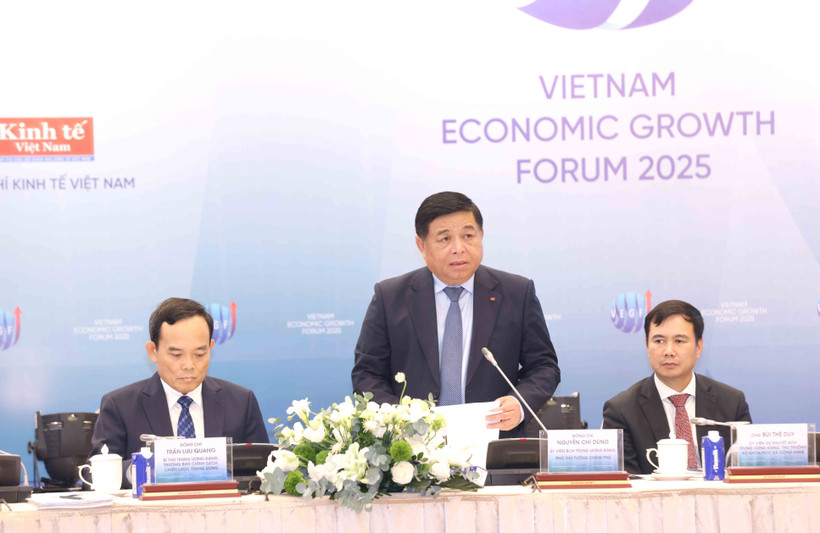
Deputy Prime Minister Nguyen Chi Dung speaks at the forum. (Photo: VNA)

Hanoi (VNA) - The Vietnam Economic Growth Forum 2025 (VEGF) provided a platform for government agencies, business community and experts to contribute ideas to help the country realise its target of rapid and sustainable growth, said Secretary of the Party Central Committee and Chairman of its Commission for Policies and Strategies Tran Luu Quang.

The event was co-hosted by the Vietnam Economic Association, the Vietnam Association of Small and Medium Enterprises, and the Vietnam Economic Times in Hanoi on July 8.

In the context of a volatile global economy, Vietnam has set an ambitious growth target: GDP growth of 8% in 2025 and exceeding the double-digit mark (10% or more) in the period of 2026 - 2030. This is a landmark goal, requiring close and synchronous coordination between the Government, ministries, sectors, local authorities and especially the business community.

As traditional growth drivers such as resource exploitation, public investment, cheap labour or processing exports gradually decline in efficiency and sustainability, the Vietnamese economy faces the inevitable need to find new breakthrough drivers.

In his keynote speech, Deputy Prime Minister Nguyen Chi Dung hailed Vietnam’s 7.52% economic growth in the first half of 2025, the highest in 15 years, as a testament to its resilience amid global challenges. Economists, both domestic and foreign, have noted Vietnam’s ability to maintain strong momentum, with ambitions to hit 8% growth in 2025 and 10% or more annually from 2026 to 2030.

To achieve these targets, Dung outlined a sweeping agenda centred on legal and institutional reforms to enhance transparency, stability, and alignment with international standards. He called for urgent revisions to laws governing land, minerals, and planning, and immediate action to revive 2,887 stalled projects, which tie up over 235 billion USD in capital and 347,000 ha of land, to unlock resources for development.

Public investment, Dung stressed, must act as a catalyst to raise private capital, with a focus on modernising infrastructure, accelerating national projects, optimising energy systems, and promoting renewable and new energy sources tailored to each stage of development. He advocated leveraging new growth spaces through administrative reforms, including merging localities and adopting a two-tier local administration model, while tapping into sci-tech, innovation, digital transformation, artificial intelligence, semiconductors, and quantum technology.

The Deputy PM also championed new economic models, including free trade zones and financial centres paired with quality workforce training and global talent networks.

“These are key drivers to restructure the economy, establish a new growth model, and push for rapid and sustainable development based on science, technology, innovation and digital transformation, thereby delivering breakthroughs in the new era of growth,” said Dung.

In parallel with attracting major strategic investment projects, he also called for progress in international integration in the current context.
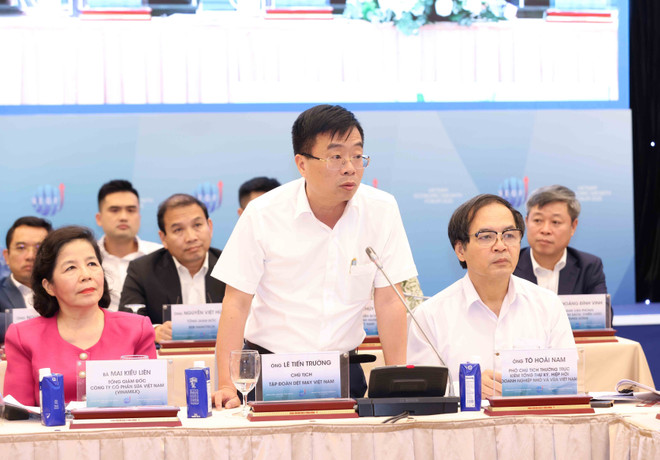
dp.jpg
Delegates at the event (Photo: VNA)

"This means domestic resources must be the foundation, while external resources should supplement and support development," he explained, adding that the integration process must ensure national independence, resilience and adaptability in the face of global disruptions.

The vision of a prosperous and powerful Vietnam would require joint efforts from the public as well as the private sector, in order to make the nation a safe, attractive destination and a regional and global hub for manufacturing, services and innovation, said the Deputy PM.

According to the organisers, the VEGF is expected to become an annual event with plenary and thematic sessions, aiming to bridge policymakers and key stakeholders, and foster stronger alignment between government policies and business practices./.
VNA

See more

Deputy Governor of the State Bank of Vietnam Pham Thanh Ha speaks at a press conference on banking sector performance in 2025 and tasks for 2026, held in Hanoi on December 29. (Photo: VNA)

Credit growth nears 18% in 2025: central bank

At a press conference on banking sector performance in 2025 and tasks for 2026, held in Hanoi on December 29, SBV Deputy Governor Pham Thanh Ha said that as of December 24, 2025, total outstanding credit to the economy exceeded 18.4 quadrillion VND (about 670 billion USD), up 17.87% compared to the end of 2024.

Workers in the Du Long Industrial Park, Khanh Hoa province. (Photo: VNA)

Key economic policies taking effect in January 2026

A wide range of new economic policies and legal provisions will come into force in January 2026, covering taxation, advertising, land use, minimum wages, public finance, railways, technology transfer and statistics, among others.

From 4 billion USD in 2015, the size of the e-commerce market increases eightfold to reach 32 billion USD last year. (Photo: VNA)

Hanoi leads 2025 Vietnam eBusiness Index

​The average score of the rankings is 9.3 points. The gap in e-commerce development between the two major economic centres–Hanoi and HCM City–and the remaining provinces and cities is very large.

An aircraft of Vietnam Airlines - Illustrative image (Photo: VNA)

Vietnam Airlines adds 270 flights to during 2026 New Year holiday

Vietnam Airlines said the swift deployment of additional flights during the New Year holiday demonstrates the carrier’s proactive approach and readiness in mobilising resources to serve passengers during peak travel periods at the end of 2025 and the beginning of 2026.

Prime Minister Pham Minh Chinh (second from right) conducts an aerial inspection of the Ca Mau–Dat Mui expressway, the road leading to Hon Khoai, and the dual-use Hon Khoai port from a helicopter. (Photo: VNA)

PM urges faster progress on key infrastructure projects in Dat Mui, Ca Mau

During an aerial survey of Dat Mui commune, home to the five islands of Hon Khoai, Hon Sao, Hon Go, Hon Doi Moi and Hon Da Le, the Prime Minister underscored the area’s strategic importance for national defence, economic development and connectivity across the province, the Mekong Delta and the wider southern region.

Dao Ngoc Tien, Vice Rector of Foreign Trade University, speaks at the event. (Photo: doanhnghiepvn.vn)

High standards key for businesses to unlock VEFTA benefits

The EFTA bloc, comprising Switzerland, Norway, Iceland, and Liechtenstein, has a relatively small population but a combined GDP of about 1.3 trillion EUR (1.5 trillion USD), high living standards, and strong demand for high-quality products.

Workers make products for the Lunar New Year (Tet) in Hanoi's Bat Trang commune. (Photo: hanoimoi.vn)

Hanoi craft villages bustle as Lunar New Year approaches

Hanoi is home to the largest number of craft villages nationwide, with about 1,350 villages and craft-based communities, accounting for roughly 56% of rural villages in the capital. Of these, 318 are officially recognised as traditional craft villages.

Four seaports and four inland waterway ports are currently in operation within the Cai Mep Ha free trade zone. (Photo: VNA)

​ HCM City seeks new growth drivers as megacity takes shape

As traditional growth engines show signs of reaching their limits, HCM City is recalibrating its long-term development strategy in search of new drivers capable of sustaining momentum and reinforcing its role as the economic nucleus of the southern region.

Garment production for export at Hoa Tho Garment JS Corporation. (Photo: nhandan.vn)

Textile, garment industry secures role in global supply chain

By diversifying markets, products and customers, the sector has mitigated risks and responded proactively to market fluctuations, despite numerous challenges such as disrupted supply chains, rising shipping costs, and rapidly changing purchasing policies in many markets.