Green credit drives Vietnam’s national green growth strategy

Green growth is no longer a choice but a pressing necessity, particularly for developing nations like Vietnam, according to Deputy Governor of the State Bank of Vietnam (SBV) Dao Minh Tu.

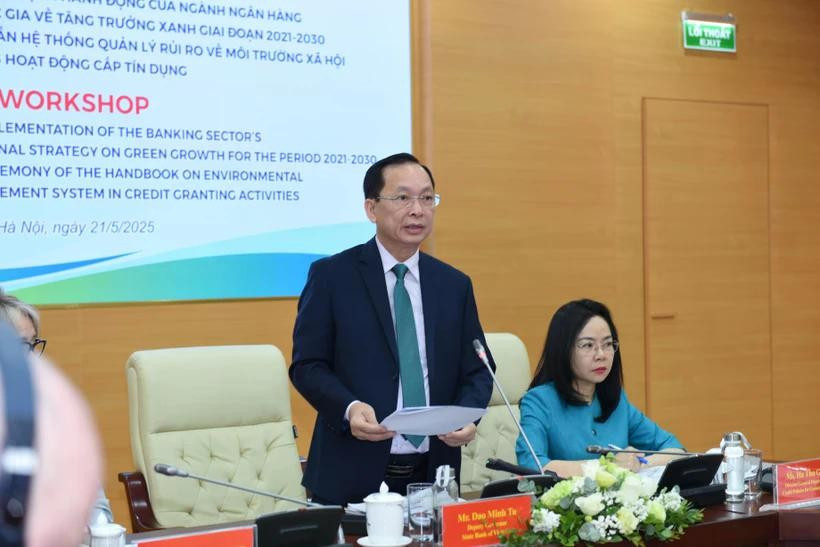
Deputy Governor of the State Bank of Vietnam (SBV) Dao Minh Tu said at the forum (Photo: VietnamPlus)

Hanoi (VNA) – Green growth is no longer a choice but a pressing necessity, particularly for developing nations like Vietnam, according to Deputy Governor of the State Bank of Vietnam (SBV) Dao Minh Tu.

Recognising the pivotal role of banking credit in realising the national green growth strategy, the SBV began integrating sustainability goals into its credit policies as early as 2015. These efforts include directives on promoting green credit and managing environmental and social risks in lending activities.

At the forum, held on May 21, the Deputy Governor said that the transition to a green growth, in which the economic development is combined with environmental protection and the efficient use of resources, is an inevitable trend for Vietnam to move towards a sustainable, inclusive and prosperous future.

Strong growth in green credit

According to the SBV, green credit has grown significantly in both scale and pace. From just 180 trillion VND (7.1 billion USD) in 2017, outstanding green loans across 58 financial institutions had reached over 704 trillion VND (28 billion USD) by the end of March, a 3.5% increase from the end of 2024. It accounts for 4.3% of the banking system’s total outstanding credit. The average annual growth rate of green credit stood at over 21% during 2017–2024, outpacing overall credit growth.

On environmental and social risk assessments, 57 institutions had assessed nearly 1.3 million loan applications, a fifteen-fold increase from 2017, totaling 3.62 quadrillion VND (143 billion USD) in credit as of March 31.

Commercial banks embrace ESG standards

The Bank for Investment Development of Vietnam (BIDV) has adopted ESG (environmental, social, and governance) standards and built a sustainable finance framework with six focus areas, including strategic governance, sustainable products, and carbon neutrality.

By end-2024, BIDV’s green credit reached 80.87 trillion VND (3.2 billion USD), representing 12% of the sector’s total green loans. It financed 1,600 clients with nearly 2,000 green projects, primarily in renewable energy and sustainable infrastructure.

vplus-2.jpg
Participants in the forum (Photo: VietnamPlus)

Similarly, Agribank has established an ESG implementation committee and issued internal ESG standards. From 0.9% in 2020, the bank’s green loan ratio rose to 1.7% in 2024.

In Q1 2025, Agribank led the sector in terms of green loan clients, with over 41,600 customers and outstanding loans of nearly 29.3 trillion VND (1.17 billion USD), mainly supporting renewable energy, clean energy, and sustainable forestry.

Policy frameworks

Dr Michaela Baur, Country Director of GIZ Vietnam, noted that clear green sorting is essential for directing capital toward sustainable development and for Vietnam’s access to global green finance.

Since 2017, GIZ has supported the SBV in developing green credit statistics, a beginning of a green classification system for the banking sector.

She emphasised the need for continued capacity building, stronger institutional frameworks, and incentives to expand green lending practices across banks.

vplus-3.jpg
Dr Michaela Baur, Country Director of GIZ Vietnam at the forum (Photo: VietnamPlus)

Nguyen Minh Chau, Deputy CEO of Military Bank (MB), said that the bank aims to become a leading green bank with full ESG integration and carbon neutrality by 2030.

MB is focusing on climate finance solutions, leveraging its strength in digital technology. She called for more support from the SBV, including ESG training programmes, experience-sharing seminars, and incentive mechanisms.

Launch of ESG risk management handbook

A key highlight of the forum was the launch of a new handbook on environmental and social risk management in lending, co-developed by the SBV and the International Finance Corporation (IFC).

The guide outlines principles, risk management systems, performance indicators, and stakeholder engagement strategies aligned with international best practices.

Deputy Governor Tu described the handbook as a practical tool that offers clear guidance for credit institutions to build tailored green lending procedures.

He said it would enhance ESG risk management and support effective implementation of the banking sector’s green growth action plan./.

VNA

See more

Air pollution in Hanoi. (Photo: VNA)

Hanoi to launch 5,000 public electric bicycles

In a move to reduce air pollution and promote green mobility, Hanoi has approved a plan to deploy 5,000 public electric bicycles, alongside restrictions on petrol- and diesel-powered vehicles in the city’s central area.

Official heritage plaque i sinstalled on the 12 recognised Shan Tuyet tea trees in Dong Phuc commune. (Photo: VNA)

Thai Nguyen: 12 ancient Shan Tuyet tea trees win national heritage status

The recognition honours the biological, cultural and historical values of these centuries-old Shan Tuyet tea trees – natural treasures deeply woven into the livelihoods, traditions and identity of local ethnic communities. The title affirms the community’s commitment to preserving and promoting the value of this iconic local tea variety.

Sarus cranes at Tram Chim National Park (Photo: VNA)

Return of sarus cranes: Hope takes wing in Dong Thap wetland

Beneath the wide Mekong Delta sky, Tram Chim National Park is racing against time, pouring heart and science into a decade-long (2022–2032) plan to rescue the Eastern sarus crane – an elegant, scarlet-headed bird listed as endangered on the International Union for the Conservation of Nature (IUCN) Red List and a living emblem of both the park and all of Dong Thap province

French Ambassador Olivier Brochet speaks at the press conference in Hanoi on December 11 to mark the 10th anniversary of the Paris Agreement on climate change and highlighting the COP30 outcomes. (Photo: VNA)

International community ready to support Vietnam in energy transition, climate response

In a video message to the press conference, UN Resident Coordinator in Vietnam Pauline Tamesis said the UN is ready to support Vietnam in building a pipeline of projects capable of absorbing financing mobilised under the Political Declaration on establishing the Just Energy Transition Partnership (JETP), as well as from global climate finance sources, including the Green Climate Fund and the Loss and Damage Fund.

Forest rangers in Son La province apply technological devices and software to forest management, monitoring, and protection. (Photo: nhandan.vn)

Digital technology application enhances forest management, protection

With a total forest area of over 14 million hectares, including more than 10 million hectares of natural forests, forests exist in all 34 provinces and cities across the country. Given the large area and limited workforce, applying digital solutions in forest management and protection has become a top priority for the forestry sector.

Sunda pangolins (Manis javanica), also known as the Javan pangolin, are listed in Group IB – critically endangered and strictly protected from all commercial exploitation (Photo: VNA)

Quang Ngai releases rare pangolin back into nature

Initial verification showed that the animal weighed 3.7kg and measured over 60cm. It was identified as a Sunda pangolin (Manis javanica), also known as the Javan pangolin, listed in Group IB – critically endangered and strictly protected from all commercial exploitation.

Residents of Tuyen Quang province take part in the One Billion Trees Programme. (Photo: VNA)

Tree-planting programme exceeds one-billion-tree goal

The total comprises 573.9 million scattered trees and 865.2 million trees grown in concentrated plantations, equivalent to 429,125 hectares of forest. Provinces posting the strongest results include Phu Tho with 177.9 million trees, Lao Cai with 108.8 million, and An Giang with 98.5 million.

Construction activity is one of the causes of air pollution in Hanoi. (Photo: VNA)

Hanoi takes urgent measures to curb air pollution

The city requires the enhanced application of advanced technologies and remote monitoring systems, including satellite remote sensing, drones, and AI-integrated traffic cameras, to monitor, detect, and strictly address the illegal burning of garbage, straw, and agricultural by-products.