Typhoon Koto weakens, changes direction, continues to move slowly

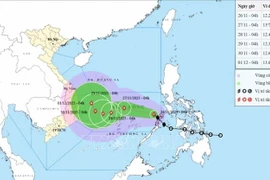
In the next days, the typhoon will continue to move slowly westward, then possibly turn west-southwest at about 5km/h, continuing to weaken.

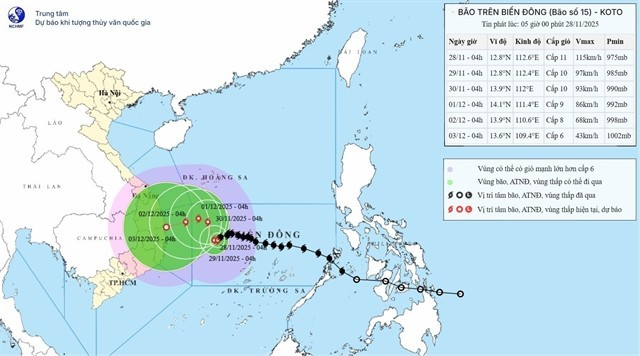
The moving direction of the typhoon Koto – the 15th storm entering in the East Sea this year. (Photo: VNA)

Hanoi (VNS/VNA) - Typhoon Koto will be in the western waters of the central East Sea by 4:00 on November 29, about 260km northwest of Song Tu Tay island, according to the National Centre for Hydro-Meteorological Forecasting.

It is moving west at approximately 3km per hour, gradually weakening. The strongest winds are about 100km per hour, with gusts up to 150km per hour.

The affected area includes the northern waters of Truong Sa special zone, with a natural disaster risk level of three.

Mai Van Khiem, Director of the National Centre for Hydro-Meteorological Forecasting, stated that November 27 night and November 28 early morning, typhoon Koto moved slowly westward-southwestward with its intensity decreasing by one level compared to the previous day.

"Forecasts indicate the typhoon will continuously change direction over the next three days. On November 29, it will shift northward, then westward on November 30; and on December 1, westward-southwestward,” said Khiem.

On average, the typhoon weakens by about one level per day, and it is likely to be reduced to a tropical depression when moving into the waters of the coast of Quang Ngai – Dak Lak, he noted.

Urgent response

Ahead of Typhoon Koto's arrival, the Ministry of National Defence issued an urgent dispatch requiring all forces to proactively prevent and respond.

The General Staff of the Vietnam People's Army directed agencies and units to draw lessons from organising and implementing prevention of the previous typhoon Fungwong and recent devastating floods in the central region, maintain strict on-duty regimes, proactively monitor and grasp the typhoon's developments to ensure absolute safety for personnel and equipment during missions.

Military Region 5 and Military Region 7 instructed provincial and city military commands to advise local Party committees and authorities on inspecting and reviewing response plans.

They will coordinate with departments to check high-risk areas, especially those severely affected by recent heavy rains.

Forces, vehicles, food supplies and other resources are prepared for immediate action, including evacuating residents from dangerous areas to safe locations.

The Air Defense – Air Force Service and Military Corps 18 directed subordinate units to be ready for air search and rescue flights upon the Ministry of National Defence’s orders.

The National Civil Defense Steering Committee reported that coastal localities from Quang Tri to Ho Chi Minh City have notified 48,380 vessels with more than 246,700 people on board the typhoon's path for safe navigation.

As many as 150,395 troops, 3,085 trucks, 489 specialised vehicles, 646 ships, 1,239 boats, and six helicopters have been ready for rescue operations.

In Truong Sa special zone, Brigade 146 and Naval Region 4 reinforced disaster prevention works, checked communications stocked essentials and opened shelters all day and night.

Over 200 fishing vessels with more than 2,500 fishermen docked at ports like Song Tu Tay, Sinh Ton, Truong Sa, Da Tay, Nam Yet and Phan Vinh. Islands provided rest areas, over 20,000 liters of fresh water and other supplies./.

VNA

See more

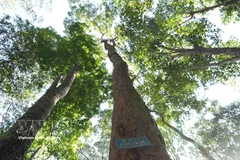
Official heritage plaque i sinstalled on the 12 recognised Shan Tuyet tea trees in Dong Phuc commune. (Photo: VNA)

Thai Nguyen: 12 ancient Shan Tuyet tea trees win national heritage status

The recognition honours the biological, cultural and historical values of these centuries-old Shan Tuyet tea trees – natural treasures deeply woven into the livelihoods, traditions and identity of local ethnic communities. The title affirms the community’s commitment to preserving and promoting the value of this iconic local tea variety.

Sarus cranes at Tram Chim National Park (Photo: VNA)

Return of sarus cranes: Hope takes wing in Dong Thap wetland

Beneath the wide Mekong Delta sky, Tram Chim National Park is racing against time, pouring heart and science into a decade-long (2022–2032) plan to rescue the Eastern sarus crane – an elegant, scarlet-headed bird listed as endangered on the International Union for the Conservation of Nature (IUCN) Red List and a living emblem of both the park and all of Dong Thap province

French Ambassador Olivier Brochet speaks at the press conference in Hanoi on December 11 to mark the 10th anniversary of the Paris Agreement on climate change and highlighting the COP30 outcomes. (Photo: VNA)

International community ready to support Vietnam in energy transition, climate response

In a video message to the press conference, UN Resident Coordinator in Vietnam Pauline Tamesis said the UN is ready to support Vietnam in building a pipeline of projects capable of absorbing financing mobilised under the Political Declaration on establishing the Just Energy Transition Partnership (JETP), as well as from global climate finance sources, including the Green Climate Fund and the Loss and Damage Fund.

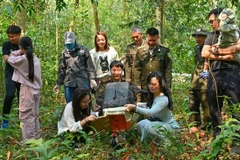
Forest rangers in Son La province apply technological devices and software to forest management, monitoring, and protection. (Photo: nhandan.vn)

Digital technology application enhances forest management, protection

With a total forest area of over 14 million hectares, including more than 10 million hectares of natural forests, forests exist in all 34 provinces and cities across the country. Given the large area and limited workforce, applying digital solutions in forest management and protection has become a top priority for the forestry sector.

Sunda pangolins (Manis javanica), also known as the Javan pangolin, are listed in Group IB – critically endangered and strictly protected from all commercial exploitation (Photo: VNA)

Quang Ngai releases rare pangolin back into nature

Initial verification showed that the animal weighed 3.7kg and measured over 60cm. It was identified as a Sunda pangolin (Manis javanica), also known as the Javan pangolin, listed in Group IB – critically endangered and strictly protected from all commercial exploitation.

Residents of Tuyen Quang province take part in the One Billion Trees Programme. (Photo: VNA)

Tree-planting programme exceeds one-billion-tree goal

The total comprises 573.9 million scattered trees and 865.2 million trees grown in concentrated plantations, equivalent to 429,125 hectares of forest. Provinces posting the strongest results include Phu Tho with 177.9 million trees, Lao Cai with 108.8 million, and An Giang with 98.5 million.

Construction activity is one of the causes of air pollution in Hanoi. (Photo: VNA)

Hanoi takes urgent measures to curb air pollution

The city requires the enhanced application of advanced technologies and remote monitoring systems, including satellite remote sensing, drones, and AI-integrated traffic cameras, to monitor, detect, and strictly address the illegal burning of garbage, straw, and agricultural by-products.