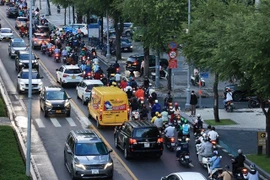
Hanoi (VNA) – Relevant agencies in Hanoi have been requested to take urgent measures to control air pollution and tightly monitor polluting activities in the face of poor air quality.
According to Official Document No 6356/UBND-NNMT signed by Vice Chairman of the municipal People’s Committee Nguyen Manh Quyen, the Department of Agriculture and Environment takes responsibility to regularly inform and update on air quality and monitor the Vietnam Air Quality Index (VN-AQI) at monitoring stations on the electronic information portal.
Notably, the city requires the enhanced application of advanced technologies and remote monitoring systems, including satellite remote sensing, drones, and AI-integrated traffic cameras, to monitor, detect, and strictly address the illegal burning of garbage, straw, and agricultural by-products.
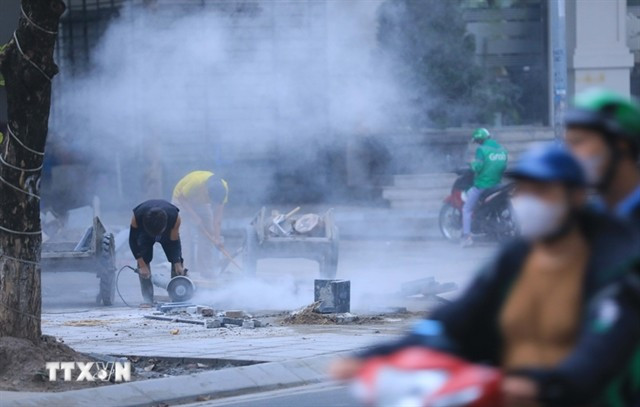
Regarding construction activities, the Department of Construction has been tasked with closely monitoring investors and contractors to ensure the implementation of dust-control measures. These include covering and misting at construction sites, as well as washing vehicles before they leave the premises to minimise dust dispersion.
In particular, for construction sites exceeding 10,000sq.m, investors are required to install automatic dust monitoring systems equipped with sensors and cameras. Additionally, they must apply ground-covering solutions—such as planting trees or using specialised materials—to prevent dust from spreading into the surrounding environment.
In order to ensure students’ health, the Department of Education and Training guides schools to limit out-door activities or adjust school schedule in severely-polluted days.
Similarly, the Department of Health should recommend people, especially the elderly, children and those with respiratory diseases, limit going out in the early morning or at night when the pollution index is high.
For traffic and urban sanitation, the Traffic Police and Environmental Police were asked to strengthen inspections and penalise vehicles that have exceeded their operational lifespan, emit black smoke, or transport materials that spill onto the road as well as detect and handle violations such as the burning of household solid waste, crop residues, and agricultural by-products.
In addition, cement and steel factories were requested to increase the use of clean input materials that meet legal quality standards, in order to reduce pollutant concentrations in emissions; strictly apply measures such as shielding, water spraying for dust suppression, and other dust and emission controls at coal storage areas, raw-material yards, slag dumps, internal transport routes, and areas surrounding factories. Factories are also required to consider implementing operational adjustments, reducing capacity, or rescheduling major maintenance and repair works (if any) on days when pollution alerts reach the “Very Poor” level (VN-AQI above 200) to reduce emission loads.
If air quality reaches hazardous levels (VN-AQI of 301 or higher), cement and steel factories must restrict, temporarily suspend, or adjust operating hours accordingly./.

Hanoi strengthens ties with IRD to tackle air pollution
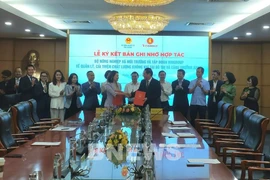
Vice Chairman of the Hanoi People’s Committee Nguyen Manh Quyen on November 6 received Sylvain Ouillon, Chief Representative of the French National Research Institute for Sustainable Development (IRD) in Vietnam, to discuss potential cooperation in air quality monitoring and pollution reduction in the capital city.